The hills of Wayanad stand apart from the rest of Kerala, not merely for their elevation or forests, but for the way history unfolded here in quiet isolation. Long inaccessible due to dense jungles and rugged terrain, Wayanad was among the last landscapes in Kerala to be explored and documented. This very remoteness allowed its indigenous communities to preserve a way of life that remained largely untouched for centuries. Today, the story of this land, its tribes, beliefs, struggles, and evolution—is carefully preserved and presented at the Ambalavayal Heritage Museum, a place of immense value to tourists, historians, and researchers alike. Unlike conventional museums that often present royal artefacts or colonial narratives, this is a true heritage museum, one that documents the cultural lineage of Wayanad’s Adivasi and tribal communities. For visitors, it offers an immersive introduction to a world shaped by forests, survival, ritual, and community. For researchers, it serves as an invaluable anthropological archive that connects material culture with lived traditions.
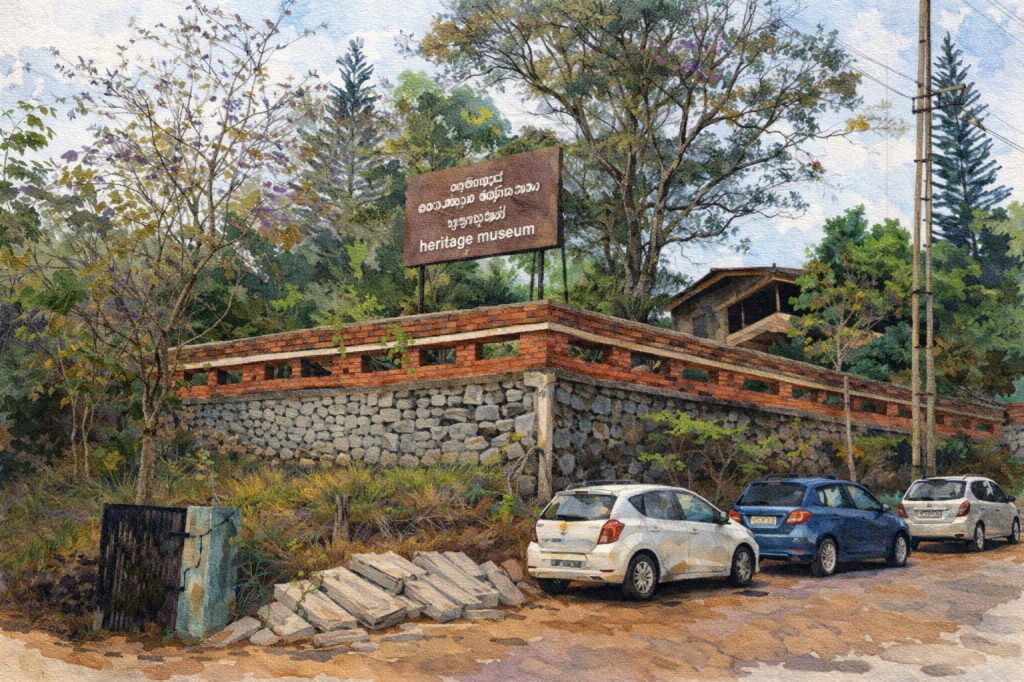
Set amidst the gentle slopes of Ambalavayal, the museum itself blends harmoniously with its surroundings. The exhibits are methodically organised into four thematic sections, each representing a different dimension of Wayanad’s past: Gothrasmruthi, Veerasmruthi, Jeevasmruthi & Devasmruthi. Clear signage, detailed descriptions, and provenance notes accompany each artefact, specifying where and when it was discovered. While there is a nominal entry fee, the depth and rarity of the exhibits, some of which are not found anywhere else in Kerala make the visit immensely rewarding.
The Gothrasmruthi section offers a grounded and intimate look at the daily life of Wayanad’s tribal communities. Here, the focus is not on grandeur but on survival, ingenuity, and harmony with nature. Visitors encounter traditional fish traps, agricultural tools, baskets woven from reeds, household items crafted from coconut leaves and husks, mud utensils, sleeping mats, and simple yet functional clothing. These artefacts reflect a self-sustaining lifestyle that relied entirely on locally available resources. While many such objects have vanished from mainstream life with the arrival of modern materials, they continue to be used in remote tribal hamlets across Wayanad. For anthropologists and cultural researchers, this section provides direct insight into indigenous technology, ecological knowledge, and material culture.
The Veerasmruthi gallery is among the most visually striking sections of the museum. It houses an extensive collection of hero stones (veerakkallu), many of which are believed to date back to the Hoysala period and other medieval eras. These stones were erected in honour of individuals who displayed exceptional bravery & often warriors who lost their lives in battle or while protecting their community. Arranged thoughtfully throughout the museum premises, the hero stones allow visitors to trace stylistic and epigraphic changes across centuries. Some stones bear simple carvings, while others are adorned with intricate human figures, battle scenes, and inscriptions. Though time has worn away parts of many stones, several remain remarkably well preserved, offering valuable material for epigraphical and historical study.
The Jeevasmruthi section celebrates life in all its everyday forms. It displays household vessels, toys, ornaments, musical instruments, ritual objects, kitchenware, and weapons such as bows and arrows. This collection highlights the seamless blending of utility and artistry in traditional life. What makes this section particularly engaging is its sense of familiarity. Many of the objects resemble items once commonly found in rural Kerala homes, bridging the gap between tribal heritage and broader regional culture. For visitors, it evokes nostalgia; for researchers, it reveals patterns of cultural exchange, craftsmanship, and continuity across communities.
The Devasmruthi gallery takes visitors further back in time, tracing Wayanad’s history from the Neolithic age to around the 17th century. Stone and terracotta figurines, idols of worship, and ritual objects illustrate the spiritual life of ancient communities. These artefacts suggest how belief systems evolved alongside settlement patterns and social structures. A particularly fascinating feature here is the display of soil samples collected from different parts of Wayanad. These samples visually demonstrate the district’s diverse topography from fertile valleys to forested hills and help explain why different forms of agriculture, habitation, and ritual developed in specific regions. Several artefacts in this section also link Wayanad culturally and historically with the wider Malabar region.
The Ambalavayal Heritage Museum is far more than a tourist stop, it is a bridge between the present and a deeply rooted past. It allows visitors to understand Wayanad not just as a scenic hill destination, but as a landscape shaped by indigenous knowledge, resilience, and cultural depth. For researchers, the museum stands as a testament to the meticulous work of archaeologists and anthropologists whose efforts have preserved fragile histories that might otherwise have been lost. For travellers, it offers a rare chance to slow down, observe, and appreciate the human stories embedded within Wayanad’s forests and hills.
 STORIES by HEARITAGE
Leave a comment