Fort Kochi is a place where time slows down with cobbled streets, old verandas, colonial homes, and silent churches together narrate stories of empires that came, ruled, departed and yet left behind indelible marks. Among these enduring witnesses stands the Santa Cruz Basilica, a magnificent structure that has survived conquest, destruction, and rebirth, continuing to serve as both a place of faith and a monument of history. More than just a church, Santa Cruz is a chronicle in stone and canvas, reflecting over five centuries of political upheaval, religious devotion, and cultural synthesis. For any visitor to Fort Kochi, stepping into its precincts is like stepping into layered history.
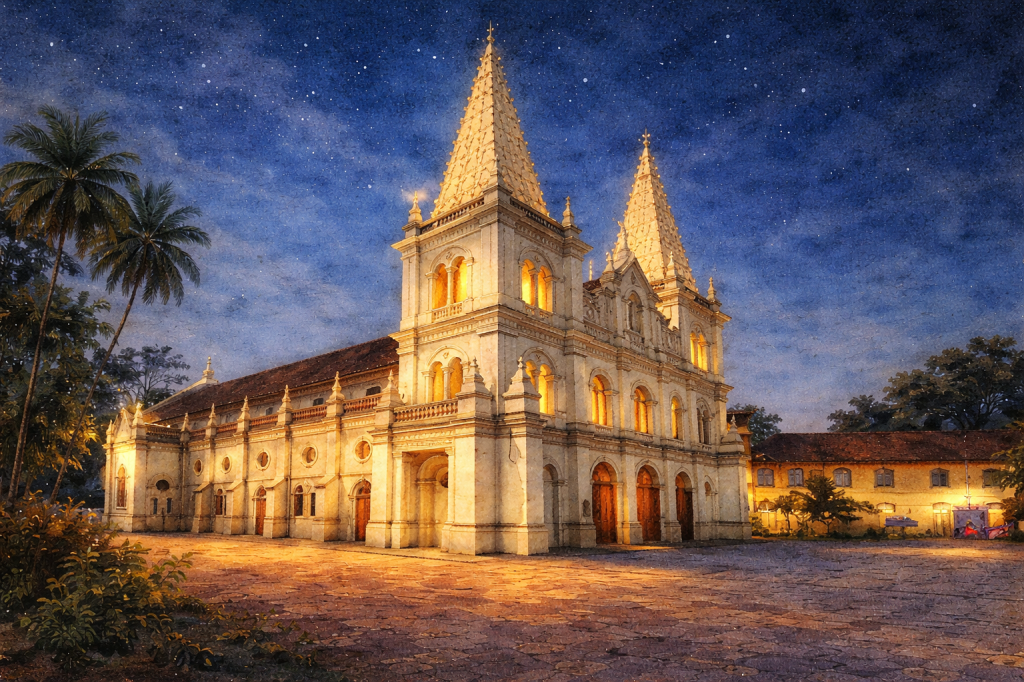
The story of Santa Cruz Basilica is inseparable from the arrival of Europeans on India’s western coast. When Vasco da Gama reached Kozhikode in 1498, he unknowingly set in motion a chain of events that would alter the course of maritime trade and regional politics. His arrival unsettled the Zamorins of Calicut, prompting the Portuguese to seek alliances further south. Cochin, under its Raja, proved to be more receptive. The turning point came when the Portuguese commander Dom Afonso de Albuquerque assisted the Cochin Raja in defeating the Zamorin’s forces. As a reward for their military support the Portuguese were granted land along the port where they soon constructed a fort and established their presence as a dominant trading power. It was during this period in 1505 that the Portuguese Viceroy Dom Francisco de Almeida commissioned the construction of a church dedicated to the Holy Cross. Built primarily of wood much like the nearby St. Francis Church it was named Santa Cruz meaning “Holy Cross.” From its earliest days, the church served the growing Catholic community of Cochin.
Santa Cruz gained prominence in 1558 when Pope Paul IV elevated it to the status of a Cathedral recognising Cochin as the second Catholic diocese in India after Goa. This distinction placed the church at the centre of ecclesiastical life along the Malabar Coast. However, the church’s fortunes mirrored the shifting powers of the region. By the mid-17th century the Dutch had begun displacing the Portuguese from their strongholds. When Cochin fell to the Dutch in 1660, the Catholic community suffered greatly. Being Protestants, the Dutch systematically destroyed Catholic churches. Santa Cruz Cathedral though spared complete demolition was stripped of its sacred character, its altar and granite pillars dismantled and converted into a military storehouse. For over a century the once-hallowed space remained a silent warehouse. The final blow came in 1795 when the British after defeating the Dutch razed the structure entirely to build a guardhouse. The cathedral that had stood at the heart of Catholic Cochin vanished from the landscape.
The resurrection of Santa Cruz began nearly a century later. In 1897, a determined missionary initiative supported by the Bishop of Cochin set in motion plans to rebuild the lost cathedral. Construction began on the same sacred ground and in 1905, the present church was completed with grandeur, more elaborate, and architecturally refined. One relic of the original Portuguese church survived the centuries: a beautifully carved granite pillar preserved by devoted Catholics and now displayed within the basilica as a tangible link to its earliest incarnation. Recognising its historical, architectural, and spiritual significance, the Vatican elevated Santa Cruz to the status of a Basilica in 1984. This honour placed it among a select group of basilicas in Kerala and reaffirmed its importance in the Christian heritage of India.
Designed in a refined Gothic style, Santa Cruz Basilica stands out with its pristine white façade and twin soaring spires visible from afar. The structure is both imposing and graceful, inviting visitors inward. Inside, the basilica unfolds into a breathtaking visual experience with tall arched pillars dividing the nave into three aisles, guiding the eye toward the elevated altar. The curved walls and high ceilings lend the space an ethereal openness while natural light filters through stained-glass windows, bathing the interior in shifting hues. The main altar is the artistic heart of the basilica, painted by the renowned Italian artist Antonio Moscheni, it features an exquisite rendition of the Crucifixion, accompanied by frescoes and murals that narrate biblical scenes. Among the most striking artworks is a detailed replica of Leonardo da Vinci’s “The Last Supper”, seamlessly integrated into the church’s visual narrative. Every canvas, column, and window reflects a harmonious blend of European artistry and local devotion making the basilica as much an art gallery as a place of worship.
Today, the Santa Cruz Basilica is one of Fort Kochi’s most iconic landmarks. Whether one visits to attend Mass, admire its art, or simply sit in quiet contemplation, the basilica offers a rare convergence of history and faith. It stands as a reminder that heritage is not merely about preservation of structures, but about resilience & the ability of a place to endure loss, adapt, and rise again with dignity. In the ever-evolving story of Fort Kochi, Santa Cruz Basilica remains a chapter written in devotion, endurance, and timeless beauty.
 STORIES by HEARITAGE
Leave a comment