Travel in Kerala often unfolds like a quiet dialogue between land and belief and places of worship rise as milestones of history rather than monuments of stone alone. One such destination steeped in faith and legend is the Aruvithura St George Forane Church nestled along the gentle bends of the Meenachil River. A visit here is not merely a pilgrimage, it is a journey through centuries of devotion shaped by apostles, merchants, floods and the enduring trust of believers.
Christian tradition in India traces its origins to 52 AD when St Thomas the Apostle, one of the closest disciples of Jesus Christ arrived on the shores of Kodungallur. His travels along the inland waterways took him deep into the heart of Kerala and among the places sanctified by his presence was Aruvithura. Though the present church was built long after his martyrdom, the land itself holds an older sanctity, it is believed that St Thomas erected a stone cross here marking the place for prayer and gathering. In those early centuries the region was known as Irapeli, a settlement inhabited largely by Jewish traders who conducted commerce along the backwaters connecting the Western Ghats to the ancient port of Muziris. Drawn by the apostle’s teachings, several among them embraced Christianity forming one of the earliest Christian communities of the East. What began as a modest congregation would over time evolve into one of the most revered pilgrimage centres of central Kerala.
The name Aruvithura itself reflects the geography that shaped its destiny. Tamil merchants navigating these waters described the wide canals of the Meenachil River as resembling the open sea with natural riverbanks serving as ports. The nearby waterfalls and river confluences inspired the name Aruvi-thura meaning “a port formed by a river.” Even today, as one stands by the riverbanks it is easy to imagine boats laden with spices and forest produce gliding silently past carrying not just goods but cultures and ideas.
The history of Aruvithura Church is remarkable for its four distinct phases of construction, each reflecting the changing times and beliefs of its people. The first church built in the 2nd century was a humble structure of stones gathered from the riverbed. With no architectural precedent, the faithful fashioned it like a simple house, an act of faith more than design. This structure endured for nearly six centuries before giving way to a second church built in the style of a temple with a long stone prayer hall and the cross placed reverently at its end. The arrival of the Portuguese in the late 15th century influenced the third church which was constructed with plastered walls, defined aisles and a high altar. During this period, the church was dedicated to the Virgin Mary and known as St Mary’s Church. A profound transformation followed in the 16th century when devotion shifted toward St George inspired by a dramatic chapter of survival and faith.
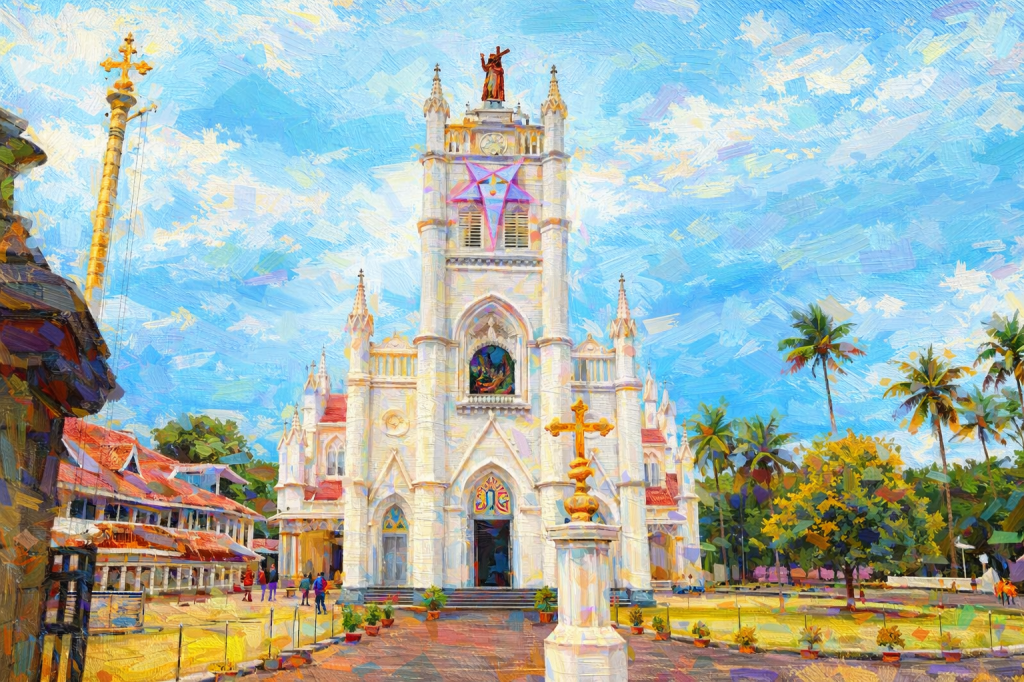
Legend tells of a devastating flood that destroyed the ancient Christian settlement of Nilackal (Chayal), another site associated with St Thomas. The refugees who fled carried with them a cherished statue of St George seeking shelter at Aruvithura to never return to their old land. Instead, miracles attributed to St George began to occur here drawing people from far and wide. Affectionately, the faithful began calling St George “Vallyachan”, a name unique to Aruvithura and unheard of elsewhere. Over time the church became synonymous with Aruvithura Vallyachan, a protector and intercessor believed to respond swiftly to prayers. This devotion firmly established St George as the church’s patron saint. The final reconstruction in 1951 gave the church its present form, a majestic Gothic structure built in a cruciform design facing Jerusalem in accordance with Oriental Christian tradition. A tall belfry, elegant arches and a striking 15-foot statue of Christ crowning the façade lend the church its timeless grandeur. Only the sanctum housing the statue of St George was preserved from earlier structures, anchoring the new church to its ancient soul.
Beyond the church lies another sacred journey, the pilgrimage to Vallyachan Mala also known as Kondoor Hills. This hillock houses a shrine containing the revered statue of St George brought from Nilackal. At its summit stands a tall concrete cross commemorating the apostolic legacy and symbolically recalling the stone cross placed by St Thomas. The climb to Vallyachan Mala is more than a physical ascent as devotees regard it as a reenactment of Christ’s suffering, an act of endurance and surrender. As one climbs, the landscape opens into sweeping views of green pastures and flowing rivers accompanied by cooling breezes that soothe both body and spirit. Prayer at the Nalpamara Cross, moments of silence at the summit and encounters with the humble community living nearby transform the pilgrimage into a deeply personal spiritual experience.
The annual festival of Aruvithura Church celebrated over fifteen days in April is a time when the quiet village bursts into colour and devotion. Fridays hold special significance commemorating the martyrdom of St George and draw large congregations for prayer and thanksgiving. The highlight of the festival is the grand riverbank procession where the statue of Vallyachan is ceremoniously taken out for public veneration. Among the church’s many unique traditions is the blessing of elephants, a ritual rarely seen elsewhere symbolising harmony between faith, nature, and culture.
Today, the Aruvithura St George Forane Church and Vallyachan Mala together form a sacred landscape where apostolic history, riverine trade, architecture and living faith converge. The church is not merely a relic of the past but a vibrant centre of devotion where miracles are spoken of with quiet conviction and traditions are lived rather than remembered. To visit Aruvithura is to walk through centuries where an apostle once prayed, to climb hills sanctified by belief and to witness how faith when rooted deeply in land and community endures the passage of time.
 STORIES by HEARITAGE
Leave a comment