The Valapattanam River today flows with a gentleness that belies its past with its broad banks, calm waters, and unhurried rhythm give little hint that this river once nurtured one of the most powerful capitals of North Malabar. Long before modern roads traced the land, Valapattanam then known as Balyapattanam was the beating heart of trade, politics, and cultural exchange under the Kolathiri kings of the Mooshika dynasty. To walk along this river today is to travel across centuries and nowhere is this continuity more deeply felt than at the humble yet historically profound Kakkulangara Masjid. At first glance, the mosque appears almost modest overshadowed by newer structures that have sprung up around it. Yet history does not always announce itself loudly. It often whispers through old stones, worn steps and the quiet dignity of places that have endured. Kakkulangara Masjid is one such whisper from the past echoing stories of faith, kingship, and communal harmony.
In its prime, Valapattanam was the largest and most important town along a crucial inland trade route connecting the hinterlands of the Western Ghats to the Arabian Sea. Merchants, sailors, scholars and emissaries from distant lands passed through this river port bringing with them not just goods but ideas and beliefs. The Kolathiri rulers known for their patronage of diverse communities allowed this region to flourish as a space of coexistence. It was in this spirit that the Kakkulangara Masjid came into being. Tradition holds that the mosque was constructed between the 8th and 9th centuries making it one of the oldest Islamic places of worship in Kerala. Its origin is tied to the early spread of Islam in Malabar, a process marked not by conquest but by trade, dialogue, and royal patronage.
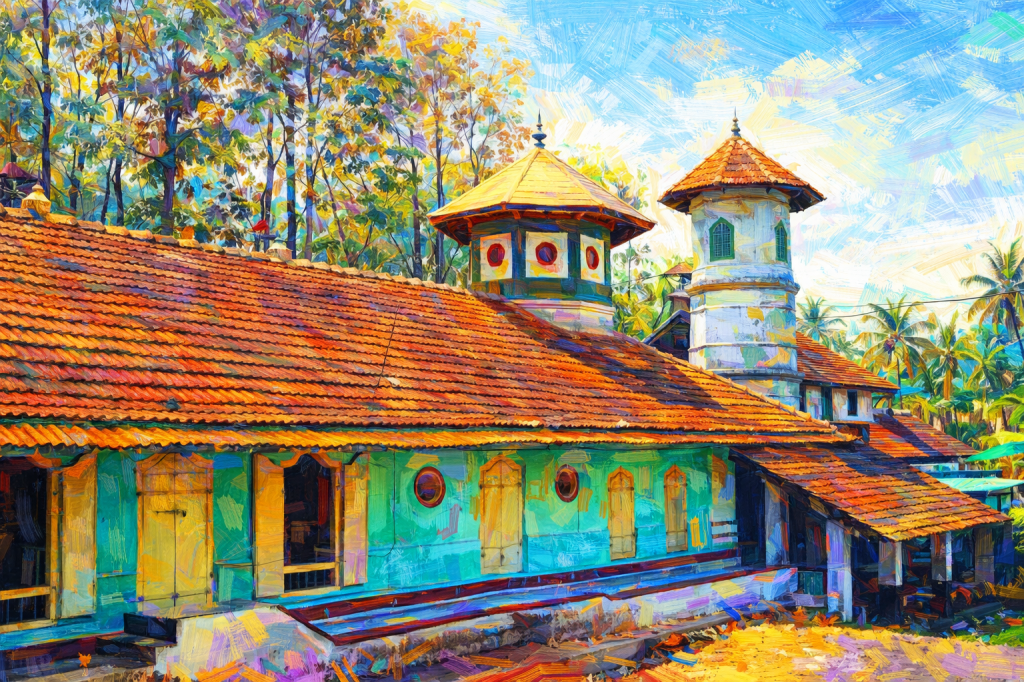
The arrival of Malik Ibn Deenar, one of the earliest missionaries of Islam to Kerala laid the foundation for the faith’s growth along the Malabar Coast. His message resonated with merchants and rulers alike and legends speak of several Kerala kings embracing Islam during this period. Among them, it is believed was a Kolathiri ruler who wished to provide his people with a space for congregational prayer. To fulfil this vision, land was granted by the Chirakkal Raja and assistance sought from the Arakkal family, Kerala’s only Muslim royal lineage renowned for their maritime connections and architectural patronage. The Arakkal masons and carpenters undertook the construction of the mosque blending traditional Kerala architectural styles with Islamic elements. What emerged was a structure deeply rooted in the local landscape rather than an imported form.
One of the most striking features of Kakkulangara Masjid is its large stepped pond, an unusual sight for a mosque. Its origin is as organic as the land itself. During construction, the builders dug a pit near the foundation to extract laterite stones and mud. Instead, they struck a natural spring within the limestone bedrock which was clear & sweet water began to fill the pit transforming it into a perennial pond. Recognising its value, the Kolathiri Raja ordered stone steps to be built on all sides granting access to everyone. Though the pond was once enclosed within the mosque precincts, time has opened it to the surrounding neighbourhood. The portions of the original boundary walls still survive, silent witnesses to centuries of use. In Islamic tradition, ritual purification before prayer is essential usually performed using water drawn through aqueducts or wells. At Kakkulangara, the pond itself fulfils this role making the mosque a rare example in Kerala where a temple-like pond forms part of a masjid’s ritual life. Even today, the water continues to be used for ablutions, linking present-day worshippers to centuries-old practice.
The mosque’s architecture reflects the limitations and ingenuity of its builders. With no access to complex blueprints or large-scale dome construction, the masons created a simple prayer hall, narrow corridors and a small minaret dome crowned with a copper conductor atop a traditional tiled roof. Rising above all is the tall minaret tower, considered one of the tallest in Malabar, serving both as a call to prayer and a symbol of faith visible from afar. The interiors are unadorned, drawing attention inward rather than outward as a space designed for humility, reflection, and devotion. This simplicity, far from diminishing the mosque enhances its spiritual presence.
Kakkulangara Masjid’s significance extends beyond local tradition. The great Moroccan traveller Ibn Battuta, who journeyed across Malabar in the 14th century, mentions this mosque in his travelogues. He records that it was built by the ancestors of the local king after embracing Islam as a rare and valuable external confirmation of the mosque’s antiquity. Within the mosque cemetery lies another remarkable link to early Islamic history: the tomb of Abubakr ibn Muhammad, believed to be the grandson of Abu Bakr As-Siddiq, the first Caliph of Islam. This alone elevates Kakkulangara from a local place of worship to a site of global religious importance.
 STORIES by HEARITAGE
Leave a comment