Kerala’s origin story is unlike that of any other land. It is not merely geography shaped by time but a sacred terrain born of penance, repentance and divine will. According to ancient mythology, this lush strip of land between the Western Ghats and the Arabian Sea was reclaimed from the ocean itself by the ,warrior-sage Parasurama. Yet the tale of Kerala does not end with its creation, it deepens, coils and sanctifies itself in the sacred groves of Mannarasala Temple where mythology is not remembered, it is lived. The temple dedicated to the king of serpents – Nagaraja, Mannarasala is believed to be among the oldest living places of worship in Kerala. More than a temple it is a kavu, a sacred grove where nature and divinity exist in seamless harmony. A dense vegetation envelopes the land creating a primeval stillness as though time itself has slowed to honour the ancient presence that dwells within.
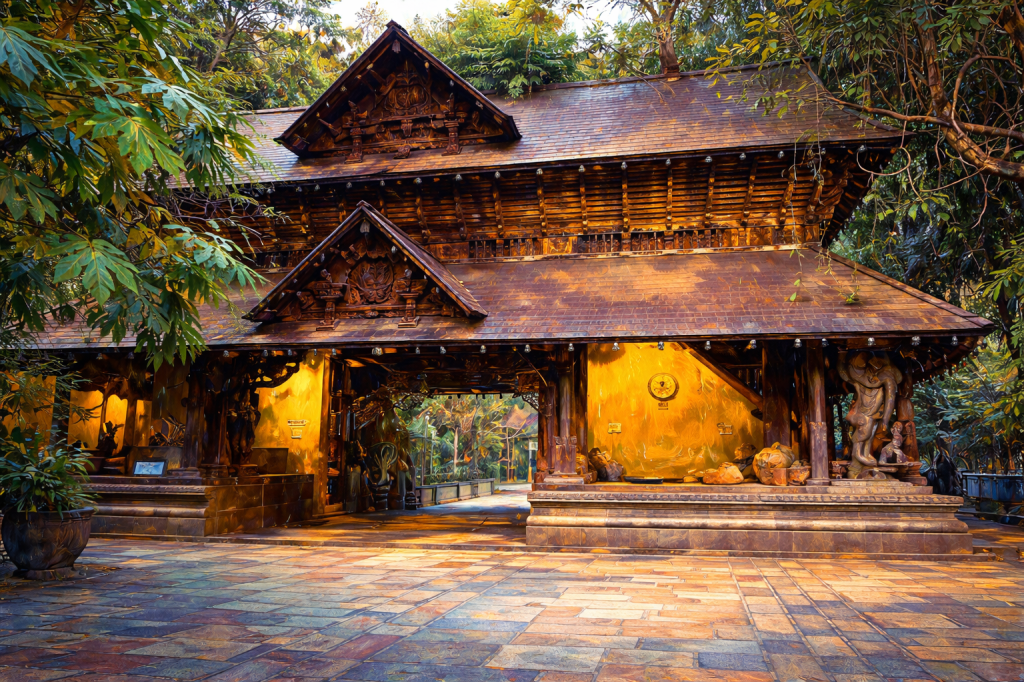
After waging relentless battles against the Kshatriya kings, Parasurama realised the weight of his actions. Seeking atonement he approached the sages who advised him to gift untouched land to the Brahmins. With intense penance, Parasurama invoked the god of the oceans, Varuna and at his behest hurled his axe into the sea. The waters receded revealing the land that would become Kerala. Yet this newborn land was inhospitable which was saline, barren and infested with serpents. Here human settlement proved impossible but one Brahmin family dwelling amidst flourishing Mandara trees chose not to flee. The family prayed to Parasurama who in turn sought the counsel of Lord Shiva & Shiva revealed that the land could be purified only through the venomous power of the serpents under the command of Nagaraja himself. Parasurama undertook penance at a deserted coastal site & Nagaraja appeared before him in a radiant form with his many hoods adorned with gold and emeralds embodying the presence of the holy trinity. Answering Parasurama’s plea, Nagaraja summoned the most potent serpents from the underworld releasing kalakuta venom across the land. The poison scorched the soil cleansing it of salinity and rendering it fertile. Thus, through venom came life. In gratitude, Parasurama consecrated Nagaraja and Vasuki at the sacred site known then as Mandarashala which later became Mannarasala. The Brahmins who had remained faithful were entrusted with the temple’s rituals and Parasurama returned to his meditative retreat in the Mahendra mountains assured of Kerala’s destiny as a blessed land.
Centuries passed & Mannarasala became a thriving serpent grove home to countless divine beings. Within this sacred land lived a devout Brahmin couple, Vasudevan and Sreedevi bound by compassion yet burdened by childlessness. Sreedevi’s kindness extended beyond humans as she fed and cared for every creature in the grove. When a devastating fire swept through the land injuring and killing many serpents, it was Sreedevi who sheltered the survivors in her home. With a healing balm of turmeric, honey, and butter she soothed their burns nursing them as her own children. Her selfless love moved Nagaraja deeply. Appearing before the couple, Nagaraja asked why she cared so tenderly for serpents. With gentle honesty, Sreedevi replied that she saw in them the children she never had & touched by her devotion, Nagaraja granted her a boon: he would be born as her son. In time, Sreedevi gave birth to two children, one human and the other Nagaraja himself born as a five-hooded serpent. The brothers grew together learning and playing side by side. When the time came, Nagaraja revealed his true purpose. He asked his human brother to continue the family lineage and chose to remain eternally within the cellar of the ancestral house, the illam in yogic form. Before retreating, Nagaraja instructed Sreedevi in the rituals to be observed and decreed that the eldest woman of the family would forever serve as the custodian of the temple. Thus was born the unique tradition of Valiamma, making Mannarasala the only temple in the world where rituals are led by a Brahmin woman.
Today, Mannarasala stands as a living testament to these legends. Spread across 15 acres, the grove shelters over 30,000 serpent idols each representing devotion, repentance or fulfilled prayers. The presence of live serpents within the grove is considered a divine blessing, never disturbed. Devotees come here seeking forgiveness for accidental harm to serpents praying for fertility, prosperity, and protection. One of the most moving rituals is urulikamazhthal, where childless couples invert a bronze vessel in prayer awaiting its spontaneous turn as a sign of fertility. Those whose prayers are answered must return offering gratitude for the child’s wellbeing, echoing Sreedevi’s own blessed journey. The turmeric paste distributed here is believed to carry the sanctity of the first healing balm applied by Sreedevi herself. Nearby lies Appooppan Kavu where Nagaraja is believed to have wandered freely, affectionately remembered as Apooppan, the divine grandfather.
The festival of Mannarasala Ayilyam is the spiritual heart of the temple. On this sacred day, every serpent idol in the grove is ceremonially cleansed with nurum palum with a mixture of rice flour and milk by the Valiamma. The idol of Nagaraja is carried in procession, an ancient ritual that draws devotees from across Kerala. This festival, among the oldest in the region transforms the grove into a living myth where chants echo through the trees and the boundary between legend and life dissolves.
Mannarasala is not merely a temple to be visited, it is a sacred ecology to be experienced. It is a place where Kerala’s creation myth continues to breathe where serpents are not feared but revered and where motherhood, compassion, and divinity are eternally intertwined. To walk through Mannarasala is to step into the womb of Kerala’s mythology, a land blessed by Parasurama sanctified by serpents and protected by Nagaraja for all eternity.
 STORIES by HEARITAGE
Leave a comment