In the sacred geography of Hindu belief, certain shrines rise above time not merely as places of worship but as living philosophies. Vaishnavites revere the 108 Divya Desams as the eternal abodes of Lord Vishnu while Shaivites look to another canon of equal sanctity: the Paadal Petra Sthalams, the 276 Shiva temples praised by the Tamil Shaiva saints-the Nayanmars in the 7th century. Among this exalted list, only one temple stands in present-day Kerala, the ancient and profoundly evocative Thiruvanchikulam Mahadeva Temple. A visit to Thiruvanchikulam is not merely a pilgrimage; it is a journey into an idea of divinity that is intimate, domestic and deeply humane.
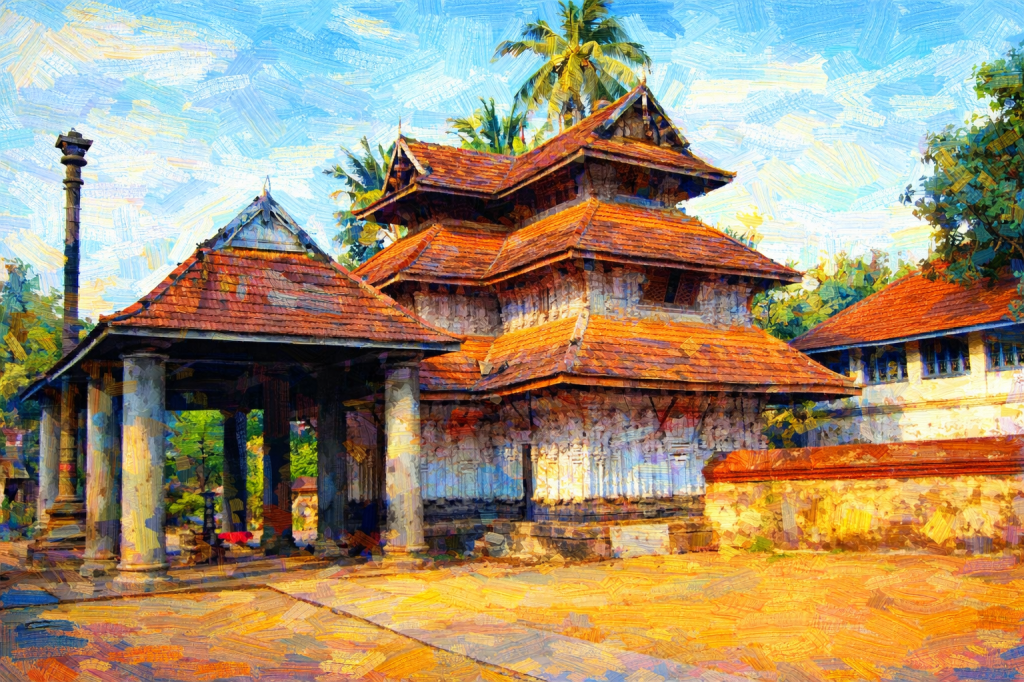
The presiding deity of Thiruvanchikulam is Lord Shiva in his most serene and complete form as Sadashiva worshipped here as Umamaheswara as he is eternally united with Goddess Parvati. Unlike many shrines where the deity is perceived as an ascetic withdrawn from worldly bonds, Shiva at Thiruvanchikulam is revered as a grihastha. This belief finds its most beautiful expression in a ritual unique to this temple: the Palliyara puja. Each night, after the evening rituals, the idols of Shiva and Parvati are ceremonially moved from the sanctum into a specially designed chamber called the palliyaraa – a divine sleeping chamber complete with a bed and pillows. Here, the divine couple is believed to rest together resuming their role as husband and wife after fulfilling their cosmic duties. At dawn, the idols are returned to the sanctum for public worship. This rare ritual transforms divinity into something profoundly relatable suggesting that the highest spiritual truth also embraces love, companionship and domestic harmony.
Tradition holds that the earliest structure of Thiruvanchikulam dates back to the Chera period and was completed under the patronage of Cheraman Perumal, one of the most revered rulers in Kerala’s history. The sanctity of the temple spread far beyond its walls, aided by its mention in the hymns of the Nayanmars particularly those of Sundaramurthi Nayanar, who shared a deep spiritual bond with Cheraman Perumal. So profound was this bond that both the king and the saint are believed to have renounced worldly life together journeying to Kailasa in search of ultimate truth. In a rare honour, both are worshipped here as upadevatas (subsidiary deities), giving Thiruvanchikulam the distinction of housing one of the largest collections of sub-shrines in Kerala. As the Chera kingdom waned, the Kulasekhara rulers later established their capital here as Mahodayapuram around this temple, allowing the sacred complex to become the spiritual and geographic heart of the region.
Like Kerala itself, Thiruvanchikulam has endured centuries of upheaval. The control of the temple shifted between the Cochin Raja and the Zamorin before the arrival of European powers. In 1670, the Dutch partially destroyed the structure, an event marked by the breaking and loss of the ceremonial sword gifted by Cheraman Perumal to the Zamorin before his legendary departure to Mecca. The temple later suffered during the Mysore invasions under Tipu Sultan when copper roofing was stripped and valuables looted. Yet faith proved resilient. In 1801, the temple rose again in its present form aided by local rulers. The consecration of the current idol, believed to have been brought from Chidambaram Temple was overseen by Paliath Achan of the Cochin Kingdom reaffirming the temple’s pan-South Indian Shaiva connection.
Architecturally, Thiruvanchikulam is a classic expression of traditional Kerala temple design. The square sreekovil anchors the complex while the majestic namaskara mandapam supported by sixteen exquisitely carved pillars stands as a testament to the craftsmanship of a bygone era. Temple murals depicting scenes from the epics glow softly within the corridors, complemented by intricate carvings and stone sculptures along the walls. So significant is its heritage value that the temple has been declared a protected monument by the Archaeological Survey of India.
Thiruvanchikulam shares ritual ties with several major shrines. Devotees participating in the Bharani festival at Chottanikkara Bhagavathy Temple traditionally seek blessings here before their performances. Those praying for marital harmony or progeny are especially drawn to the Palliyara pujas when Shiva is believed to be at his most benevolent. The temple’s annual eight-day festival highlighted by Anayottam, the ceremonial elephant race and the grandeur of Mahashivaratri fills Kodungallur with devotion and celebration.
Standing amid Kodungallur, a town shaped by Hindu, Christian, Jewish and Islamic traditions, Thiruvanchikulam embodies Kerala’s legacy of spiritual coexistence. Here, divinity is not distant or severe but compassionate and domestic; not abstract, but lived. To walk through Thiruvanchikulam is to understand a uniquely Kerala vision of faith where God rests after prayer, where kings become saints, and where architecture, mythology, and humanity converge in quiet harmony.
 STORIES by HEARITAGE
Leave a comment