In Hindu tradition, most temples are born of a revelation where a deity chooses a land, a devotee or a moment to manifest divinity. Rare, however is a shrine whose very sanctity flows from another temple bound across geography by legend and faith. Nestled amid the quiet greenery of northern Kerala, the Ananthapadmanabha Temple popularly known as the Ananthapura Lake Temple is one such sacred anomaly. For over seven centuries this serene shrine has been revered as the moolasthanam, the original seat of Lord Padmanabhaswami whose more widely known abode lies far to the south at the Padmanabhaswamy Temple. A journey to Ananthapura is not merely a visit to a temple; it is a pilgrimage into a legend where water, time, devotion and divine play converge.
The spiritual bond between Ananthapura and Thiruvananthapuram is woven through the life of the mystic sage Vilwamangalam Swami believed to have lived across several generations. Legends recount that the Swami once encountered a young orphan boy wandering near his hermitage in Kasaragod and asked him to stay here. Touched by compassion, the child agreed to stay on one condition: he must never be scolded. The child, playful and mischievous tested the patience of the sage until one fateful day when he kicked the sacred salagrama stone during the Swami’s meditation. In a moment of human anger, the sage pushed the child and instantly the boy vanished. A divine voice then revealed that if the Swami wished to see the child again, he must search for him in a place called Ananthankadu. The repentant sage followed this calling southward, finally reaching Thiruvananthapuram where the child disappeared once more, this time into an iluppa tree. When the sage pleaded for forgiveness, the tree fell and transformed into the majestic reclining form of Lord Vishnu upon the serpent Anantha. Thus was revealed the deity of Padmanabhaswami. Vilwamangalam Swami consecrated the shrine there and chose to remain in Thiruvananthapuram for the rest of his life. Centuries later in the 14th century his lineage, the Tulu Brahmins built a temple at his original place of worship in Kasaragod naming it Ananthapadmanabha, in eternal remembrance of that divine journey.
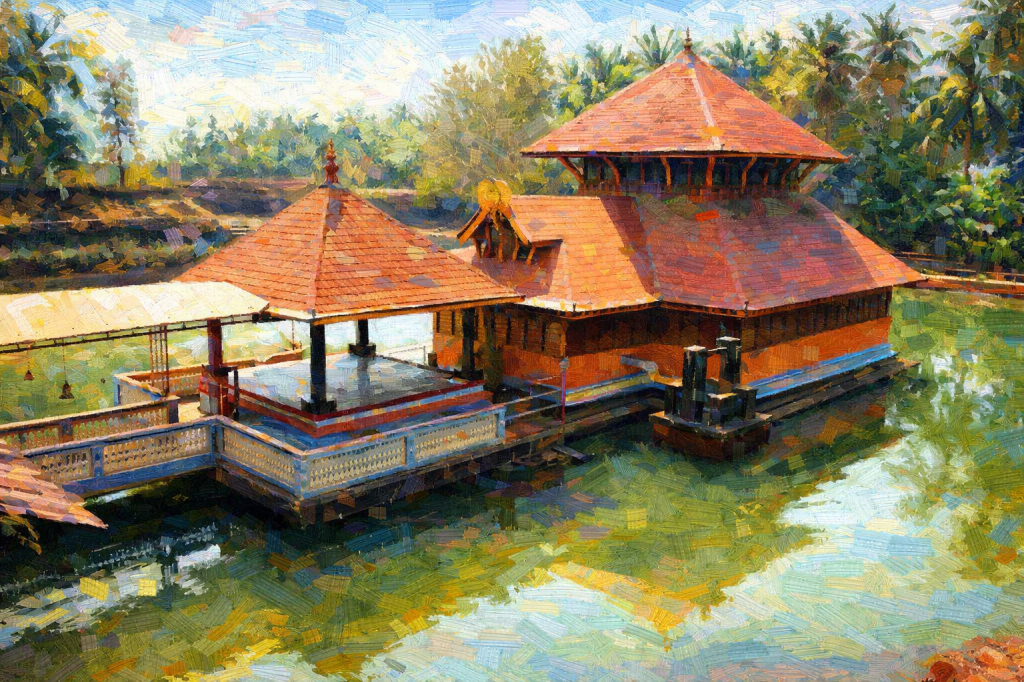
What sets Ananthapura apart is not just its legend but its extraordinary physical form. Unlike most temples that possess a pond, this temple stands within one. The sanctum rises from the middle of a clear, perennial water body fed by underground springs that have never run dry. This design is no accident as it mirrors Vaikunta, the celestial abode of Vishnu where the Lord rests upon the serpent Anantha in the ocean of milk, symbolising infinite time and cosmic energy. Crossing the narrow bridge to the sanctum feels like stepping away from the temporal world into that mythic ocean of stillness. Within the sreekovil, Lord Vishnu is worshipped alongside his consorts, Sreedevi and Bhoomidevi embodying harmony across the three realms. The original idol crafted in the rare katu-sarkara-yogam, a sacred composite of 108 organic ingredients echoes the same divine alchemy used at Padmanabhaswamy Temple. Though a panchaloha idol donated by a Kanchi pontiff was installed temporarily in the 20th century, the ancient idol has since been reinstated preserving ritual continuity.
Ananthapura’s architecture reflects the understated elegance of the 14th century. Copper-tiled roofs, laterite stone floors and finely balanced proportions lend the temple a quiet dignity. Tulu craftsmen have etched the Dasavatara, the ten incarnations of Vishnu onto the temple walls with remarkable precision while murals from the 17th century glow softly, narrating divine stories in pigment and line. Within the complex lies a small cave shrine housing an idol of Lord Krishna believed to have been worshipped by Vilwamangalam Swami himself. Folklore speaks of a secret underground passage from this cave to Thiruvananthapuram, now sealed yet lingering in the imagination of devotees.
Perhaps the most intriguing resident of Ananthapura is Babiya who is the temple’s legendary crocodile. For over seven decades, this reptile has lived peacefully in the temple pond astonishing visitors with its vegetarian diet subsisting solely on temple offerings of rice. Local lore recounts that a British officer once shot a crocodile here, violating temple sanctity. Fearing divine retribution, the local ruler ordered atonement rituals. Soon after, another crocodile emerged named Babiya who remains to this day. Revered as a divine presence, he is fed daily by the priests and is even believed to enter the sanctum on auspicious occasions. His calm coexistence with devotees has become one of Ananthapura’s most enduring symbols of faith. It is of quite surprise that over centuries a new crocodile has mysteriously surfaced here after the passing of the existing one which continues its reverence.
More than a shrine, Ananthapura is a lived metaphor of divinity that rests, of time that flows gently and of faith that bridges centuries and landscapes. As the moolasthanam of Padmanabhaswami, it holds a quiet primacy untouched by crowds yet saturated with meaning. To sit by its waters, watch the reflections ripple around the sanctum and hear the temple bells echo across the pond is to understand why devotees believe this land to be Vaikunta on earth, a place where the eternal pauses just long enough to be felt.
 STORIES by HEARITAGE
Leave a comment