Across India, countless temples draw pilgrims through legends of divine origins with heroic deeds or miraculous interventions. Yet, in the lush backwater country of Kerala there stands a shrine whose fame travels on a gentler note through taste, memory and an offering that has become inseparable from faith itself. The Ambalapuzha Sreekrishna Temple is not merely a destination of worship; it is a place where devotion is savoured, spoon by spoon in the form of its legendary palpayasam. From the moment one steps into Ambalapuzha, the air seems infused with sweetness both literal and spiritual. For centuries, this temple has been regarded as one of the most important Vaishnava shrines in Kerala, its identity shaped as much by its presiding deity as by the humble yet divine porridge offered daily to all who come in faith.
The origins of the temple trace back to the 16th century, during the reign of Pooradam Thirunal Devanarayanan Thampuran, ruler of the Chembakassery kingdom. Though his land was fertile and crisscrossed by canals and paddy fields, the king’s people suffered from a recurring agrarian curse: crops withered just before harvest leaving granaries bare and hopes crushed. A devoted worshipper of Lord Krishna, the king prayed earnestly for relief. Legend holds that Krishna himself arrived at the royal court disguised as a sage encountering the king in the midst of a chess game with his minister. When asked what reward he desired, the sage made a simple yet startling request, I need rice equal in quantity to the chessboard squares doubled with each square. What began with a single grain soon became an impossible sum. As the numbers multiplied, the granary emptied and by the final square the kingdom’s entire supply was exhausted. Seeing the king’s distress, the sage revealed his true form as Lord Krishna. Rather than punishment, he offered grace: the king was to repay the debt not in grain but by serving sweetened rice porridge to devotees every day. In return, the land would know prosperity. Thus was born the tradition of Ambalapuzha palpayasam served without interruption from that day to this.
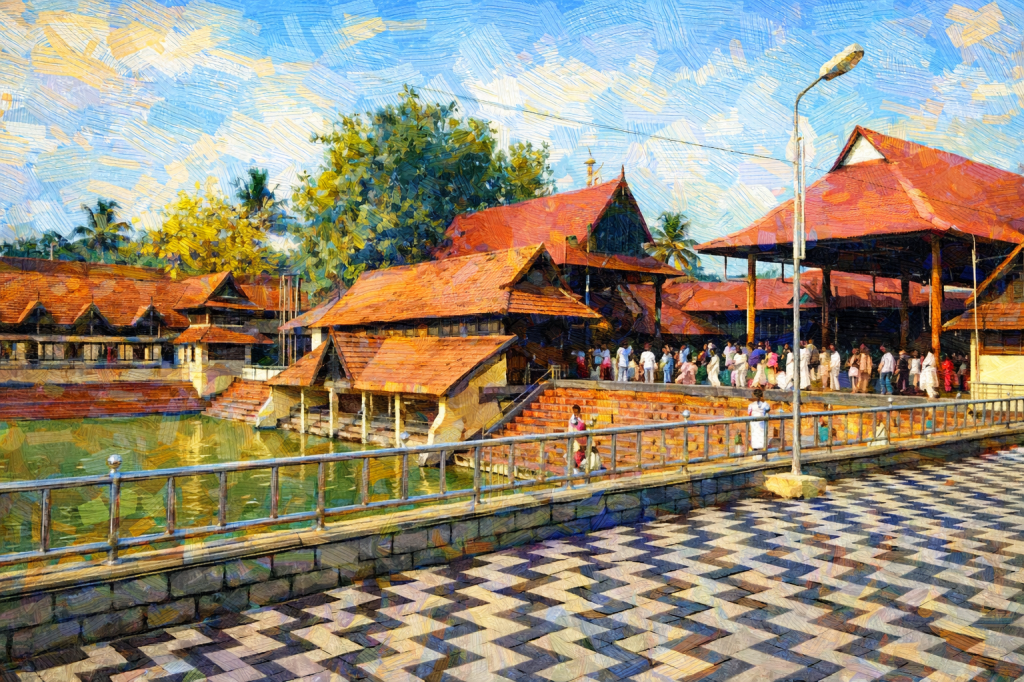
At the heart of the temple stands Lord Krishna in his form as Parthasarathy, the divine charioteer of Arjuna from the Mahabharata. The idol depicts him standing with whip in his right hand and conch in his left, a rare and dynamic posture that captures Krishna not as a playful child but as a guide, strategist, and protector. Architecturally, the temple is a classic example of traditional Kerala style with sloping tiled roofs, intricate wooden carvings and a large temple pond that mirrors the sky. Spread across an expansive compound, the temple has long served as a cultural and intellectual nucleus not merely a ritual space.
Ambalapuzha’s legacy extends far beyond worship. It is believed that Thunchathu Ezhuthachan, the father of the Malayalam language composed his immortal Adhyathmaka Ramayanam Kilipattu while seated within the temple precincts. The verses that shaped Kerala’s spiritual imagination thus emerged from this very soil. The temple is also inseparable from the evolution of Kerala’s performing arts. The first performance of Ottamthullal created by Kunjan Nambiar is said to have taken place here. A large mizhavu drum preserved in the temple is believed to be the very instrument used by the master himself, a silent witness to laughter, satire and cultural awakening. The temple’s festive calendar is as vibrant as its legends. The Chundan Vallam boat race fills nearby waters with rhythm and colour while performances of Krishnanattam and Ottamthullal transform the temple grounds into living theatres of devotion and art. These celebrations reaffirm Ambalapuzha’s role as a place where faith flows seamlessly into culture.
Ambalapuzha’s bond with the Guruvayur Temple adds another layer to its sacred story. During the Mysore invasions under Tipu Sultan, priests of Guruvayur feared for the safety of their deity. Under cover of secrecy they brought the idol of Guruvayoorappan to Ambalapuzha where it was reinstalled and worshipped for years. During this period, the rituals at Ambalapuzha were dedicated to Guruvayoorappan himself. Even today, devotees believe that Lord Krishna from Guruvayur visits Ambalapuzha to partake of the famed naivedyam, a belief that binds the two temples in eternal fellowship.
In many ways, Ambalapuzha is a temple that mirrors its offering. Its divinity is gentle, nourishing and enduring like the payasam that has been served here daily for centuries. Pilgrims may arrive seeking blessings, history or art, but they leave with something deeper: the taste of a promise kept between a god and his devotee. Today, the Ambalapuzha Sreekrishna Temple stands among the most visited shrines in South India, a luminous thread in Kerala’s spiritual heritage. To visit is not just to pray, but to partake in a story where faith, culture and sweetness have been simmering together through time.
 STORIES by HEARITAGE
Leave a comment