Thiruvananthapuram is a city where history is not confined to museums or archives, it lives quietly in streets, institutions and monuments that still shape everyday life. Among its most evocative landmarks stands Kuthiramalika Palace, also known as Puthen Malika. Built beside the sacred Padmanabhaswamy Temple, this palace is not merely a royal residence but a witness to one of the most transformative periods in the history of Travancore.
The story of Kuthiramalika unfolds through the life of Swathi Thirunal Balarama Varma, a ruler whose reign marked an intellectual and cultural awakening in Kerala. His kingship began even before birth. With no male heir in the Travancore royal family for years and with treaties that allowed the British East India Company to intervene in the absence of a successor, the birth of the prince was a moment of political urgency. He was proclaimed king as Garbha Sreeman, ruling nominally under regency until he formally ascended the throne in 1829 at the age of sixteen. Though his reign lasted barely seventeen years, it is remembered as the golden decade of Travancore. Swathi Thirunal was a rare blend of scholar, administrator and artist who was fluent in several languages, deeply learned in Sanskrit and equally at ease with English. As a composer, he left behind more than four hundred compositions in both Carnatic and Hindustani traditions, many of which remain central to classical concerts today. There were many landmark decisions taken by him during his reign & most of the institutions started by him still stand strong. The first major institution he started was a school which provided free education to all & named it the Maharajah’s High school which later became a college & is today known as the University College. He was also instrumental in bringing better medical practices to Travancore & for this also appointed a British surgeon at the General Hospital. Swathi Thirunal was also interested in creating better infrastructure facilities taking interest in engineering projects which resulted in the construction of many bridges like the Karamana Bridge which still is used by the people of Trivandrum. Swathi Thirunal was also good in administration & so to understand the finances is said to have ordered the first resurvey of land along with performing the first census in 1836. It is also important to know that most of the iconic landmarks are all the handy work of Swathi Thirunal, the Zoo which was a concept of open enclosures, the observatory atop Kanakakunnu, the earliest museum of the state & the Trivandrum Public Library. Swathi Thirunal thus changed the whole image of Thiruvananthapuram during his reign & made it a hub of cultural activities.
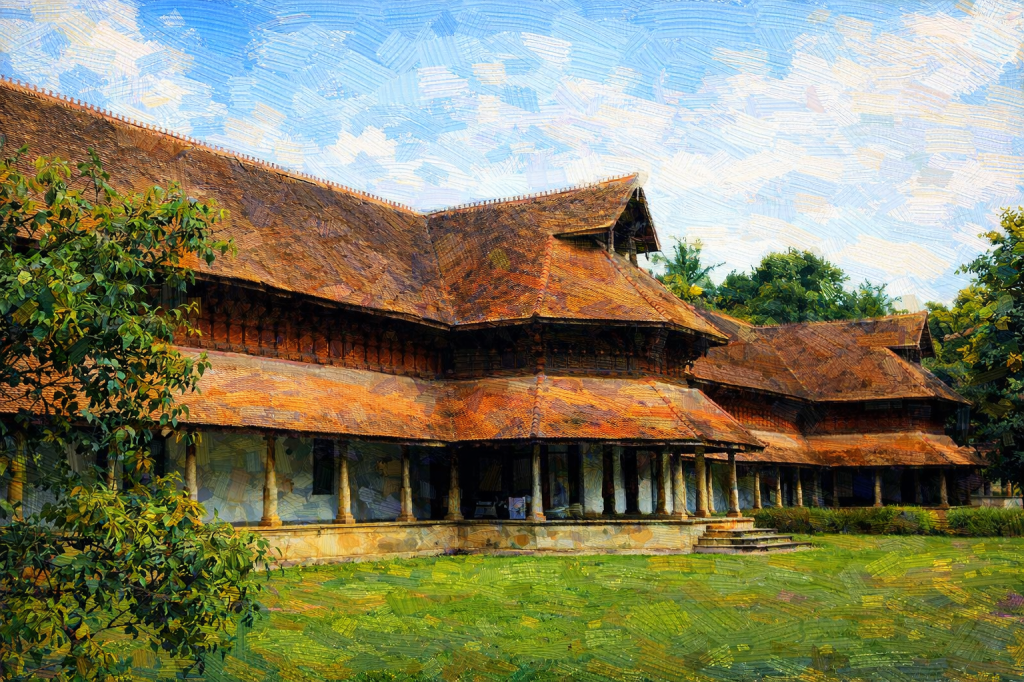
Kuthiramalika was the last major project undertaken by Swathi Thirunal. Until the 1840s, administration was largely overseen from Kollam but the king envisioned a palace in Thiruvananthapuram that would place him close to his chosen deity, Padmanabhaswamy. Construction began in 1842 on land adjoining the temple and was completed in 1846. Architecturally, the palace follows traditional Kerala design with sloping terracotta-tiled roofs, expansive verandas and masterful wooden craftsmanship. The king visualised the palace as a place for him to meditate & give him peace to create his musical compositions, so one can find the large lawns & rooms with ventilation in such a manner that the interiors stay cool even in the harshest of summers. Yet, one feature puzzled contemporaries: the palace façade faces south, a direction considered inauspicious in Vastu Shastra and known as Yamakonam. When the king died soon after the palace’s completion, this orientation gained an almost prophetic reputation. The palace fell into neglect serving as a granary for over a century while royal residence shifted to Kowdiar.
The name Kuthiramalika or “mansion of horses” comes alive when one looks up at the roofline. One hundred and twenty-two finely carved wooden horses adorn the brackets beneath the gabled roof, each unique in posture and detail. The façade opens into three porticos supported by carved wooden pillars, leading to wide verandas and cool interiors designed for contemplation. Inside, the palace reveals its most intimate spaces. The Mantrashala, the king’s audience chamber on the upper floor is believed to be where many of his compositions were conceived. From here, a balcony offers a direct view of the Padmanabhaswamy Temple allowing the king to blend governance, devotion and music. In its prime, the palace housed around eighty rooms, sixteen of them royal chambers each distinct in ceiling design, woodwork and flooring. The palace does not have a central courtyard but has a large lawn in front of the façade where the concert venue was built which has a soundproofing arrangement made in traditional manner by placing clay pots upside down on the ceiling insulating sound. In total the palace was built keeping in mind all the needs of Swathi Thirunal but towards the year 1846 he was constantly sorrowed by the death of his close family including his beloved wife & children. The transfer of power to the British resident also made governance an issue for the King which affected his physical & mental health finally resulting in his untimely death.
Today, a portion of Kuthiramalika functions as a museum preserving the legacy of the Travancore royal family. Guided tours take visitors through galleries displaying royal thrones, weapons, ceremonial gifts, sculptures and life-size Kathakali mannequins. Among the most intriguing exhibits are Belgian glass mirrors and a celebrated illusion portrait of Swathi Thirunal by Svetoslav Roerich, whose gaze seems to follow the viewer. The guided tour is integral to the experience, transforming architectural beauty into a narrative of governance, art and personal loss.
Each year, its grounds host the Swathi Sangeethotsavam which is a ten-day classical music festival that celebrates the king’s compositions. Musicians from across India perform beneath the palace porticos, filling the space with melodies born within its walls nearly two centuries ago. To visit Kuthiramalika is walking through the making of modern Thiruvananthapuram. The palace stands as a testament to a ruler who governed with vision, created with devotion and reshaped a city in less than two decades. More than a monument, it is a living chronicle of history, of ideas and of a legacy that continues to define the cultural soul of Kerala’s capital.
 STORIES by HEARITAGE
Leave a comment