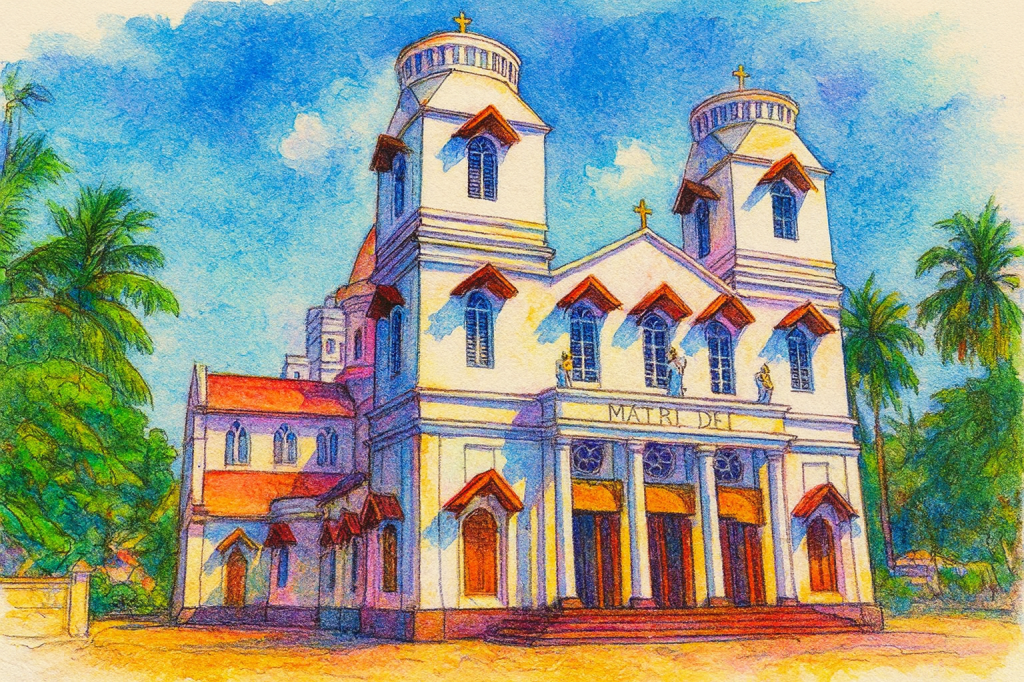
In the heart of Kozhikode stands a church that has witnessed five centuries of history, culture, conflict, and devotion. Locally called Valiya Palli, this is the oldest church in Kozhikode, believed to have been built in the early 16th century. What began as a small chapel born out of a treaty between the Portuguese and the Zamorin has today grown into a magnificent cathedral that continues to inspire awe in every visitor.
The story of Valiya Palli begins with the arrival of the Portuguese in Kerala. On 20 May 1498, Vasco da Gama stepped onto the shores of Kozhikode, an event that would change not only European maritime history but also the political and economic landscape of the Malabar Coast. The Portuguese soon realized the immense potential of Malabar’s spice trade and were determined to gain control over it leading to decades of friction with the Arab traders who had long dominated these waters. Conflicts escalated, reaching tragic heights in Ramzan of 1510, when Portuguese commander Albuquerque led a brutal attack on the Muslim quarters of Thekkepuram. The retaliation that followed forced the Portuguese community in Kozhikode into a fragile truce, eventually leading to the 1513 treaty with the Zamorin. It was this treaty that granted them permission to build a factory and a chapel in Calicut, the humble beginning of what would become Valiya Palli. The first chapel built by the Portuguese was destroyed by lightning in 1525. A second church rose in 1596 at the current site, administered by Jesuit priests. But the structure that truly transformed the skyline of Kozhikode came much later. By the 18th century, the old church had fallen into ruin. In 1725, the Portuguese rebuilt it with stone and mortar, adding a parochial house and a belfry. The inscription at the cathedral’s entrance still commemorates the arrival of the Portuguese man-of-war Madre de Deos in 1724, marking a significant moment in the shared history of Kozhikode and Portugal. Over the years, the church premises expanded beyond spirituality. Two schools St Joseph’s Boys School (1796), the oldest school in Kerala, and St Joseph’s Anglo-Indian Girls School (1862) were established, later taken over by the Sisters of the Apostolic Carmel.
By the early 20th century, the growing Catholic community needed a larger place of worship. In 1924, under the newly formed Diocese of Calicut, the old structure was demolished and replaced with an elegant new cathedral. Italian architects were specially brought in to design this Gothic marvel, blending Neo-classical charm with Kerala’s traditional aesthetics. The result is stunning with arched windows, tall spires, intricate colonnades, and a façade inscribed with the Latin words Matri Dei, meaning Mother of God.
A visit to Valiya Palli is a journey through time. As you step inside, the play of white and brown interiors exudes quiet majesty. One of the church’s most treasured possessions hangs on the wall, a 200-year-old portrait of St. Mary, serene and luminous, a reminder of centuries of devotion with one notable exception, the name of the painter. Nearby stands a remarkable stone cross carved in bas-relief on granite, bearing a Portuguese inscription. Even after centuries, it remains an object of veneration. A short walk past the prayer hall takes you to the beautifully maintained cemetery, where lies the tombstone of Pedro de Covilhany, the first Catholic missionary to visit Kozhikode. Standing here, surrounded by weathered stones and towering trees, you cannot help but feel a whisper of forgotten centuries. Valiya Palli is not just a church, it is a chronicle etched in stone. It tells of explorers and kings, conflicts and treaties, missionaries and local communities; of architecture shaped by foreign hands but brought to life by Indian artisans; of faith that endured through storms both literal and historical. It stands as Kozhikode’s timeless witness, its past carved into every arch, and its spirit carried in every prayer.
 STORIES by HEARITAGE
Leave a comment