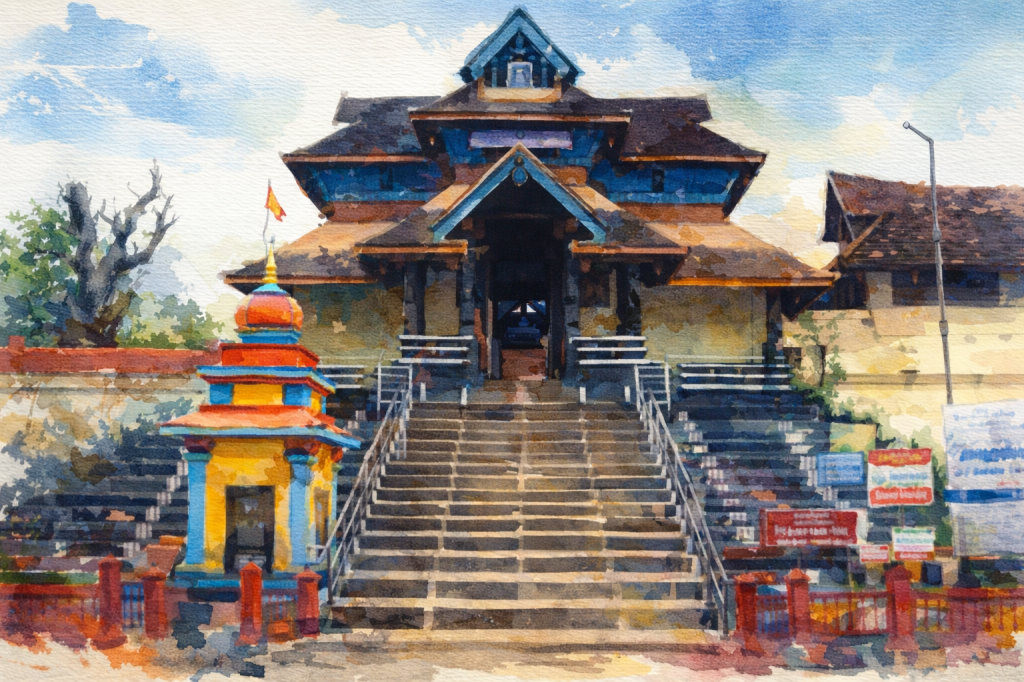
Standing on an elevated pedestal along the serene banks of the holy Pamba, the Aranmula Parthasarathy Temple is not merely a place of worship, it is a living chronicle of divine mythology, sacred remorse, and eternal faith. Revered as one among the 108 Divya Desams, this ancient shrine draws pilgrims not only for darshan, but to walk into the very heart of legends that date back to the age of the Mahabharata. Tradition believes that the origins of the temple go back to the Treta Yuga, when the Pandavas, burdened by the moral weight of the Kurukshetra war, set out on a path of atonement. Though victorious, they realised that the war had cost them more than it gave. To cleanse themselves of the sin of fratricide, they consecrated five temples dedicated to Lord Krishna. Arjuna, guided always by his divine charioteer, is believed to have consecrated the temple at Aranmula.
It was Arjuna’s intimate bond with Krishna that gave rise to the presiding deity of Parthasarathy, the charioteer of Partha. During the great war, Krishna had taken a solemn vow never to wield a weapon. Yet, one moment in the battlefield shattered that promise. When Bhishma, enraged and unstoppable, rained destruction upon the Pandavas, Arjuna faltered, overcome by grief at the thought of fighting his grandsire. Seeing his beloved devotee surrender, Krishna leapt from his chariot, Sudarshana Chakra in hand, ready to end the battle Himself. That divine vision seen only by Arjuna and Bhishma is believed to be eternally captured in the fierce yet compassionate form of the deity at Aranmula, holding the discus aloft. The temple also stands as a silent witness to Arjuna’s greatest remorse of the slaying of Karna when he was unarmed. Many believe that the consecration of this shrine was Arjuna’s way of seeking forgiveness for that irreversible moment.
Legend further tells that the idol of Lord Krishna was transported to the temple on a raft made of six bamboo poles. From this act comes the name Aranmula as aaru (six) and mula (bamboo). Every ritual and festival of the temple echoes this sacred journey. The grand Vallasadya, held on Ashtami Rohini, the birthday of Lord Krishna is a divine offering of 64 traditional dishes served to thousands of devotees. The feast arrives by small boats called Palliyodams, re-enacting the mythic crossing of the Pamba. Equally symbolic is the famed Aranmula Vallamkali, once a temple ritual and today a celebrated cultural event. The majestic snake boats glide through the river, rowed in rhythmic unity, singing ancient hymns. Conducted during the Onam season, the spectacle is believed to herald prosperity and divine blessings upon the land.
Architecturally, the temple reflects Kerala’s traditional temple style. Though originally a modest structure, it later evolved into the form seen today, with a central sreekovil, chuttambalam, and a beautifully carved namaskara mandapam. Murals depicting episodes from the Ramayana and Mahabharata, added in the 18th century, bring myth to life on temple walls. The idol itself is believed to be the tallest Krishna idol in Kerala, radiating the awe-inspiring Vishwaroopa revealed during the Bhagavad Gita discourse. The temple’s sacred ties extend beyond Krishna. Aranmula is intrinsically linked to the Sabarimala pilgrimage. During the annual procession of Lord Ayyappa’s Thiruvabharanam, the golden ornaments are ceremonially received at this temple, where the sacred Thanka Anki is preserved, a tradition sanctioned by the Travancore kings and honoured to this day.
Beyond worship, Aranmula is also home to the famed Aranmula Kannadi, a metal mirror with no glass, crafted using a secret alloy of copper and lead. Born from a royal commission to create a timeless crown for the deity, this art form continues through generations and remains an enduring symbol of Kerala’s spiritual craftsmanship. Today, the Aranmula Parthasarathy Temple stands as a sacred confluence of river, ritual, and remembrance. For pilgrims, it is a place where myth breathes, vows are remembered, and Krishna’s eternal message of dharma echoes softly with the flow of the Pamba. To walk its steps is not merely to visit a temple, it is to journey through devotion itself.
 STORIES by HEARITAGE
Leave a comment