Travel in Kerala often unfolds as layers of faith, trade and shared histories, quietly preserved in small towns that once stood at the crossroads of the world. One such place is Chendamangalam, a serene village near the ancient port of Muziris where the story of the Jews in India finds one of its most evocative expressions. Walking through this village today is not merely a heritage walk, it is a journey into centuries of resilience, acceptance and cultural harmony.
For centuries, the Jewish people wandered in search of lands where they could live without persecution. Jews first arrived in Kerala over 2,000 years ago most probably as traders following the destruction of the Second Temple during King Solomon’s era in the 1st century The refuge unexpectedly was found on the Malabar Coast of Kerala. When Jewish traders arrived at the bustling port of Muziris or Shingly, they encountered a society that valued commerce, pluralism and coexistence. Though cautious about unfamiliar customs, the local rulers quickly recognised the Jews as skilled traders and valuable allies in maritime commerce. The Cochin Raja granted the Jewish settlers land to live and practise their faith freely, an extraordinary gesture at a time when religious intolerance was widespread elsewhere. By around the 12th century, Jewish life had taken firm root in Kerala, gradually branching into two groups: the Cochin Jews often called White Jews who settled near the port towns and the Malabari or Black Jews who moved inland. Chendamangalam became a prominent settlement for the latter evolving into a close-knit Jewish town where tradition and local culture blended seamlessly.
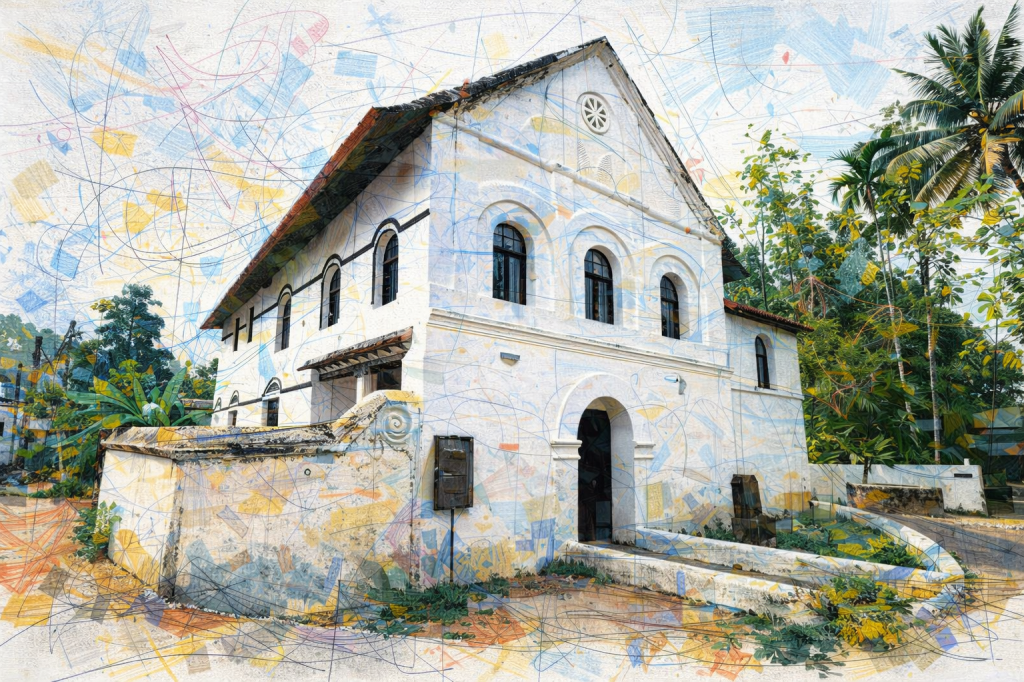
At the heart of this settlement stands the Chendamangalam Synagogue, regarded as the oldest synagogue in India. The first structure was built in 1420 inspired by the synagogues of Jerusalem, marking a milestone in the Jewish religious landscape of the subcontinent. Though modest in size, it symbolised permanence & a declaration that the Jewish people had found a home. The synagogue’s history mirrors the turbulence of Kerala’s political past. Fires, colonial rivalries and invasions led to repeated destruction. The Portuguese, once patrons later became adversaries and Tipu Sultan’s campaigns further devastated the structure. The present synagogue built in 1830 rose from these ashes, reflecting both survival and adaptation.
At first glance, the synagogue resembles a traditional Kerala house with simple, whitewashed walls and enclosed within high compound walls which is a common feature of Jewish places of worship. Its two-tiered structure, arched windows, laterite walls and tiled roof blend harmoniously with the local architectural language. Inside however, the synagogue reveals its spiritual richness. The central hall which is called the sanctuary is a large hall with high ceilings made of wood & painted with different floral designs. The Azara or arrival hall leads to a beautifully adorned sanctuary with high wooden ceilings painted in floral patterns. The central pulpit or Tebah stands at the heart of the hall symbolising the centrality of the Torah in Jewish worship. As per rituals, the rabbi stands in the central pulpit while men sit around him while praying to the Altar. The Heichal stands opposite which is the ornately carved wooden ark that once housed the sacred scrolls considered among the finest examples of synagogue craftsmanship outside Israel. The holy book or Torah is placed inside the altar. The women’s gallery overlooks the sanctuary, accessed by a narrow staircase while antique European chandeliers cast a warm glow across the prayer hall. The upper tier of the synagogue also has a balcony which opens to the outside & was mainly used as a way to allow natural flow of air into the structure. Every element reflects a fusion of Jewish ritual requirements and Kerala’s indigenous building traditions.
Among the synagogue’s most important relics is a Hebrew inscription marking the tomb of Sarah Bat Israel, dated to 1270 AD, the oldest surviving physical evidence of Jewish presence in Kerala. Another treasured artefact once housed here was the Golden Sefer Torah crown, a magnificent gift from the Travancore king in recognition of the Jewish community’s contributions to trade and social harmony. This 200 carat gold crown was an impressive item which was embedded with precious gems & stones. Though no longer present, its memory speaks volumes about the esteem in which the Jews were held. The synagogue also once formed part of a larger complex that included a cemetery and seminary, further underscoring Chendamangalam’s role as a vibrant centre of Jewish learning and life.
The story of Chendamangalam’s Jews is inseparable from the Paliath Achans, the powerful prime ministers of the Cochin kingdom. Their vision of governance was rooted in inclusivity. Around their palace, they encouraged the establishment of a temple, church, mosque, and synagogue which is an architectural expression of Kerala’s pluralistic ethos. The Achans valued the Jews not only as traders but as trusted advisors. Jewish voices found a place in royal councils and cultural exchanges flourished so much so that a celebrated folk song praising the Paliathachan was composed by a Jewish woman. This level of integration was rare in the medieval world and remains one of Kerala’s most remarkable historical achievements.
After India’s independence and the formation of Israel in 1948, a profound shift occurred. Through Aliyah, most of Kerala’s Jews migrated to their ancestral homeland in the 1950s. Houses were locked, businesses closed and synagogues fell silent. Chendamangalam, once vibrant with prayer and community life, slipped into quiet abandonment. Recognising the immense heritage value of these structures, the Kerala government initiated restoration efforts in the late 20th century. Today, the Chendamangalam Synagogue stands beautifully preserved under the Muziris Heritage Project, allowing visitors to step into a world shaped by faith, trade and coexistence.
A visit to Chendamangalam is more than a tour of an old synagogue, it is a way to know India’s unique relationship with its Jewish community. Here, Jews were not outsiders but neighbours, advisors and contributors to society. The synagogue stands as a testament to a time when diversity was not merely tolerated but celebrated. As one walks through its quiet halls, the story of the Jews in India unfolds not as a tale of exile, but as one of belonging. In Chendamangalam, history whispers gently, reminding every traveller that harmony, once achieved, can echo across centuries.
 STORIES by HEARITAGE
Leave a comment