The hills of Wayanad are more than a landscape, they are also a living archive of legends, beliefs and traditions shaped by centuries of tribal life. Among the many sacred spaces that define this land Valliyoorkavu Devi Temple in Mananthavady stands out as a place where mythology, tribal culture and devotion merge seamlessly. For pilgrims, a visit to Valliyoorkavu is not merely an act of worship; it is a journey into the spiritual consciousness of Wayanad itself and the annual festival at the temple is one among the most unique festivals in Kerala.
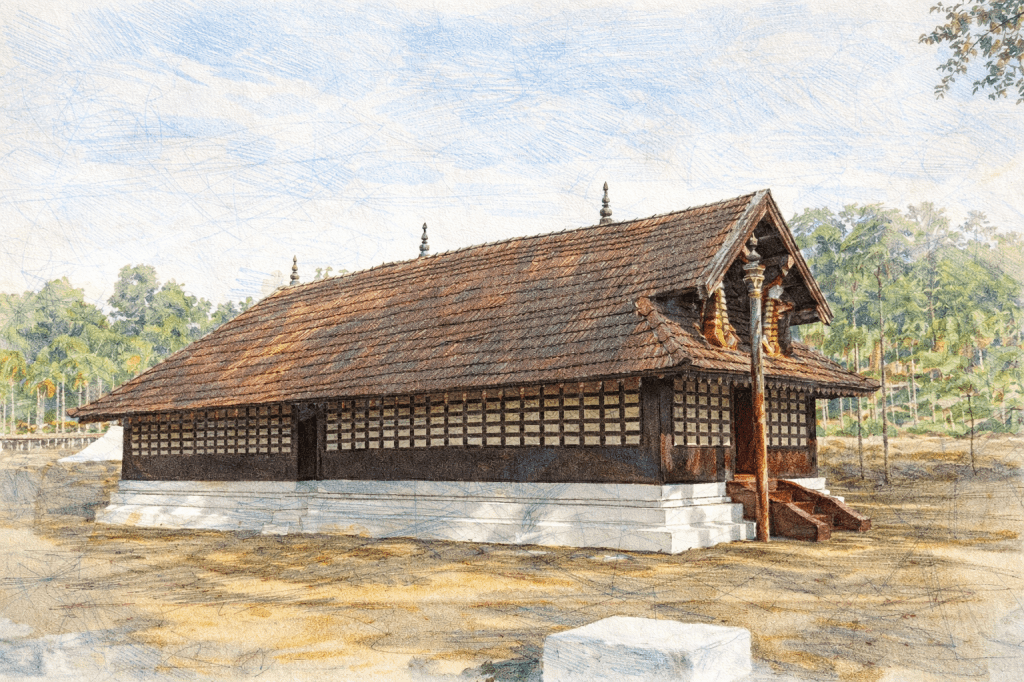
Set within a vast open ground, the Valliyoorkavu temple complex reflects the humility and grounded faith of its origins. Built in a style reminiscent of traditional Kerala homes the temple avoids architectural grandeur in favour of spiritual presence. The complex consists of the Sreekovil, Nadappanthal and Pathayapura along with two sacred groves – the Mele Kavu and the Keezhu Kavu. Even today, the temple’s architecture conveys a sense of quiet dignity, inviting pilgrims to focus inward rather than be distracted by external splendour. The presiding deity of Valliyoorkavu is a swayambhoo (self-manifested) presence, revered in three distinct forms as: Vana Durga as the guardian of forests worshipped by tribal communities who depend on nature for survival, Bhadrakali as the fierce and powerful mother goddess for all, Jala Durga as the protector of waters and livelihoods along the Kabini River deeply venerated by river-dependent tribes.
According to tradition, the origins of Valliyoorkavu date back to the 14th century during the reign of the Kottayam Raja. A revered oracle and healer travelling through Wayanad is said to have rested by the banks of the Kabini River. During his rest his sacred sword and anklet mysteriously vanished. Seeking help, the oracle approached the leader of the Paniya tribe who instructed his people to search the forests and riverbanks. After days of searching, the sacred objects were discovered hanging from a creeper (valli) entwined around a peepal tree. As the items fell to the ground a divine voice proclaimed that the Goddess had chosen this place as her abode. Moved by this revelation, the Kottayam Raja ordered the construction of a temple. From that moment Valliyoorkavu Devi became the Ooru Devi or the clan goddess of major Wayanad tribes including the Paniyas, Adiyars, Kurumas and Kaadans.
The temple’s 14-day annual festival is one of the most significant cultural events in Wayanad. During this time, the sacred space transforms into a living canvas of myth and tradition. Devotees witness the ancient art of Kalamezhuthu where the Goddess is painted on the floor using rice powder in vivid, symbolic forms. The Valiyoorkavu festival is conducted with great devotion over several days drawing people from across Wayanad and neighbouring plains. Each day of the festival has its own ritual significance but the final three days stand apart in both intensity and meaning. These days are believed to be the period when the presence of the goddess becomes most tangible and the temple transforms into a space where the divine and the human realms intersect. The rituals of the concluding days revolve around the goddess not as an abstract cosmic force but as a living protective mother directly accessible to her devotees. The festival commences with one of its most awe-inspiring rituals, the ceremonial bringing of the holy sword from the Palliyara Bhagavathy Temple. This sword, believed to embody the fierce protective energy of Valliyoorkavu Amma is carried in a deeply reverential procession. The priest bears the sword seated atop a caparisoned elephant, and the procession moves through the night illuminated by a vast entourage of traditional oil lamps. People from every stratum of society from tribals, farmers, artisans, merchants, and pilgrims walk together in devotion. The rhythmic sounds of percussion, the glow of lamps, and the quiet intensity of faith make this procession one of the most visually and emotionally striking moments of the festival.
Unlike most Kerala temple festivals where the kodiyettam (flag hoisting) marks the beginning, Valliyoorkavu follows a unique tribal tradition. The festival flag is hoisted only on the seventh day reflecting the temple’s deep-rooted adivasi custodianship. At the start of the festival tribal chieftains along with members of their clans venture deep into the forests to locate the tallest and most suitable bamboo to serve as the flagpost. The sight of the tribal community and temple authorities uniting for this ritual is one of the most defining images of the Valliyoorkavu festival, an affirmation that this temple belongs as much to the forest as it does to the shrine. Though the festival ends ceremonially on the fifteenth day, the festival flag remains hoisted for another seven days. Only after this period do the two prominent tribal clans-the Kurichiya and Paniya jointly bring down the flag, officially closing the festival cycle for the year. Historically, the Valliyoorkavu festival was the largest meeting ground for the adivasi communities of Wayanad. Tribes such as the Kurichiya, Paniya, Adiyar and Kuruma gathered here to exchange goods, sell forest produce, share crafts and strengthen kinship ties.
The Valliyoorkavu festival is inseparably linked to the memory of Kerala Varma Pazhassi Raja, the lion of Kerala’s resistance against British rule. It is believed that Pazhassi Raja attended the festival even while in hiding using it as a rare opportunity to meet his people, understand their grievances and discreetly issue instructions to Nairs and Nambiars. The British, aware of his presence, maintained heavy security during the festival. Yet, aided by the Kurichiya clan, Pazhassi Raja repeatedly evaded capture through intricate protective arrangements. A sad episode from this period is the death of Vembilan Kunjaman who was the temple guard was shot dead by the British in the temple courtyard during the festival mistakenly believed to be Pazhassi Raja’s soldier. The Kurichiya community thereafter revered him as Negal, the principal devotee and eternal guardian of Valliyoorkavu Amma.
The festival extends over two weeks each marked by devotion, ritual, and generosity. Annadanam (free community meals) is conducted twice daily and each day the responsibility is taken up by different communities. Notably, even the Jain community, which once had a significant presence in Wayanad participates in this sacred offering. Over the course of the festival, 27 feasts are conducted with an exception on the final day. This continuous act of feeding underscores the temple’s role not only as a spiritual centre but also as a space of social equality and shared humanity. The reach of Valliyoorkavu Devi extends beyond Kerala. On the fourteenth day, communities from across the Kabini River in Karnataka arrive bearing bananas and plantains as offerings. They consider themselves descendants of the erstwhile Valluvanadu kingdom and uphold this ritual as a sign of ancestral allegiance to the Goddess. The festival of Valliyoorkavu Devi Temple is not confined to ritual worship alone. It is a living chronicle of Wayanad’s soul and a space where tribal traditions, resistance history, social justice, mythology, and devotion coexist. In every procession, ritual, and shared meal, the festival reaffirms Valliyoorkavu Amma’s role not just as a deity but as a protector, unifier, and eternal witness to the life of the land and its people.
Once a space known only to the tribes, Valliyoorkavu today draws pilgrims from far beyond Wayanad. Yet, despite the growing footfall, the temple has remained true to its essence as a protector of people, forests and traditions. To visit Valliyoorkavu is to step into a world where myth breathes through ritual, where the forest listens and where faith remains rooted in the soil of Wayanad itself.
 STORIES by HEARITAGE
Leave a comment