Kerala has always been blessed by some great souls who made their life an example for all to follow. This has also been a place which values faith & who better to follow than the revered Alphonsamma or St Alphonsa who in many ways manifests the way of God with sincere faith. For people today the life of this sacred soul can be realised at Bharananganam in Pala & it’s a place of solace for all.
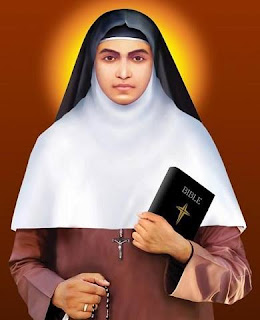
St Alphonsa is the first Indian woman to have been canonised as a Saint & it is indeed a matter of pride that such a person graced the lands here. Alphonsamma was born in 1910 to Christian articulate parents in 1910 at Kudamaloor & was named Anna. The young girl was born with a clubbed feet deformity but that never stopped Anna to do all her daily chores with a lot of vigour. It is important to know that the young girl from her very young age suffered a lot of hardships. The death of her beloved mother at an early age made her leave the house & live with her maternal aunt who was quite demanding. The clubbed feet also became the reason for ridicule in the school for the young child. Annakutty as she was fondly called by her father at the age of three contracted eczema which made her stay at home for over a year. Over the years she became more close to the church as the Murickan family in which she was raised were prominent members associated with the church. At a very early age Alphonsa had decided to work for the well being of people & be the bride of Jesus but her family did not approve of it as they worried for the lineage. For Annakutty, Therese of Lisieux became a beacon of hope as both women endured the same difficulties at a young age. Alphonsa’s maternal aunt wanted to marry her off & when Anna knew about this predicament is said to have burnt her hand which became a permanent scar for the rest of her life. At the age of 17, Anna came to the Bharananganam convent & studied here for over a year. It was in 1928 that she received the postulant’s veil & took the name Alphonsa along with taking up the job as a teacher in the school of the church. Sister Alphonsa is said to have been a good teacher & her work was applauded by the church which sent her to Vakkakad as a temporary teacher. It was while working here that her heath kept waning. It is to be known that though Alphonsa was in deep distress with her failing health she never forgot to pray as she believed that the pain she endured was for a reason & God had a reason for her suffering.
Kerala has always been a land shaped by faith & that flows quietly through its villages, churches, temples and the lives of ordinary people who became extraordinary through devotion. Among such luminous souls stands St Alphonsa, a woman whose life was woven with pain, prayer and unshakable belief. She is also the first Indian woman to have been canonised as a Saint. To understand her story is to understand the strength of faith itself and the small hill town of Bharananganam near Pala is where this story continues to breathe, offering solace to pilgrims from every walk of life.
St Alphonsa, lovingly remembered as Annakutty was born in 1910 at Kudamaloor into the devout Murickan family and was christened Anna. From birth, life tested her relentlessly. She was born with a clubfoot deformity, a physical challenge that would shadow her entire life, yet never diminish her determination. Even as a child, she carried out her daily chores with remarkable resilience refusing to let pain define her spirit. Tragedy struck early when Anna lost her mother at a tender age. She was sent to live with her maternal aunt, a stern disciplinarian and this phase marked the beginning of a life shaped by hardship. School was no refuge either as her deformity made her a subject of ridicule. At just three years old, she suffered from severe eczema confining her indoors for over a year. Yet, through illness, loss and isolation, Anna’s faith only deepened & she found comfort and strength in prayer. Even as a young girl, she felt a powerful calling to dedicate her life to God and become the bride of Christ. Her family, however, feared for their lineage and future, resisting her decision. It was during this emotional struggle that St Thérèse of Lisieux became Anna’s guiding light. She saw in Thérèse a reflection of her own suffering and endurance. When her aunt attempted to arrange her marriage against her will, Anna made a dramatic choice & burnt her own hand leaving a permanent scar to affirm her resolve. It was a moment of silent defiance that sealed her path toward religious life.
At the age of 17, Anna arrived at the Bharananganam convent, a place that would become inseparable from her life story. After a year of study and spiritual formation she received the postulant’s veil in 1928 taking the name Sister Alphonsa. She began her vocation as a teacher, a role she embraced with dedication and compassion. Her service took her briefly to Vakkakad but her fragile health worsened. Illness followed illness, yet Alphonsa never questioned her suffering. Instead, she believed it was part of God’s divine plan. Pain, for her, became prayer. By 1932, Alphonsa could no longer sustain a full teaching role. After making her perpetual vows she returned to Bharananganam, where she continued her work as much as her health allowed. In 1936, when her condition became critical and medical treatments failed, a turning point occurred. St Kuriakose Elias Chavara, during a visit, is believed to have healed her miraculously. This moment became deeply significant as she not only regained strength but she also developed lifelong devotion to Chavara Achan. Remarkably, the Vatican later recognised this healing as a miracle attributed to him and both St Alphonsa and St Kuriakose Chavara were canonised on the same day, binding their legacies together forever.
Despite this brief recovery, Alphonsa’s health declined again. She suffered from pneumonia & lost her speech, endured seizures, breathlessness and prolonged periods of unconsciousness. There were moments of memory loss, yet prayer never left her lips. By 1945, her body was failing completely & her stomach and liver were severely affected causing constant vomiting and weakness. On 28 July 1946, Sister Alphonsa of the Immaculate Conception passed away quietly in her convent room at Bharananganam. She was only 35 years old. Though her life was marked by suffering, her death revealed her true impact as thousands gathered to pay their respects sensing that a holy soul had departed. She was laid to rest at St Mary’s Forane Church, Bharananganam, the place she loved and served.
For a time, the world seemed to forget Annakutty but her students did not. They returned to her tomb, praying silently, finding comfort. Gradually, stories of healing began to emerge of physical recovery, emotional peace and renewed hope. One miracle stood out: a young boy born with clubbed feetmuch like Alphonsa herself prayed fervently at her tomb. Within days, his feet straightened and he began to walk normally. News spread rapidly, drawing pilgrims from across Kerala and beyond. People believed that only someone who had suffered so deeply could understand their pain. Soon, devotees of all religions began visiting Bharananganam, seeking Alphonsa’s blessings at her tomb.
The Vatican officially recognised the first miracle attributed to Alphonsa in 1985. In 1986, during his historic visit to Bharananganam, Pope John Paul II declared her Blessed, calling her Venerable Sister Alphonsa. Finally, in 2008, Pope Benedict XVI canonised her at St Peter’s Basilica, Rome. He described St Alphonsa as a soul who endured “extreme physical and spiritual suffering” with grace and unwavering faith, an example of holiness rooted in humility. Thus she became the first Indian woman to be canonised, a moment of immense pride for Kerala and India.
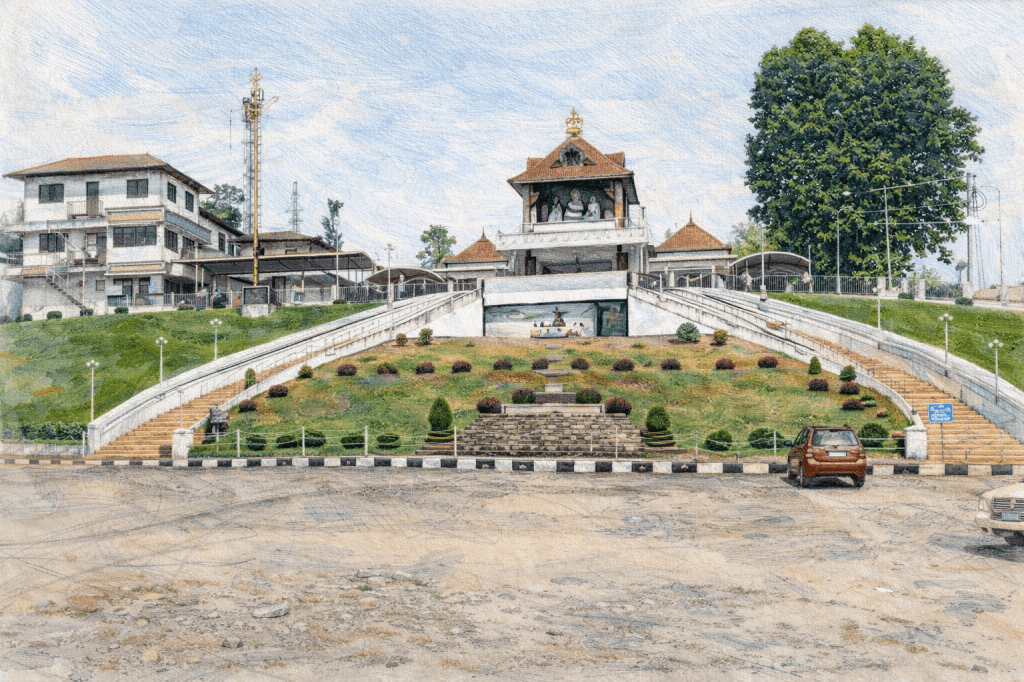
Today, Bharananganam is one of India’s most important Christian pilgrimage centres. The St Mary’s Forane Church, rebuilt and expanded over centuries stands in Gothic elegance with tall arches, vast prayer halls and a majestic altar. The church’s origins trace back to the 11th century when it was known as Aanakallu Palli, named after a legend where a king’s elephant chose the site for construction. The old wooden altar is still preserved linking the present to the past. St Alphonsa’s tomb remained inside the church until her canonisation after which a dedicated shrine was built nearby. The St Alphonsa Shrine is now the heart of pilgrimage activity. Pilgrims gather here for Mass, silent prayer and thanksgiving. Nearby, a museum preserves her personal belongings like her simple cot, daily-use articles and manuscripts allowing visitors a glimpse into her austere life. A life-sized statue of Alphonsa along with a powerful painting depicting St Kuriakose Chavara healing her deeply moves visitors. The convent where she lived, the stone cross opposite the church and the grotto narrating her life are all integral parts of the pilgrimage circuit.
Walking through Bharananganam today is not merely a religious journey, it is an inward pilgrimage. The quiet surroundings, the prayers whispered by countless devotees and the enduring story of St Alphonsa remind every visitor that faith does not remove suffering, but gives it meaning. Bharananganam stands as a testament to how a life lived in silence and pain can echo across generations. To visit this sacred place is to remember that even in the deepest suffering, faith can transform the human soul and that St Alphonsa continues to walk beside those who suffer, offering comfort, understanding, and hope.
 STORIES by HEARITAGE
Leave a comment