In the long and layered history of Kerala, temples were never meant to be places of worship alone. They were centres of power, learning, justice and governance institutions around which society revolved. Among such temples, a special category known as Thali temples held exceptional importance. These were not merely sacred spaces but administrative capitals that guided the political and cultural life of the land. Out of the four great Thali temples of ancient Kerala, the Keezhthali Mahadeva Temple, located near Kodungallur in present-day Thrissur district stands today as a poignant reminder of a once-glorious past but reduced in form, yet undiminished in spirit.
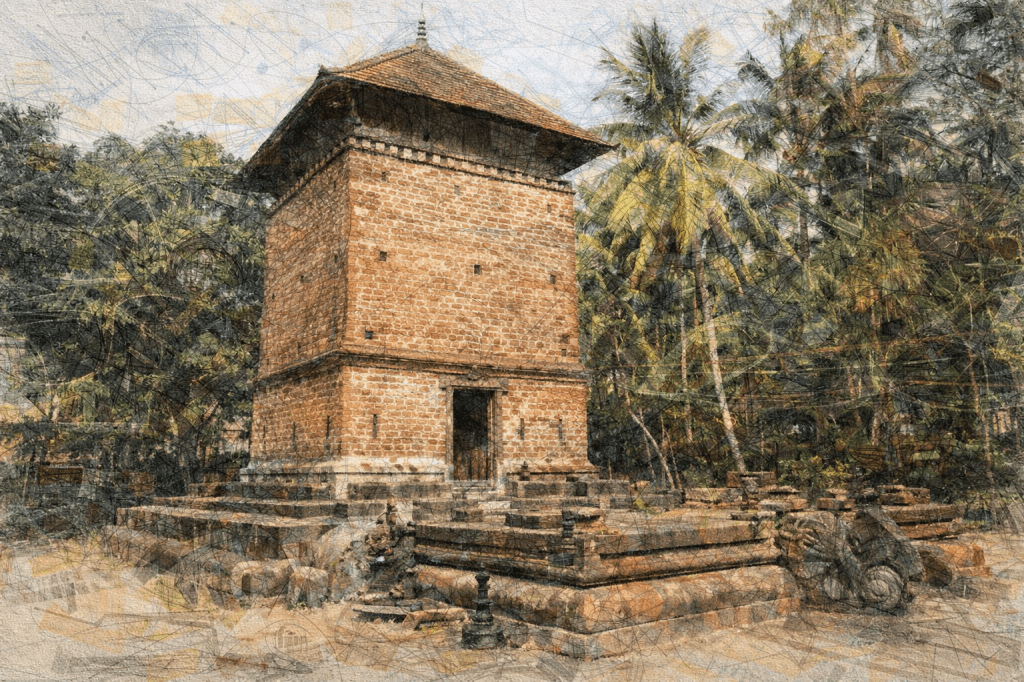
According to tradition, the origins of Keezhthali are traced back to Lord Parasurama, the legendary creator of Kerala. It is believed that Parasurama consecrated numerous Shiva lingas across the length of the land he reclaimed from the sea and the imposing idol of Lord Shiva in the form of Kirathamurthy at Keezhthali is counted among them. Kirathamurthy is the fierce hunter aspect of Shiva who symbolises divine vigilance and protection, befitting a temple that once stood at the heart of governance. One of the most striking features of the Keezhthali temple is the sheer height of its presiding deity, regarded as the tallest Shiva idol in Kerala. This extraordinary scale necessitates a rare ritual practice: priests perform the daily poojas standing upright unlike the seated or bent postures common elsewhere. This alone sets Keezhthali apart hinting at the grandeur and ritual precision that once defined the temple. The Perumals who ruled Kerala in the early centuries of the Common Era were devout Shaivites and are credited with establishing the temple as an important religious and administrative centre. Over time, local rulers restored and expanded the temple, most notably during the 12th century when Keezhthali flourished as a major Shaiva hub.
Though today only the garbhagriha (central sanctum) remains intact, historical records and architectural studies reveal that Keezhthali was once a vast and sophisticated temple complex. The temple followed the Dwitala Vimana style characterised by a square sanctum topped with a pyramidal superstructure. The sanctum stood on a granite pedestal richly carved on all sides while the upper portion featured plastered walls crowned by a terracotta-tiled roof. Keezhthali lacked a namaskara mandapam in front of the sanctum which is an architectural deviation that underscores its antiquity and distinct ritual traditions. Surrounding the sanctum were massive laterite walls enclosing a complex that housed shrines for various upadevatas. Beyond these lay spaces that defined the temple’s role as a cultural nucleus: a koothu parambu for ritual performances, a kalari parambu for martial training, and a kalapura parambu for scholarly and ritual assemblies. In its prime, Keezhthali was not just a temple, it was a city within walls.
The fortunes of Keezhthali changed drastically with the arrival of European colonial powers. In the 16th century, Portuguese forces inflicted the first major blow dismantling outer walls and subsidiary shrines. The Dutch followed, completing the devastation of the temple complex and driving inhabitants away from the area. The most brutal assault came in the 18th century, during the invasion of Malabar by Tipu Sultan’s army. Temples across the region were vandalised and Keezhthali suffered immense destruction. Yet, in what devotees consider divine intervention, the central sanctum was spared, allowing the spiritual heart of the temple to survive when everything else fell. This survival transformed Keezhthali from a bustling place into a solitary shrine being quiet & wounded.
In the centuries that followed, the temple’s physical footprint shrank dramatically. Residential houses and smaller places of worship now surround what remains of the ancient complex. Many of the destroyed idols, inscriptions and architectural fragments have been recovered and preserved at the Shakthan Thampuran Palace Museum where they stand as mute witnesses to Keezhthali’s former splendour. Today, the temple is jointly cared for by a managing trust and the Archaeological Department of Kerala, under whose protection it stands as a monument of historical importance. Despite its reduced scale, daily poojas continue uninterrupted and devotees still gather here drawn by the towering presence of Kirathamurthy and the deep sense of antiquity that permeates the sanctum. A namaskara mandapam has been built now to conduct the temple rituals.
Keezhthali Mahadeva Temple may no longer command the authority it once did nor display the architectural majesty of its golden age, yet its significance has not diminished. To walk into Keezhthali today is to step into layered time: to imagine chants echoing across vast courtyards, scholars debating under oil lamps, warriors training in sacred precincts and rulers administering justice in the shadow of Shiva. Though stripped of its outer glory, the temple’s spiritual stature remains towering, much like its presiding deity. The temple today has evolved from a centre of power to a symbol of resilience.
 STORIES by HEARITAGE
Leave a comment