In sacred India, the Ramayana is not merely an epic it is part of cultural memory. Across the country there are temples dedicated to Lord Rama, yet deep in the forested hills of Wayanad lies a shrine that tells the story from a different perspective, a temple where Rama is not the presiding deity but Devi Sita herself reigns supreme. The Seetha Devi Temple at Pulpally in Wayanad holds the rare distinction of being the only temple in the world where Sita is worshipped as the principal deity alongside her sons Lava and Kusha. Visiting this temple is not just a pilgrimage; it is a journey into the emotional heart of the Ramayana.
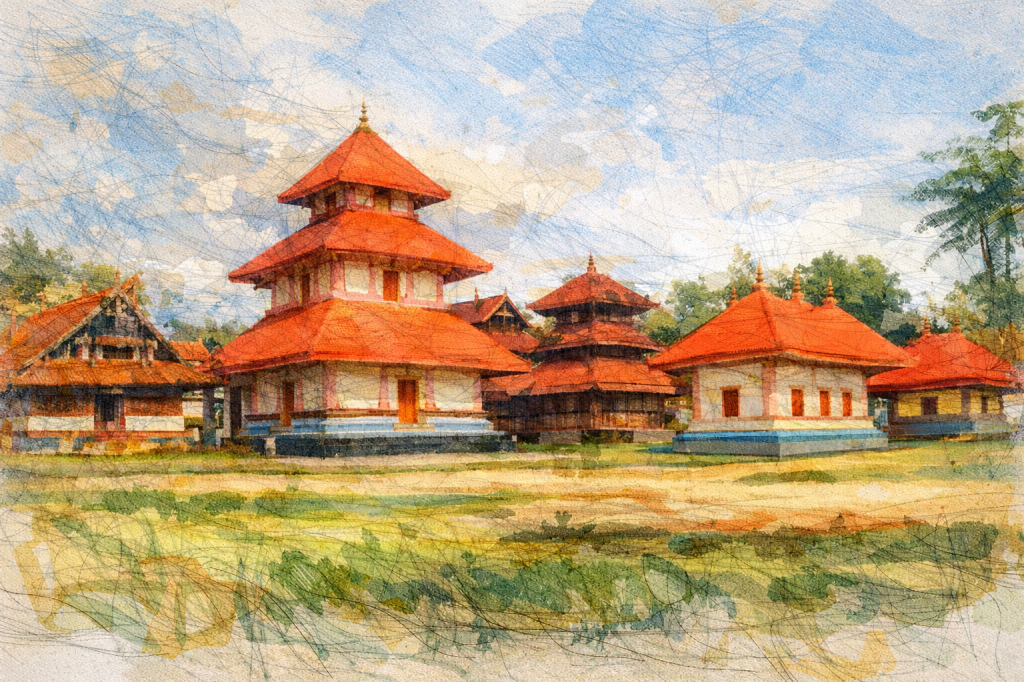
Pulpally is surrounded by dense forests and rolling hills & is traditionally believed to be the site of Sage Valmiki’s ashram. According to legend, after Lord Rama abandoned Sita due to public suspicion about her purity & she sought refuge in this forest hermitage. It was here, amidst nature’s silence that she gave birth to the twins, Lava and Kusha. The lands surrounding the temple are dotted with anthills which are natural formations that subtly reinforce the legend of Sage Valmiki. Mythology says that Valmiki attained enlightenment after years of penance during which he remained so still that an anthill (valmika) grew over him. The abundance of anthills around the temple complex seems almost symbolic of that ancient meditation.
Local lore also speaks of a tender yet powerful episode involving Sita and her children. It is said that when Lava and Kusha were bitten by leeches while asleep and Sita in maternal anger, cursed the leeches and banished them from the ashram. Even today, devotees believe that the temple premises remain mysteriously free of leeches despite Wayanad’s moist forest terrain. This sacred ground is also believed to be the last earthly abode of Sita where she ultimately returned to Mother Earth.
One of the most dramatic episodes of the Ramayana unfolds here in local tradition. Lord Rama conducted the Ashwamedha Yajna releasing a ceremonial horse to assert his sovereignty. Lava and Kusha wandering through the forest captured the horse near the ashram. According to ritual, capturing the horse meant facing the king’s army in battle. What followed was a legendary battle where the young princes defeated Rama’s mightiest warriors. Eventually, Lord Rama himself entered the battlefield. The world watched as father and sons unknowingly faced each other in combat. Fearing tragedy, Sage Valmiki intervened and revealed the truth. Sita was reunited with Rama but she refused to return to Ayodhya and instead she prayed to Bhoomidevi, her divine mother. The earth opened and Sita descended back into it. As she disappeared, Rama is said to have tried to stop her grasping only a lock of her hair. This moment gave rise to local place names such as Jadayittakavu (the grove of the fallen hair) and Chedattinkavu, the earlier shrine believed to mark the exact spot of her return to earth.
The present structure of the Seetha Devi Temple was built in the 18th century by Pazhassi Raja, the legendary ruler of Wayanad known for his resistance against British colonial forces. Before the temple’s construction, local tribal communities worshipped Sita here through traditional forest rituals. The architecture is modest reflecting Kerala’s traditional temple style. The sanctum of Sita Devi stands at the centre, flanked by shrines dedicated to Lava and Kusha which is a unique arrangement not found elsewhere. The temple’s wooden carvings add subtle elegance to its otherwise simple structure. Pazhassi Raja is believed to have held secret meetings here with his commanders while planning guerrilla warfare against the British. The large temple pond said to be one of the largest in Wayanad is linked with another legend: the king is believed to have thrown his golden sword into its waters before his final battle. After the king’s death, the custodianship of the temple passed to the Kuppathode Nair family who continue to oversee many of its traditional rituals.
Local stories recount that during the Mysore invasions under Tipu Sultan, soldiers attempted to approach the temple. As they neared it, sudden darkness enveloped the area in broad daylight. Interpreting this as divine intervention, the troops retreated, leaving the shrine untouched. Whether history or legend, the belief in Sita’s protective grace remains strong among devotees. The temple’s annual festival held in January draws thousands of devotees from across Kerala and neighboring states. What makes this celebration special is its inclusive spirit and people from all religions, castes and communities gather here united in reverence for Sita’s purity and strength. Rituals are conducted with deep devotion and the presence of Lava and Kusha in worship reinforces the temple’s identity as a sanctuary of motherhood, sacrifice and resilience.
The Seetha Devi Temple is not grand in scale nor is it architecturally overwhelming and its power lies in emotion. It invites pilgrims to reflect on Sita, not merely as Rama’s consort but as a mother, a woman of immense endurance and a symbol of unwavering dignity. Walking through the temple grounds, one senses that this is a place where myth and landscape intertwine seamlessly. The forests whisper of Valmiki’s penance, the breeze carries the echoes of a battlefield between father and sons and the soil itself feels sacred as though it still remembers the moment it embraced Sita. In a land filled with temples dedicated to Rama, Pulpally stands apart as a tribute to the silent strength of Sita. It is a reminder that the Ramayana is not just about victory and kingship but also about sacrifice, integrity and the quiet power of truth.
 STORIES by HEARITAGE
Leave a comment