Rising above the paddy fields of Kuttanad stands the majestic Kalloorkad St Mary’s Basilica, more fondly known as Champakulam Church, a monument of faith, history and continuity that has watched fifteen centuries unfold around it. Today the church appears grand and imposing, yet its beginnings were humble and tradition holds that in 427 AD it began as a small parish chapel seating barely a hundred worshippers. Built by early Christians who traced their faith to the apostolic mission of St Thomas the Apostle, it belonged to the ancient parish network linked to the historic Niranam Church, one of the legendary churches associated with the apostle’s mission in India. What began as a modest prayer hall has through centuries of devotion and rebuilding grown into one of Kerala’s most revered basilicas.
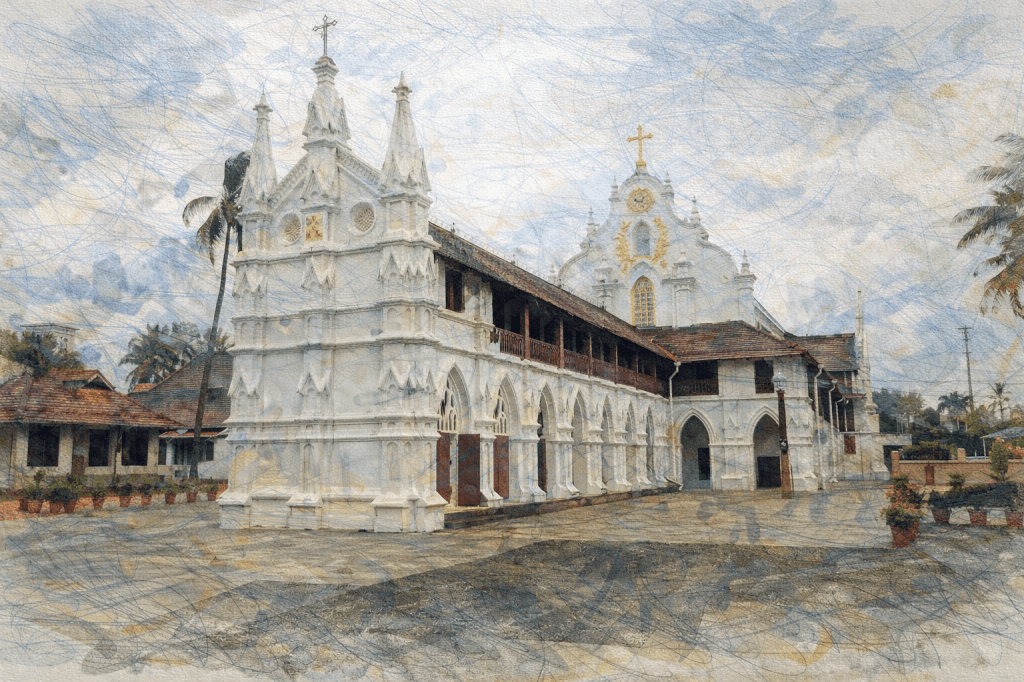
Local Christian memory preserves the belief that St Thomas established several early Christian communities along Kerala’s coast in the 1st century. Champakulam’s church, though built later is said to have arisen from one such ancient community supported by regional feudal rulers who respected the trading and social influence of early Christians. The earliest structure resembled a traditional Kerala house: sloping tiled roof, wooden beams and a simple altar. Over generations, as the faithful multiplied, successive rulers and patrons added halls, shrines and structures with each layer reflecting the artistic taste and architectural knowledge of its era. A major reconstruction is believed to have taken place in the 12th century when the old building was replaced with a larger church. From this period dates one of the site’s most treasured relics, a freestanding rock cross erected in 1175 AD, considered among the oldest surviving stone crosses in Kerala.
The church’s present form bears marks of both local craftsmanship and European influence. Portuguese and later Dutch involvement in Kerala introduced Gothic design elements which were blended with indigenous construction styles. The front of the church is not an open veranda but it is closed with plaster while the courtyard extends to the central prayer hall. The entrance leads into a spacious prayer hall framed by gracefully curved pillars. Above, a lofty arched roof spreads like a protective canopy, its panels adorned with murals depicting scenes from the life of Christ. Elaborate timber work enriches the structure and the altar finely carved and richly ornamented serves as the artistic and spiritual focal point. An upper gallery overlooks the sanctuary offering a sweeping view of the liturgical space. The interplay of light, wood and colour creates an atmosphere at once solemn and welcoming drawing visitors into quiet solace.
In the early 18th century, when the region was ruled by the Champakassery kings, the growing Christian population required a larger church. The king himself initiated construction around 1720 and within a decade a grander structure stood in place of the old one. The parish is also remembered as the birthplace of Ikkako Kathanar, one of the martyrs of the East Syrian Catholic tradition adding another layer of spiritual significance to the site.
The church stands in Champakulam village, part of the famed Kuttanad region often called the rice bowl of Kerala. Here, fields lie below sea level, canals crisscross the land and life flows in rhythm with water and harvest cycles. The church is also renowned for the historic Moolam Boat Race, one of Kerala’s oldest snake-boat festival. During festival season, the waterways near the church come alive with decorated boats, drumming rhythms and cheering crowds transforming the quiet riverscape into a vibrant spectacle. Faith at Champakulam is not confined to liturgy, it lives in celebration. The most important event is the Feast of Apparition of Mother Mary observed annually on the third Sunday of October which lasts eleven days and the festival draws pilgrims from across Kerala and beyond. Another cherished observance is the Feast of St Joseph in March commemorating the saint’s life and virtues. One of the most fascinating traditions during feast days is the use of the Ootuvanchi, a large wooden boat used to transport food offerings such as rice and sambar to the church. Watching this vessel arrive laden with provisions is a scene both devotional and picturesque symbolising generosity and communal sharing.
Centuries of devotion eventually earned the church recognition from the global Catholic community. In 2016, Pope Francis granted it the title of Minor Basilica affirming its historical, spiritual and cultural importance. This honour placed Champakulam among a distinguished group of churches recognised for their exceptional heritage. Today the basilica functions as a Forane church overseeing several parishes and serving as a major centre of worship for the Syro-Malabar faithful.
Despite its grandeur, it retains the warmth of a village shrine where locals gather daily for prayer just as their ancestors did centuries ago. For travellers, pilgrims and lovers of heritage alike, a journey to Champakulam is more than sightseeing as it is an encounter with time itself, flowing as gently and faithfully as the river beside it.
 STORIES by HEARITAGE
Leave a comment