Along the gentle curve of the Meenachil River in Kottayam stands a monument that seems less built than sculpted from time itself, the iconic Thazhathangady Juma Masjid locally called the Taj Juma Masjid. In a town celebrated as one of Kerala’s heritage circuits, this mosque is not merely a place of prayer; it is an archive of craftsmanship, cultural harmony and early Islamic history in the subcontinent.
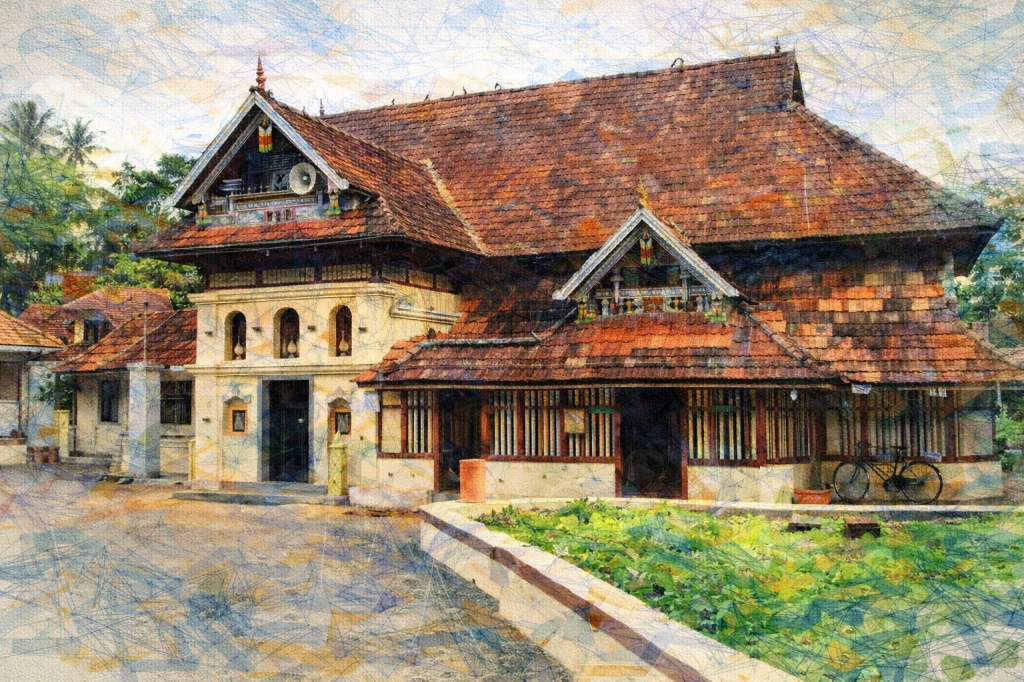
Anyone approaching the mosque, the first impression is surprising as unlike the domes and minarets associated with Islamic architecture elsewhere, this structure resembles a traditional Kerala mansion or palace. Its layered wooden roofs, sloping tiles, carved gables and ornate facade evoke the aesthetic language of indigenous architecture rather than West Asian forms. This distinctive appearance is no accident & it reflects the historical context of its construction when local artisans adapted familiar building traditions to new religious purposes. The mosque’s riverside setting deepens its charm further.
History attributes the spread of Islam in Kerala to Malik Dinar who is believed to have reached the Malabar coast in the 7th century. His mission continued through his nephew Habib Dinar who is credited with founding several mosques across the region. Thazhathangady is said to be among these early foundations making it one among the oldest surviving mosques in Kerala. Historical accounts also speak of the patronage of the rulers of the erstwhile Thekkumkoor Kingdom who are believed to have provided land and resources for its construction. Such royal support illustrates how early Kerala society fostered coexistence among faiths, enabling new religious communities to flourish alongside older traditions.
The architectural brilliance of the mosque lies in its adaptation of local craftsmanship and its reverence is more towards this aspect of the structure. Instead of stone domes or marble courtyards, the entire structure is a celebration of timber artistry. The Two-tiered wooden structure is built almost entirely of wood, supported by carefully carved pillars. The front mukhappu with balcony mirrors traditional Kerala royal residences and the absence of minarets is a rarity among mosques emphasizing regional identity over imported design. The colourful gables aredecorative elements which soften the structure’s lines and add elegance while a small window (Killivaadil) used historically by the qazi to view the courtyard completes the front. The single-stone water aqueduct inside is connected to a well and is used for ritual cleansing. Such stonework reflects the engineering ingenuity of early craftsmen.
Inside, the mosque unfolds like a carved jewel box with twelve wooden pillars rising from the floor, their surfaces etched with floral motifs and geometric designs. The interior is divided into two sections: Purampally which is the outer hall or vestibule & Akkampally where the main prayer hall is made. A carved wooden partition separates them, pierced by three doors. One bears a rare mukooti saksha lock which is a three-pin wooden mechanism that opens only through a precise sequence of sliding motions. Another features the famous manichitrathazhu locking system known from traditional Kerala homes. The prayer hall ceiling is adorned with intricate carvings of flowers and Arabic patterns demonstrating the fusion of Islamic artistic motifs with Kerala’s decorative traditions. At one end stands the mihrab and minbar, both carved from wood rather than stone or marble, highlighting the region’s mastery of timber architecture. Above, an upper hall once served as a teaching space where students studied theology and scripture. Even today, its wooden beams reveal the structural intelligence of traditional builders who achieved strength without nails or metal fastenings.
The mosque complex preserves several remarkable elements like Arabic inscriptions featuring verses from the Quran and devotional poetry, Temple-style pond still used for ablutions before prayer, Ancient sundial once employed to calculate precise prayer times, Tombs believed to belong to early religious figures and craftsmen associated with the mosque’s construction. These details transform the site into a living museum of medieval Kerala craftsmanship and religious life.
Historically, the mosque served not only as a religious centre but also as a social and intellectual hub. During India’s freedom movement, it functioned as a gathering place for discussions and planning, demonstrating how sacred spaces often doubled as community forums. Despite centuries of renovations, caretakers have carefully preserved its original aesthetic. The polished wood, sloping roofs and carved interiors remain faithful to the ancient design, allowing visitors to experience the mosque much as it might have appeared centuries ago.
Standing before Thazhathangady Juma Masjid, one senses how architecture can narrate history. Every beam speaks of artisans who carved faith into wood; every pillar recalls kings who patronised harmony, every prayer whispered within its halls echoes generations of devotion. To visit this mosque is not merely to see a monument. It is to encounter a rare synthesis of culture where Islamic spirituality, Kerala craftsmanship, royal patronage and riverine landscape unite.
 STORIES by HEARITAGE
Leave a comment