In the bustling heart of Thiruvananthapuram where history breathes through crowded streets and temple bells mingle, stands the revered Pazhavangadi Ganapathy Temple. Its a shrine that completes every pilgrim’s visit to the sacred city. Devotees say that no journey to the great Sree Padmanabhaswamy Temple is truly fulfilled until a coconut is broken here before Lord Ganesha, the remover of obstacles. Yet this small temple nestled within the historic East Fort precinct carries a story far larger than its size, a tale woven from royal legacy, soldierly faith, folklore and unshakable devotion.
The origins of Pazhavangadi temple take us back to the 18th century when the capital of Travancore lay not in Thiruvananthapuram but at Padmanabhapuram. The fort there was guarded by the famed Nair Brigade, elite soldiers entrusted with protecting the royal stronghold and near the fort walls stood a sacred grove dedicated to a fierce spirit known as Melankottu Yakshi. Night patrols always terrified the soldiers as many claimed the Yakshi attacked them in the darkness, leaving them unconscious by dawn. Fear spread through the ranks and even royal priests or oracles could quell the nuisance. One day, a newly posted soldier went to bathe in the nearby river before his shift. On his return, his foot struck a stone half buried in the earth and when he tried to free it, he discovered it was not a stone at all, but a small idol of Lord Ganesha seated in a rare posture with one leg folded. He carried it reverently to his post and worshipped it. That night, unlike the others, he slept undisturbed as the Yakshi never appeared. By morning the soldiers were astonished and when he showed them the idol, they believed they had found their divine protector. From that day onward, the brigade worshipped the idol daily.
The Travancore king, hearing of the soldiers’ experience accepted their faith and ordered a small shrine built near the fort walls to house the idol. The Nair Brigade was entrusted with its rituals and upkeep, a responsibility they treated as both duty and devotion. When the Travancore capital shifted to Thiruvananthapuram in 1795, the garrison moved to the East Fort area. The ruler Karthika Thirunal Rama Varma allotted a small piece of land near a fruit market known as Pazha Angadi. Over time, the locality itself came to be called Pazhavangadi and the shrine became inseparable from the identity of the place.
The present temple structure dates to around 1860 when the shrine was rebuilt in a more permanent form. Remarkably, the tradition of military guardianship continued. Even today, the temple is administered under the supervision of the Indian Army’s Pangode cantonment, a rare example of a shrine whose caretakers trace their lineage directly to soldiers who first worshipped there. Inside the temple are two principal idols: a golden image used for special rituals and the larger original idol that the soldier discovered. Surrounding them are sculptures of Ganesha in many forms, symbolizing his diverse manifestations as protector, teacher and remover of obstacles.
The most striking feature of Pazhavangadi is its signature ritual: the breaking of coconuts. This practice began with the soldiers themselves as before beginning duty, they would smash a coconut in prayer for protection and victory. If the coconut split evenly, it was taken as a sign that their wish would be fulfilled. If not, they would try again, sometimes breaking dozens until the omen felt right. Today that tradition continues on a grand scale as devotees arrive carrying sacks of coconuts, hurling them against the stone surface before the shrine. The rhythmic cracking echoes through the courtyard, sounding almost like ceremonial drums. For many, the act symbolizes shattering ego, obstacles, and misfortune before the deity.
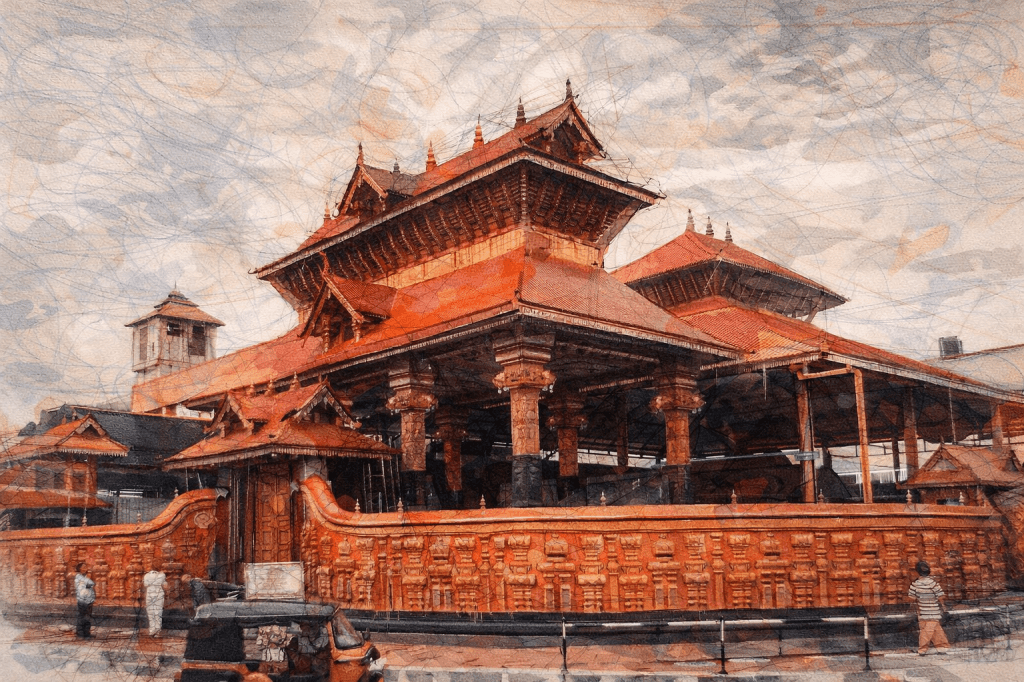
Though modest in scale, the temple reflects classic Travancore-era aesthetics. The structure follows a Dravidian style with tiled roofs, intricately carved wooden doors and a maroon façade that gleams under the Kerala sun. The renovation of recent decades has preserved traditional design while strengthening the structure for modern crowds. Despite urban expansion and the disappearance of the original East Fort walls, the temple retains its aura of antiquity. Standing here, one can almost imagine sentries pacing the ramparts, whispering prayers before their divine guardian. The currect structure is a complete overhaul from its old design and elaborately stands with a lot of aura continuing in its divinity.
What makes Pazhavangadi truly remarkable is not just its legend or architecture, but its living continuity. Unlike monuments that exist only in memory, this temple thrives in daily devotion. Students pray before exams, travelers seek safe journeys, traders ask for prosperity and soldiers still visit to offer silent salutes. In a city filled with grand shrines and royal monuments, this small temple reminds visitors that faith often grows strongest in humble places. Its story is one of protection, courage and belief which is proof that sometimes the smallest idol can cast the greatest shadow of grace.
 STORIES by HEARITAGE
Leave a comment