There are places along the Kerala coast where the sea seems to whisper history. One such place is the historic Thangasseri Fort, once the mighty Fortaleza de São Tomé but today reduced to a solitary gateway that stands like a silent witness to five centuries of colonial ambition. A visit to Thangasseri is not merely a stop at a ruined fort, it is a journey into the era when Kerala’s coastline was the most coveted stretch of land in the Indian Ocean.
Kerala’s long coastline was more than a geographical feature, it was a gateway. Through these waters came traders, missionaries, adventurers and conquerors. Long before the Europeans, Arabs, Jews and Chinese ships had anchored at its ports. But the arrival of the Portuguese in the late 15th and early 16th centuries changed the balance of power forever. After Vasco da Gama’s historic voyage, Portuguese influence in Malabar grew rapidly. Their conflict with the Zamorin of Calicut forced them to seek allies further south and the Cochin Raja became their strongest supporter. Yet trade in this region was largely controlled by Jewish merchants and local networks. To dominate commerce, the Portuguese needed not just treaties but stone, cannon and fortified ports.
The man who shaped this strategy was Afonso de Albuquerque, the powerful governor of Portuguese India often called the architect of the Portuguese empire in the East. He identified the Thangasseri coast near present-day Kollam as the ideal location for a major military and trading base. Its construction began in the early 16th century and was completed in 1519, shortly after his death. The fort that rose here was among the largest Portuguese fortifications in the region. Contemporary records speak of massive sandstone walls, three imposing towers, four bastions facing the sea, large barracks, warehouses and underground cellars. Unlike many Kerala forts built with laterite, this one used sandstone which waa choice that symbolized both strength and imperial ambition. From here, the Portuguese monitored shipping routes, protected their trade and projected their authority across the Arabian Sea.
Standing before the ruins today, it is difficult to imagine the glory of naval warfare that once shook this coast. In 1658, the Dutch East India Company launched a powerful attack and captured the fort after a fierce naval battle and renamed it St. Thomas Fort. The Portuguese briefly regained control but the Dutch returned with greater force. This time their objective was not merely conquest but it was destruction. In the struggle that followed, large sections of the fort were destroyed marking the end of Portuguese dominance in this region and the existence of a grand structure. The defeated Portuguese gradually withdrew towards Goa, closing a major chapter in Malabar’s colonial history.
The Dutch continued to control Thangasseri until the rise of Marthanda Varma, the visionary ruler of Travancore. After his historic victory over the Dutch at the Battle of Colachel in 1741 which was one of the earliest defeats of a European naval power by an Indian kingdom, the balance of power shifted. Thangasseri came under Travancore’s influence and later passed into British hands through treaty arrangements. By then, however, the fort had lost its strategic importance as the British preferred Anjengo Fort further south as their main stronghold. Thangasseri was abandoned, and time completed what war had begun.
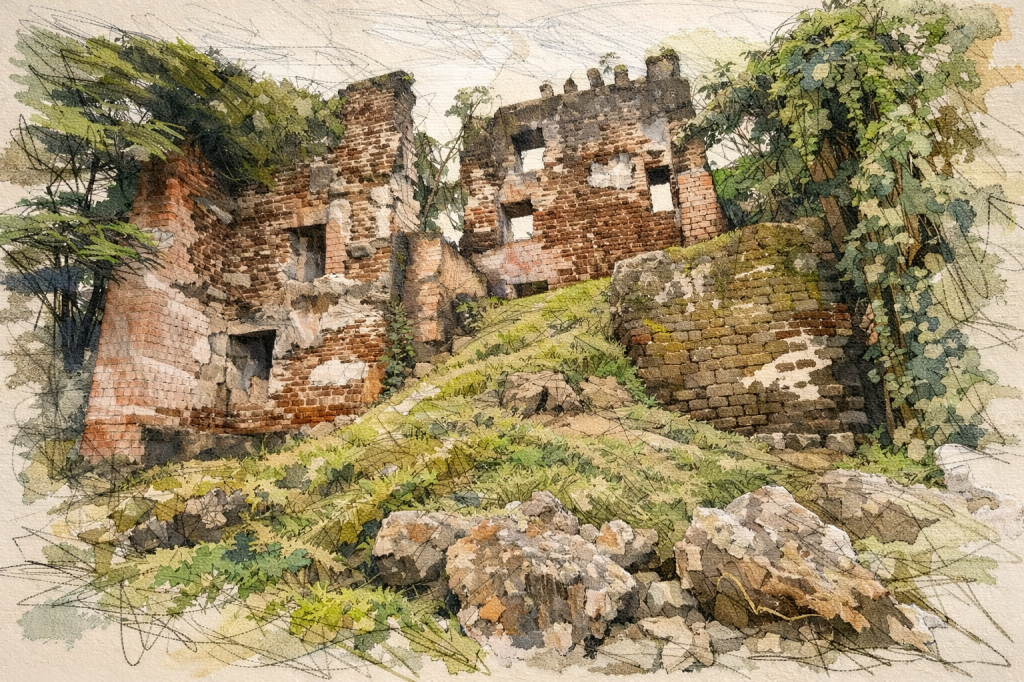
Today, visitors would be surprised and even disappointed to find that the once-mighty fortress has almost vanished. Where there were ramparts and bastions, there is now open ground and only the grand entrance tower survives, rising against the sky like a memory carved in stone. The site is today protected by the Archaeological Department, and public access is restricted, but even from outside its presence is powerful. It forces the traveler to imagine rather than merely see and in that imagination the fort rises again in its full glory. The experience of Thangasseri is not limited to the fort alone. The surrounding landscape completes the story when you visit the elegant Thangasseri Lighthouse which is one of the tallest in Kerala offering sweeping views of the Arabian Sea, the quiet Thangasseri beach where waves now wash over the routes once taken by warships & old colonial-era churches and streets that still carry the European imprint.
Thangasseri Fort is not a place of towering walls and grand courtyards anymore. It is something more subtle and more profound, also a reminder of how power shifts, how empires fade and how the sea outlives them all. To visit Thangasseri is to walk through a vanished city of soldiers, traders, missionaries and kings. It is to stand at a point where Portuguese ambition, Dutch aggression, Travancore resistance and British indifference all intersected. As the wind from the Arabian Sea moves through the broken past, you realize that this is not a lost monument, but a surviving memory.
 STORIES by HEARITAGE
Leave a comment