On the quiet shoreline of Thikkodi where the Arabian Sea curves gently into the famed crescent coast of Malabar rises a tower banded in black and white, the Kadalur Lighthouse. At over 34 metres in height, it is not merely a navigational aid but a monument layered with maritime memory, colonial engineering, and the stories of traders, pirates and shipwrecks. A visit here becomes less of a sightseeing stop and more of a journey through time.
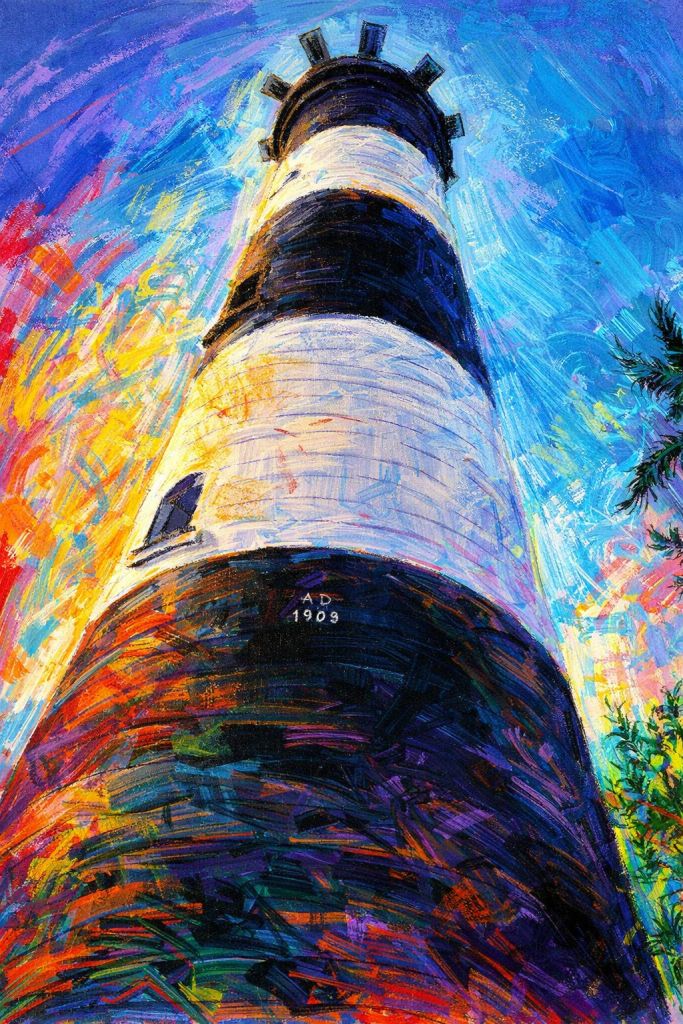
The approach to the lighthouse is through a serene stretch lined with coconut palms, the sound of the sea growing stronger with every step. The structure suddenly appears geometric, austere and purposeful. The alternating black and white bands are not decorative; they are daymarks, designed so that sailors could identify the tower even in bright daylight. Climbing the 246 plastered steps and the final steep wooden ladder is like ascending through layers of history. When one reaches the lantern gallery, the landscape opens dramatically to see the endless Arabian Sea on one side and the fertile Nandi countryside on the other. It is a view that explains why this point has always been strategically important.
Long before the British tower rose here, this coast was a guarded frontier. The name “Cotta Point” comes from kotta which is a fort. In the 18th century, Tipu Sultan wary of a British naval assault fortified this shoreline. The sea has since swallowed much of that bastion leaving only memory and scattered remains. Yet the choice of this location for a later lighthouse was no accident, it was already known as a strategic watch point over the Malabar waters. This coast was never an empty horizon, it was a busy maritime corridor connecting the ancient port of Panthalayani (Koyilandy), Arab and Chinese trade routes & later Portuguese and Dutch merchant fleets. But these waters were treacherous
not only because of political conflict but because of what lay hidden offshore. These waters witnessed numerous shipwrecks. One of the most remembered is the Ganesh Prasad which met its fate while sailing from Beypore to Cannanore. Each wreck reinforced a painful truth, the coast needed a guiding light.
About 8 km into the sea stands Velliyamkallu, a massive rock formation that shaped the destiny of this coast. To sailors it was a deadly obstruction, to pirates it was a perfect ambush point, to migratory birds it was a seasonal sanctuary, to the British it became the ominous “Sacrificial Rock.” Local lore tells of pirates hiding behind these rocks and attacking passing merchant ships, dividing their plunder on its flat surface. During the colonial conflicts, captured prisoners were reportedly executed here, a grim practice that gave the British their dramatic name for the formation. The white appearance of the rock caused by centuries of bird droppings gave it the Malayalam name Velliyamkallu, “the white rock.” This single geological feature was enough to alter shipping routes and ultimately led to the decision to build a lighthouse.
The idea for a lighthouse was first formally proposed in 1895 after the British consolidated their control over Malabar following the Anglo–Mysore wars. The original plan by F. W. Ashpitel was ambitious, a sea-washed lighthouse on Velliyamkallu itself but colonial bureaucracy intervened as there was high construction cost, difficulty in transporting materials, the challenge of maintaining lighthouse keepers offshore. Thus the proposal was rejected by the Madras administration & only with the passing of the Coast Light Dues Bill (1904) did the project gain momentum again. The location was shifted to the safer Cotta Point and construction began in December 1907 under Captain Smith.
The lighthouse is a fine example of functional colonial engineering built with wire-cut bricks from the Basel Mission factory, teak wood used for the steep internal staircase, a lantern room designed for maximum visibility, height and elevation giving a range of nearly 27 nautical miles. Though structurally completed in September 1908, it remained dark until the optical system arrived. The final illumination came with the installation of the Chance Brothers’ dioptric revolving lens and incandescent oil burner, approved by Trinity House, the authority governing British lighthouses. In October 1909, the first beam swept across the Arabian Sea and the Kadalur Lighthouse officially came alive.
One of the most touching aspects of its history is human rather than mechanical. The first light keeper was a member of the local family that assisted Captain Smith during construction. For four generations, the responsibility for maintaining the light remained within this family which is a rare continuity of indigenous participation in a colonial maritime system until the Government of India took over the appointment of keepers.
Today the lighthouse no longer guards a bustling colonial trade route. Instead, it watches over a peaceful coastline where fishing boats trace the horizon. The beam that once warned large merchant vessels now guides coastal navigation but symbolically it still illuminates the layered history of Malabar. Standing at the top as the evening sun melts into the Arabian Sea, one realises that the Kadalur Lighthouse is not just a structure of brick and lens. It is a memory of vanished forts, a response to a deadly rock in the sea, a product of global trade networks, a testament to colonial engineering and a living marker of local heritage. In the vast maritime chronicle of Kerala, the Kadalur Lighthouse stands as a quiet but unwavering sentinel being a beam not just for navigation, but for history itself.
** The information of its construction is taken from the essays published in calicutheritage website.
 STORIES by HEARITAGE
Leave a comment