In the calm village of Kumbazha one enters a landscape watched over by five silent hills. The landscape is protected for generations by the powerful Malayalapuzha Devi Temple. This is not merely a temple, it is a living centre of faith where mythology, tantra and folklore merge into an intense spiritual experience. Here the Goddess is not distant or symbolic as she is present, watchful and fiercely protective.
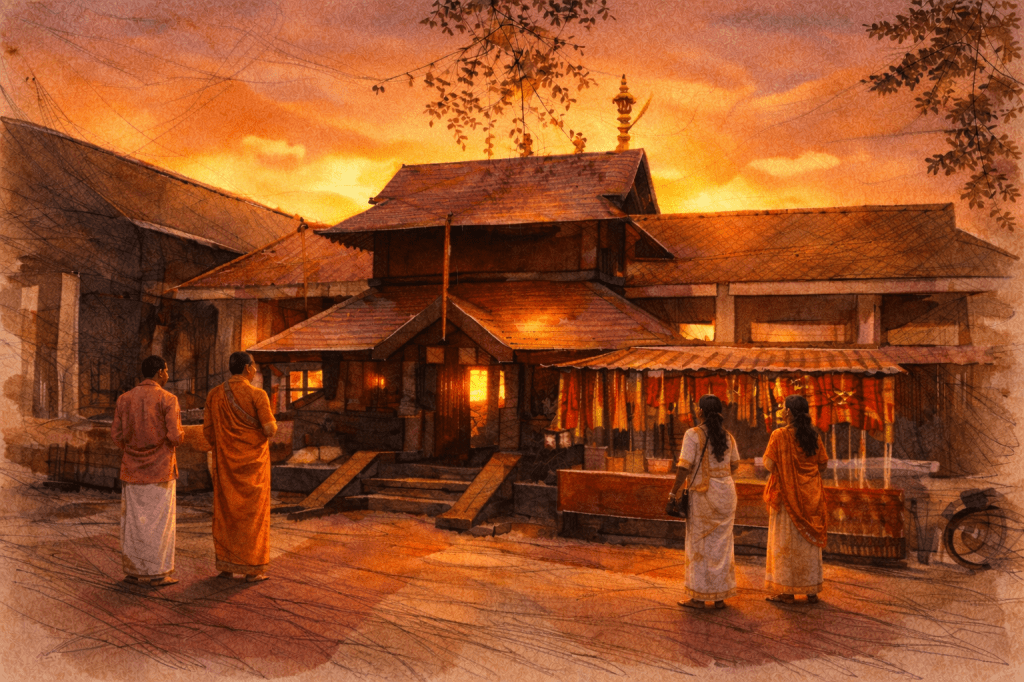
The most cherished legend of Malayalapuzha begins far away in the Western Ghats at Kollur Mookambika Temple, one of the most sacred seats of the Divine Goddess. Two aged Namboothiri Brahmins filled with devotion undertook an extraordinary vow. They wished to bring with them the presence of the Goddess not in memory but in form. Carrying an idol of Parvathi, they began a long and arduous pilgrimage on foot, moving southward through forests, rivers and hills. Old age bent their bodies but not their faith. As they reached the serene landscape of Malayalapuzha, exhaustion overcame them. That night, the Goddess appeared in their dream not as the gentle mother they had worshipped, but as the blazing Bhadrakali where she is said to have settled.
The Namboothiris’ journey, according to legend had been protected by a Brahmarakshas, a powerful spiritual being. Not once were they harmed by wild animals, disease or malevolent forces. From this belief arose the temple’s greatest reputation: Malayalapuzha is the Mother who removes unseen afflictions like black magic, negative energies, mental disturbances & inexplicable misfortunes. Unlike many temples where prosperity is the primary prayer, here the prayer is for protection for a life free from the invisible shadows that trouble the human mind.
The sanctum reveals a rare and deeply moving sight of a life-size idol of Bhadrakali, installed through tantric pranaprathishta, the ritual that infuses life force into the deity. Her presence is intense, fiery, majestic, yet compassionate. Within the temple there is also another extraordinary form of Parvathi holding little Ganapati in her arms where the ferocious mother becomes the tender universal parent. This duality defines Malayalapuzha for evil she is Bhadrakali & to devotees she is Amma.
Not all divinity here is enclosed within walls as under the shade of a sacred konna tree which is the golden flower of Kerala lies a swayambhu Shiva lingam, open to the sky. Local belief says that the lingam is slowly growing. It is a reminder that divine presence here is organic, living and not bound by architecture.
The temple structure follows traditional Kerala architecture with gopuram, namaskara mandapam, chuttambalam & bali peedam. Yet the true architecture is the geography itself with the five hills that surround the shrine like a protective yantra. In tantric symbolism, such natural enclosures represent energy fields. Malayalapuzha is believed to be one such shakti kshetra where the Mother’s power radiates outward.
Every year thousands of children are initiated into learning here, placed before the Mother who is both Saraswati and Kali & knowledge and power in one form. Farmers bring their first produce and offer it at her feet, seeking protection for their fields. It is a ritual that connects agriculture, ecology and faith. The temple once had the legendary elephant Malayalapuzha Rajan, honoured with the title Gajaraja Pattam which is the highest recognition for a temple elephant in Kerala.
Bhadrakali here is fierce but her ferocity is not for destruction, it is for protection. She is said to burn away jealousy, curses, negativity, & suffering. A visit to Malayalapuzha is not about seeing a monument, it is about experiencing a living myth. In this quiet town, among five ancient hills, stands a Mother who has chosen according to legend to remain here for eternity, watching over all who seek refuge from the unseen.
 STORIES by HEARITAGE
Leave a comment