Kottayam, often described as the cultural and literary heart of central Kerala is also a land where faith has quietly shaped history. Temples, churches and mosques stand here not merely as places of worship but as chronicles carved in stone, wood and memory. Among these enduring landmarks, the Valiyapalli and Cheriyapalli rise with particular distinction. Standing barely a short distance apart, these two ancient churches together narrate the layered history of Christianity in Kerala of migration, royal patronage, cultural synthesis and the evolution of distinct Christian identities.
From the 13th century onwards, Kottayam emerged as a prosperous inland region blessed with fertile plains and trade routes connecting the high ranges to the backwaters. Though ruled by the Kottayam kings, the region also lay close to powerful principalities such as Thekkumkur whose capital was at Thirunakkara. The Thekkumkur rulers were known for their progressive outlook and actively encouraged the settlement of Christian traders and agriculturists recognising them as honest, skilled and economically valuable subjects. By the early 16th century, a sizeable Christian population had settled in Kottayam and most of these Christians belonged to the Knanaya Syrian community, a distinct group that traces its lineage to Thomas of Cana who is believed to have migrated from Jerusalem to Kodungallur in the 4th century with a group of Syrian Christians. Their strong sense of identity, tradition and endogamy set them apart within the broader Nasrani fold.
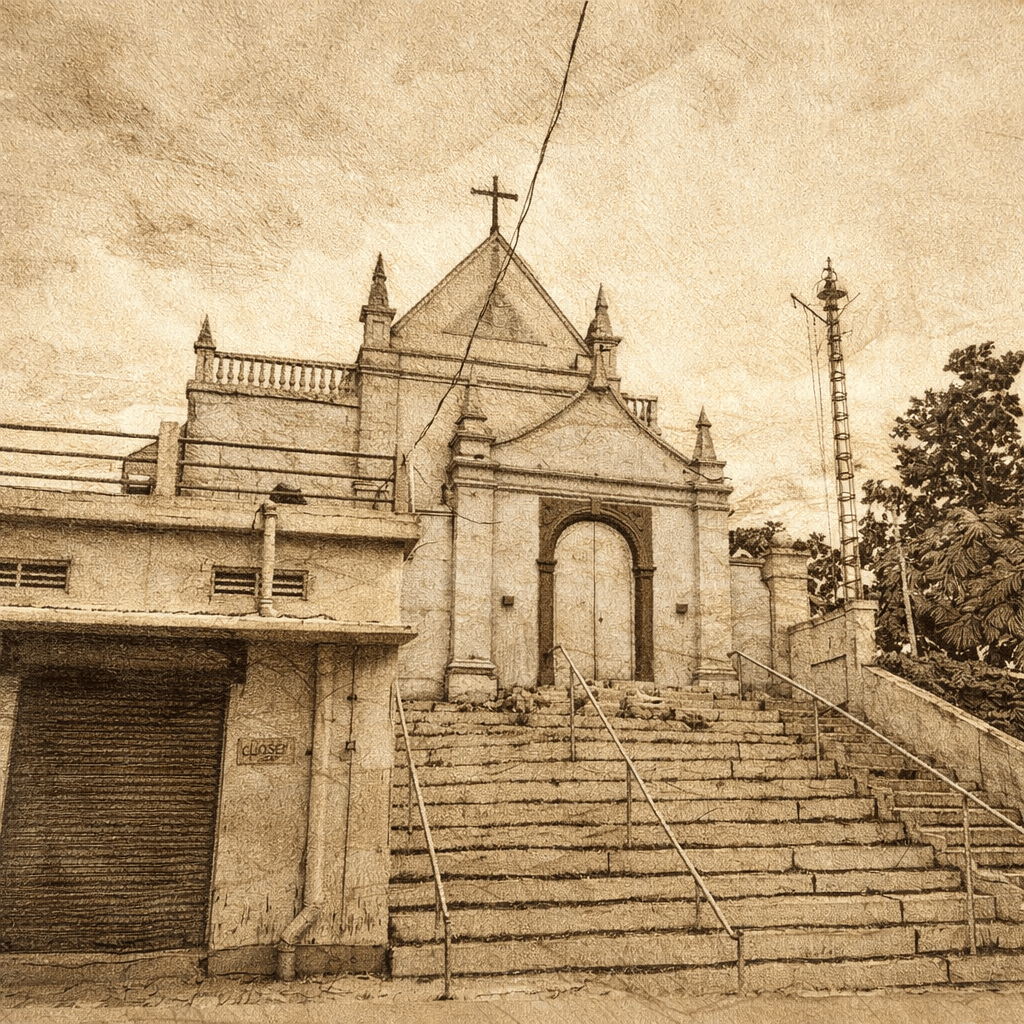
As the Knanaya population grew, the need for a large and permanent place of worship became important. So, responding to their request the Thekkumkur king granted land on a small hillock, a site that symbolised both prominence and protection. In 1550 AD, the St Mary’s Knanaya Church was constructed which today is known as Valiyapalli, literally meaning “the Big Church.” Interestingly, the construction was undertaken during a period of Portuguese influence in Kerala. Although the Portuguese missionaries did not subscribe to Syrian Christian traditions, their architects and craftsmen were involved in building the church. The result was a striking blend of European ecclesiastical design and traditional Kerala architecture. The church features high sloping roofs, thick lime-plastered walls, spacious interiors and large doors and windows designed to suit the tropical climate. One of the most extraordinary features of Valiyapalli is the presence of two ancient Persian crosses carved on stone slabs. These crosses believed to have been brought from Kodungallur, bear inscriptions in Pahlavi, an ancient Persian script. Such crosses are rare survivals from the early centuries of Christianity in India and stand as powerful evidence of Kerala’s long-standing links with West Asia. The larger cross is placed on the southern altar while the smaller one rests on the northern side, both revered as priceless relics of early Christian history. Over time, Valiyapalli became not just a Knanaya parish church but a major religious centre for Christians in and around Kottayam.
As decades passed, the demographic and ecclesiastical landscape of Kottayam changed. The influence of the Malankara Orthodox Syrian Church grew and differences in both ethnic and administrative began to surface between the Knanaya community and the Orthodox Syrians. These differences eventually led to a demand by the Orthodox group to establish a separate place of worship. The Knanaya community opposed the idea of another church within the same village leading to tension between the two groups. The matter reached the Kottayam Raja, who chose a diplomatic and farsighted solution by dividing the settlement into two administrative villages, allowing both communities to practice their faith independently. From this point onward, St Mary’s Knanaya Church came to be known as Valiyapalli, while the new Orthodox church was called Cheriyapalli—the “Small Church.”
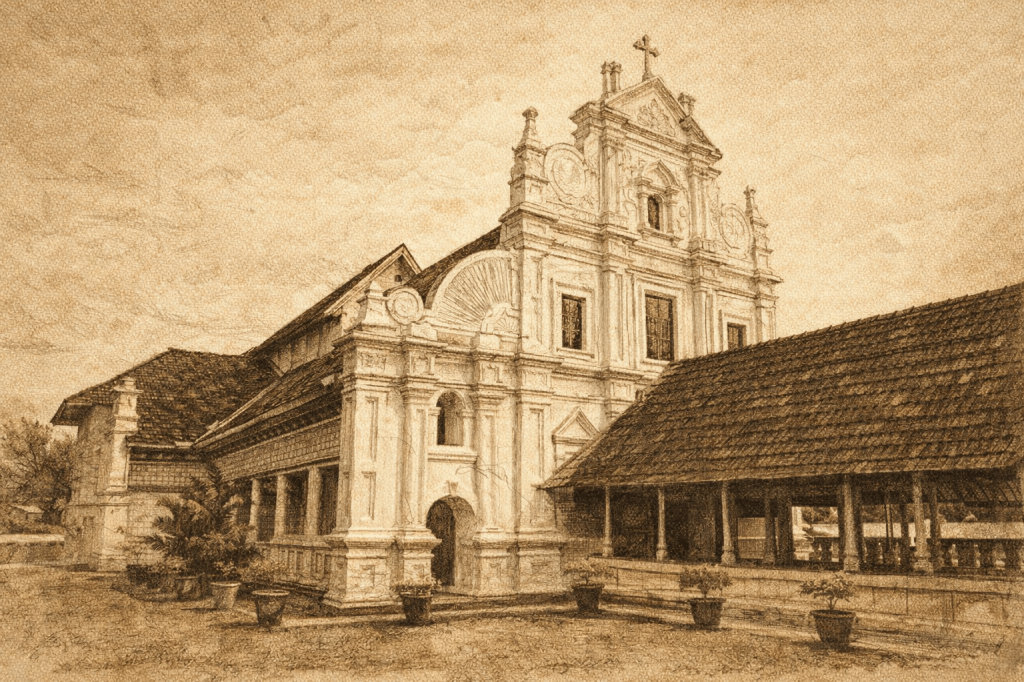
Construction of Cheriyapalli, formally known as St Mary’s Orthodox Syrian Church began under the guidance of a Portuguese architect named Anthony with extensive involvement of local craftsmen. Completed in 1579 AD, the church soon defied its modest name. In scale, design, and influence, it emerged as one of the most impressive churches in central Kerala. The most striking feature of Cheriyapalli is its natakashala, a grand temple-style entrance pavilion supported by ten massive granite pillars each carved with elegant lotus motifs. This structure, more commonly associated with Hindu temples immediately signals the deep cultural integration of Kerala Christianity. The wooden roof of the natakashala is richly carved and today displays portraits of eminent Metropolitans of the Orthodox Church. Beyond the portico lies the main prayer hall built in a European basilica style with high ceilings, wide windows, and a sense of openness. The interior is adorned with exquisite murals depicting scenes from the life of Jesus Christ and the Virgin Mary. Though inspired by European iconography, these paintings were executed by local artists using natural pigments giving them a distinctly Kerala aesthetic. The painted ceiling tiles and altar artwork together create an atmosphere of solemn grandeur.
For centuries, Cheriyapalli served as a major centre of the Malankara Church and functioned as its headquarters until the early 19th century. In recognition of its historical and spiritual prominence, the church was elevated to the status of a Maha Edavaka in 2011, a rare honour within the Orthodox tradition. Among its most treasured possessions is a sacred relic of the Virgin Mary, believed to be part of her holy girdle. Installed in 1966, this made Cheriyapalli the first church in India to possess such a relic. The relic is ceremonially taken out during the two-week fast of the Dormition of Mother Mary, drawing devotees from across Kerala. Another unique tradition associated with Cheriyapalli is the annual feast known as “Vithukalude Perunnal” or the Festival of the Seeds. Celebrated before the sowing season, devotees bring seeds to be blessed seeking the intercession of the Virgin Mary for a bountiful harvest. This agrarian ritual beautifully reflects the church’s deep connection with the land and its people.
Together, Valiyapalli and Cheriyapalli form far more than a pair of historic churches, they represent the plurality within Kerala Christianity, the coexistence of distinct traditions and the ability of faith communities to adapt, negotiate and endure. Their architecture captures centuries of cultural exchange, while their histories echo stories of migration, royal diplomacy and spiritual resilience. For a traveller, visiting these two churches is like walking through a living museum of Kerala’s Christian past. For the faithful, they remain sacred spaces of prayer and continuity and for anyone interested in heritage, they stand as powerful reminders that faith when rooted deeply in the soil of a land becomes inseparable from its history. A journey through Kottayam is incomplete without standing between Valiyapalli and Cheriyapalli where stone, wood and belief together tell a story that has unfolded for nearly five centuries and continues still.
 STORIES by HEARITAGE
Leave a comment