To many he was a madman. The road to Branthachalam Bhagavathy Temple on the hillock of Rayirenelloor does not announce itself with grandeur as it begins quietly, moving through villages, paddy fields and groves of trees, this is the place to meet the mind of one of Kerala’s most misunderstood sages, Naranathu Branthan. This travel is not merely a climb to a hilltop shrine but it is an ascent into a mythology that questions the meaning of life itself.
Naranathu Branthan, the fifth child of the legendary scholar Vararuchi grew up among the Ambalavasi community who are custodians of temple ritual and sacred rhythm. Yet from the beginning he walked a path that no scripture prescribed. Every morning he climbed a hill pushing a massive boulder to the top, in the evening he rolled it down laughing aloud. The villagers watched in bewilderment calling him “Branthan” or lunatic. But the hill today tells a different story as standing here and looking at the massive rocks scattered across the slopes, one begins to understand the oldest lesson of the human mind – Lift your burdens, release them and begin again.
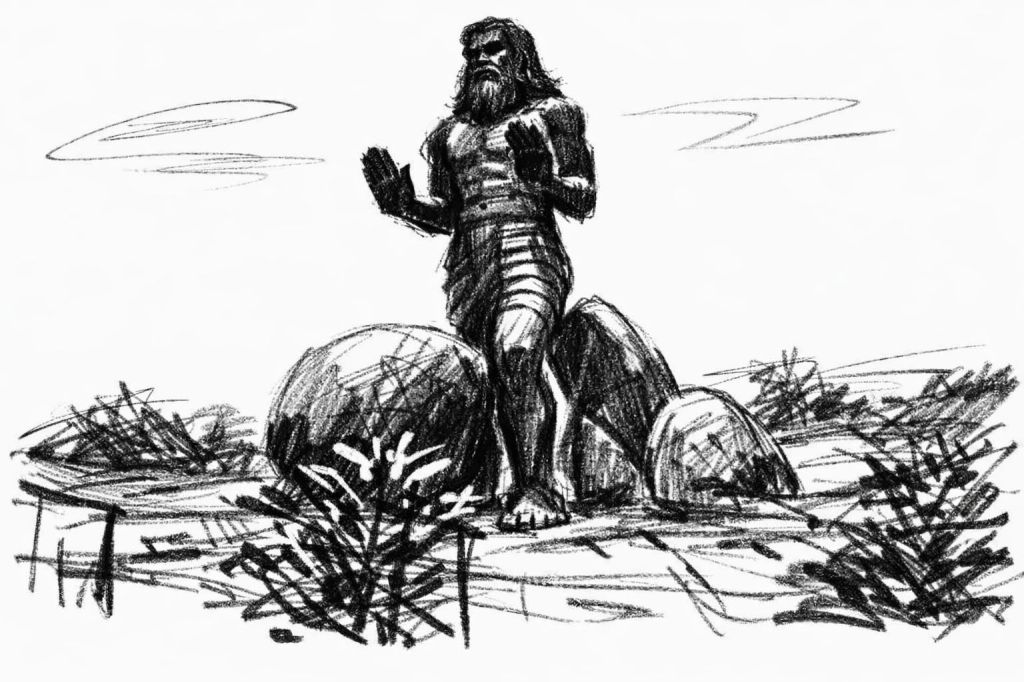
His daily routine was as precise as temple worship: climb the hill, release the stone, walk for rice but never alms, cook a single pot of porridge, eat a handful, offer the rest to nature. Nothing was stored. Nothing carried forward. In an age obsessed with accumulation, he practised renunciation through simplicity.
One of the most powerful myths tied to Branthan comes alive in the imagination when you visit the rocky clearings and wind-swept spaces near the hill. Here tradition says he once cooked his evening meal in a cremation ground. That night, Chudala Bhagavathy, the fierce Goddess who roams the burning grounds arrived with her attendants to perform her cosmic dance and carry the departing souls. But a human was sitting there being calm, unmoving, unafraid. She took her most terrifying form with flames arising around, spirts singing & circling, night howling but Naranathu Branthan did not even look up. When she finally asked why he was not afraid, his answer became immortal: “Only one who has desires can be frightened.” Bound by divine law, the Goddess had to offer him a boon. He did not ask for wealth or food, he asked for one extra day of life which was denied. He then asked for a day less which was again rejected as it affects the cosmic order. Having been denied & nothing to ask, a very drusterated Pranthan asked the Goddess to shift the limp from his left to right leg so that he can live out the rest of life with a different prespective. The thought from this myth is “Suffering cannot be removed, It can only be carried differently.”
Many parallel legends survive in oral tradition: that he freed a disciple from blind devotion, he made a sick man realise that truth heals more than medicine, he granted liberation to his sister Karakkal Amma from the burden of eternal youth. Each story dismantles ego, dependency and illusion.
The climb to Rairanalloor is steep, rhythmic, almost meditative and tradition says Branthan once sat here on a swing when Goddess Jagdamba appeared before him. She took nine steps toward him and those nine sacred steps are still worshipped in the temple not as stone but as the path between seeker and divine. Around the hill you encounter places that feel less like historical remains and more like echoes of a yogic life: the Kanjiram Tree with Chains where Branthan is believed to have been bound before attaining moksha not as punishment, but as liberation from the body. The sweet water wells scattered across the rocky terrain, said to have been dug by him. The meditation caves and ofcourse his statue amidst boulders in yogic stillness where the madman transformed into a rishi.
Kerala’s Parayi Petta Panthirukulam is the story of the twelve children of Vararuchi each represent a path of destiny. Among them, Branthan stands for: the courage to be misunderstood, the rejection of social approval, the discipline of inner freedom He lived outside society so that society could see itself.
As a pilgrim or traveller reaching the summit today you realise why he chose hills, they are places where burdens roll away, pilgrims sit in silence not out of ritual but reflection, because here mythology is not about gods alone but it is about the human mind and its liberation. It is believed Naranathu Branthan attained liberation here. Not in a hermitage, not in a palace, but on bare rock under open sky. A fitting end for a man who owned nothing, carried nothing and left behind everything except wisdom. The story and life of Naranathu Pranthan & his 11 siblings are beautifully narrated in the epic book Aithihyamala by Kottarathil Sankunni and is in many ways the basis of the Kerala way of life.
 STORIES by HEARITAGE
Leave a comment