Place of Interest: Temple <> District: Kannur
Some places are not built with stone or by humans but by divine ideas. Hidden deep within the lush forests of Kerala divided by the flowing Bavali river lies a temple like no other, the Kottiyoor Temple locally known as Thruchherumana kshethram or Vadakkeshwaram. But to devotees and travelers, it is lovingly called the Akkare–Ikkare Kshethram: the temple of “myths”.
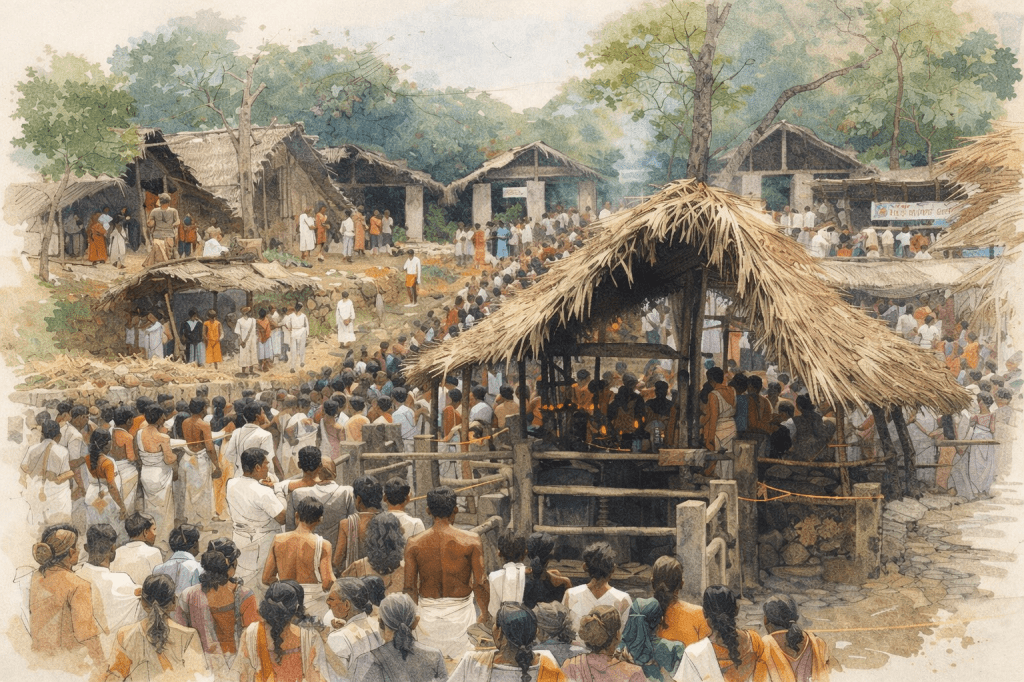
On the western bank of the river stands the permanent shrine, Ikkare Kottiyoor with its sanctity and age-old traditions but across the waters on the eastern bank is something far more unusual, the Akkare Kottiyoor yagna site. Here, no walls rise and no sanctum stands, for it is forbidden to build anything permanent. This sacred ground is meant to remain simple, echoing the life of hermits who once bore witness to a tragedy etched forever in Hindu mythology: the self-immolation of Goddess Sati.
Unlike other temples that bring crowds of devotees year-round, Kottiyoor is a place of silence for most of the year. Its doors open only for 27 days during the Vishakha month (May–June) when the annual festival transforms the quiet grove into a sea of pilgrims. Beyond those days, no rituals take place and no devotees are allowed as this is the very ground where the Daksha Yaga took place.
Daksha, a Prajapati and son of Brahma had a daughter Sati who was in awe of Shiva & in love asked him to marry her. Lord Shiva at first did not approve of it but later accepted the proposal from Devi Sati & married her. Daksha, disapproved of his daughter marriage to Lord Shiva who was the ascetic hermit and showered many insults at Lord Shiva whenever the opportunity came. When Daksha conducted a grand yagna he invited every god and sage except Shiva. At the Yagna, Sati listened as her father ridiculing Shiva for his actions and way of life. As this continued, Sati unable to bear the humiliation threw herself into the sacrificial fire. This news shattered Shiva & consumed with grief & anger manifested as Veerabhadra, stormed the yagnashala and unleashed his wrath in the cosmic tandava dance. In his fury, he cut off Daksha’s head and by opening his third eye reduced the whole yagashala in the forest to ashes. It was when Lord Vishnu embraced Shiva in the divine Aalinganam that his rage subsided. Later, Shiva restored Daksha to life giving him the head of a goat and withdrew into meditation upon the request of all the Gods. Lord Shiva then assumed the form of a Swayambhoo lingam & vanished to his abode in Kailasa.
The origins of Kottiyoor is from the time when a swayambhu lingam appeared along the riverbank. Today, at Akkare Kottiyoor the swayambhu lingam rests near the very spot where Sati immolated herself. The most unique offering here is the Aalinganam Pushpanjali, a floral ritual that recreates Vishnu’s embrace of Shiva, a moment of divine reconciliation that saved the world from destruction.
Kottiyoor is unlike any other temple because it unites the three great streams of Hinduism; Shaivism, Vaishnavism and Shaktism within its rituals. It is also the only place where devotees can worship Devi Sati, a rare honor in Hindu tradition. For pilgrims, one visit during the Vishakha festival is said to be a glimpse into the world of the ancients to a time when gods walked among men and myth was lived as truth. The temple has also been associated with the Kottayam royal family whose descendants still hold key ritual roles during the festival. The very name Kottiyoor is believed to mean “the land where all the gods assembled” (Kooti–uru), a reminder of the divine presence said to bless the site. Here, the Hindu Trinity of Shiva, Vishnu and Brahma are believed to reside. Goddess Parvathy in her fierce form as Kali once promised sage Parasurama that Kaliyuga itself would never darken this sacred grove.
For tourists and pilgrims, Kottiyoor is not just a temple visit, it is an experience. The journey takes you through winding forest paths, the wild chirps and the calmness of the Bavali river. There are no towering gopurams or ornate stone carvings here but something far more profound, the stillness of nature, the echo of legends and the living fire of faith. If you find yourself in Kerala during the Vishakha month, step into this sacred grove to witness rituals that have been preserved for centuries. Watch as devotees cross the river barefoot, offerings in hand, as if time itself has slowed and remember: you are standing on the very ground where love, loss, fury and divine grace once shaped the course of mythology.
Story No: 05


Leave a Reply