As you walk along the coastline of Kappad Beach in Kozhikode you’ll find more than just sand and sea, you’ll find the place where the world changed forever. A simple stone memorial marks 20 May 1498, the day Vasco da Gama stepped onto Indian soil. But the story of this shore is far more layered than the textbooks reveal.
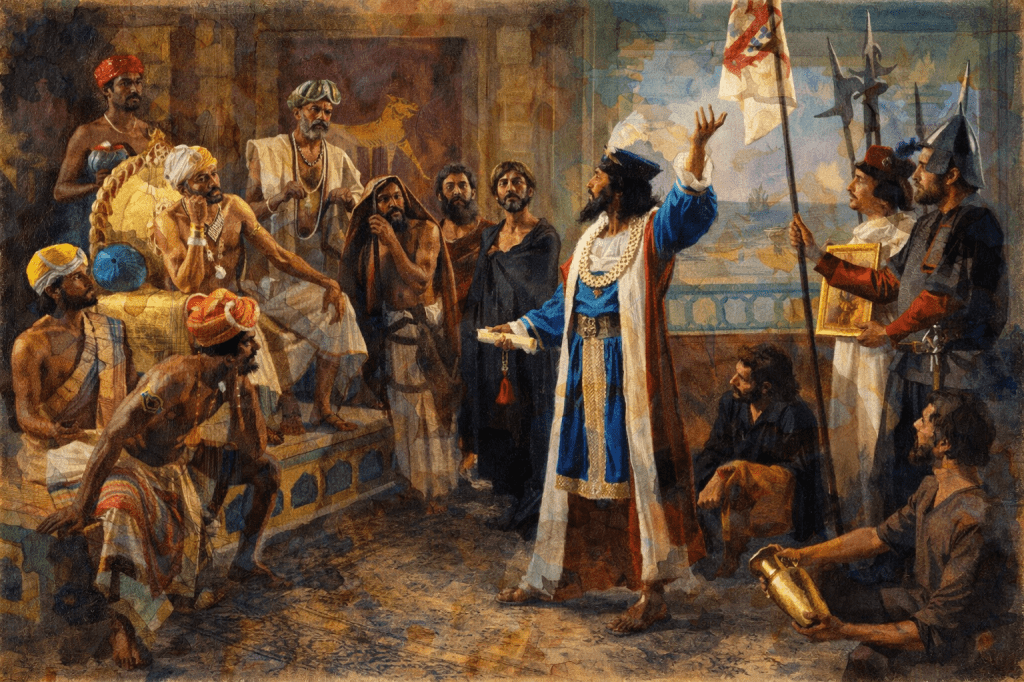
Long before the Portuguese arrived, Calicut was a thriving international port trading with Arab merchants and Chinese sailors. Spices from Kerala were world-famous and the Zamorin of Calicut welcomed traders from every corner of the seas. So, was Vasco da Gama the “discoverer” of India? Not exactly. He was the first European to arrive by sea but he followed routes known to Arab and Indian navigators guided by local pilots supplied by African kings.
Gama sailed into Kappad with three massive ships, São Rafael, São Gabriel and São Miguel which was a sight that stunned local fishermen. Their arrival was unusual, not just for the season of rough seas but for their strange appearance, language and dress. Gama intended to dock at Kodungallur but fate brought him right here to Kappad or how it was called then, Kappakadavu. Gama came unnaounced and with a large fleet but the Zamorin of Calicut extended legendary hospitality as always & Gama with his men were escorted in a grand land and canal procession led by trumpets and gunshots. Game accompanied by 3,000 armed Nair soldiers was taken to the Bhagavathy Temple for auspicious ceremony & finally welcomed into the royal palace glittering with gold, silver & timber opulence.
Gama is said to have offered gifts like cloth, hats, corals, sugar but no gold or precious items. Local traders and Arabs were suspicious as they thought, “Is he a merchant… or a pirate?” Still, the Zamorin traded spices in return for the gifts. When taxes were requested (as per custom), Gama grew angry and seized his goods from locals by force, he left in haste to Portugal. He was received at the Porto port with a hero’s welcome. The goods he brought back were worth 60 times the cost of the expedition!
Gama after his first voyage returned two more times. His second voyage sparked a century-long conflict between the Portuguese, Zamorins and Arab traders. On his third, he died in Kochi in 1524. His body was laid to rest at St. Francis Church in Kochi before being taken back to Portugal in later years leaving behind his tomb inside the church.
Stand on this shoreline and you can almost hear the creaking masts of distant ships and the trumpets of a royal procession. Kappad is not just a beach, it’s a turning point in world history. Whether we celebrate or critique his legacy, Vasco da Gama put Calicut on the world map, opening the door to an age of global trade, exploration and empire.
 STORIES by HEARITAGE
Leave a comment