Place of Interest: Site <> District: Kozhikode
As you walk along the coastline of Kappad Beach in Kozhikode you’ll find more than just sand and sea, you’ll find the place where the world changed forever. A simple stone memorial marks 20 May 1498, the day Vasco da Gama stepped onto Indian soil. But the story of this shore is far more layered than the textbooks reveal.
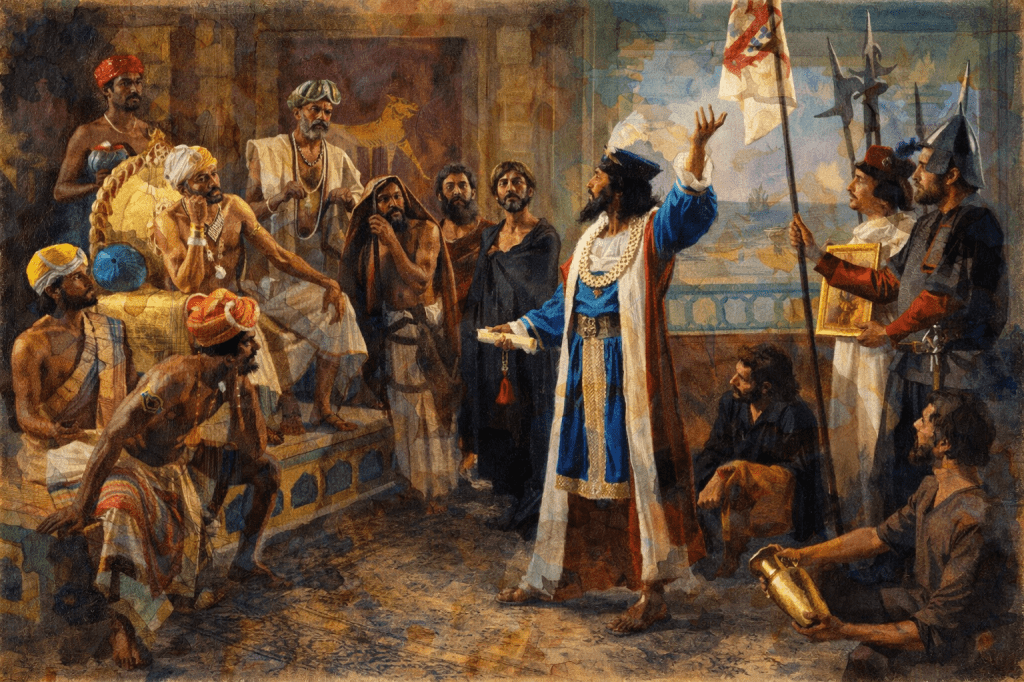
Long before the Portuguese arrived, Calicut was a thriving international port trading with Arab merchants and Chinese sailors. Spices from Kerala were world-famous and the Zamorin of Calicut welcomed traders from every corner of the seas. So, was Vasco da Gama the “discoverer” of India? Not exactly. He was the first European to arrive by sea but he followed routes known to Arab and Indian navigators guided by local pilots supplied by African kings.
In 1495, King Manuel of Portugal ascended the Portuguese throne and he was eager to acquire the wealth of Asia particularly spices such as pepper, cinnamon and cloves controlled largely by Muslim traders and their middlemen. After the initial attempt by Christopher Columbus had failed to reach Asia, King Manuel revived Portugal’s eastern strategy. To lead the expedition, he chose Vasco da Gama who was an unexpected choice as he did not possess extensive experience on long ocean voyages. Nevertheless, he was entrusted with a mission that would change world history. On 8 July 1497, Da Gama departed from Lisbon with a fleet of four ships and 170 crew members. The expedition also carried stone pillars to be erected at newly discovered locations as markers of Portuguese presence. To avoid the mighty currents of the African peninsula, Da Gama took a detour and eventually brought the fleet around the southern tip of Africa. The fleet rounded the Cape of Good Hope and anchored at Mossel Bay for a short duration. Further he sailed to Mozambique but Da Gama stayed here for nearly a month as many sailors were suffering from scurvy, resulting in large group of men dying which slowed down his journey. During this period, he met Muslim merchants and Arab traders who had long dominated Indian Peninsula commerce to understand how trade functions between Africa, Arabia and India. The expedition then moved north to Mombasa before reaching Malindi where Vasco Da Gama obtained the services of an experienced navigator, often believed to have been a Gujarati merchant who convinced Da Gama to sail to Calicut rather than Muziris. He knew the monsoon winds and the sea routes across the Arabian Sea. Guided by this advise, the fleet sailed across the open ocean toward the Malabar Coast of India.
In May 1498, Da Gama sailed into coast of Panthalayani with three massive ships, São Rafael, São Gabriel and São Miguel which was a sight that stunned local fishermen. He along with his crew landed on the Kappad port in smaller boats. Da Gama was received by the ruler of Calicut, the powerful Zamorin. Calicut was one of the most important trading ports in the Indian Ocean world where merchants from Arabia, Persia, Africa and Southeast Asia gathered to trade spices and luxury goods. For Da Gama, this was also a profound cultural encounter as he had never interacted with Hindus before and was unfamiliar with their religious practices and social customs. Gama is said to have offered gifts like cloth, hats, corals, sugar but no gold or precious items. Local traders and Arabs were suspicious as they thought, “Is he a merchant… or a pirate?” Still, the Zamorin traded spices in return for the gifts.
The relations were tense especially due to Da Gama’s hostility toward Muslim traders & no formal trade treaty was concluded with the king. But still the Zamorin allowed him to explore the markets and observe the thriving spice trade. Da Gama remained in Calicut for about three months studying the trading process, knowing about commodities available for trade and gathering goods to carry back to Portugal. When preparing to depart, local officials demanded duties on the goods he had acquired which to Gama was offensive & left Calicut with a sense of resentment and promised to return with greater power.
The return journey proved even more dangerous than the initial voyage for Gama. Not paying heed to usual thought and overcome by anger & ego he began sailing during the monsoon season when the Arabian Sea becomes extremely turbulent. His fleet moved northward along the Indian coast, passing regions such as Goa before attempting the long crossing back toward East Africa. Violent storms, harsh winds and disease devastated the crew. Many sailors who had already weakened by scurvy died during the journey. By the time the expedition reached the region of Mogadishu, nearly half the crew had perished. To reduce operational costs and because there were not enough sailors left to manage all ships, da Gama ordered the burning of the vessel São Rafael, this also was a move in frustration as it took him 3 months to find land. The surviving ships sold the goods in the coast, rounded the Cape of Good Hope again and finally returned to Portugal. When da Gama reached Lisbon in 1499, only about 50 crew members of the original 170 were still alive. Despite the immense human cost, the voyage was considered a monumental success. Portugal had finally discovered a direct sea route between Europe and India, opening the door to a new era of maritime trade and imperial expansion. King Manuel honored Vasco da Gama with the noble title “Dom”, along with estates, valuable gifts and an annual pension of 1,000 cruzados.
Vasco Da Gama became a celebrated merchant in Portugal & his exploits helped King Manuel fund another expedition under the command of champion navigator Pedro Álvares Cabral who followed the route of Da Gama and returned with many riches. The second voyage of Da Gama started in 1502 after he became an admiral & is possibly the most blood soaked voyage. He knew the hostilities of the Arabs at the sea and the unfavorable reception by the Zamorins at the coast so he set his target for Cannanore which was ruled by the Kolathiris who were at battle with the Zamorin to control the Malabar trade. Before reaching Kannur he is said to have rounded off a large ship bound for Mecca for pilgrimage and looted the riches from the ship, then burned down the party at sea. This single incident made him the most hated and a big adversary on the Arabian Sea. The burning down of the ship in many ways was a signal to the Arabs that the Portuguese will go to any extent to control the trade. Before arriving at Cannanore, he stopped at Goa to establish a small colony for his men. The Kolathiri welcomed Da Gama and worked with him to attack the Zamorin from the sea, destroy trade routes and sink ships. The only adversary at sea for the Portugues who could ward off these attacks were the brave Kunjali Marakkar and his fleet who kept them under check and inflicted many calamities by way of night attacks and guerrilla tactics at sea. With the Kolathiri at his side, Vasco Da Gama needed another ally on the coast and the Cochin Raja proved to be that. Before leaving back to Portugal, Da Gama signs treaty with both Kolathiri in the North & Cochin Raja in the South leaving the Zamorin in a state of siege. Upon return at Lisbon, he expected a large reward but the King had lost interest in his expedition and ordered Da Gama not to undertake anymore voyages. This decision greatly affected the Admiral as he only a merchant advising other seafarers about the route to East.
After the death of King Manuel, King John III took the throne and Da Gama convinced him to again send him on an expedition to east. With a title of Viceroy this time, Da Gama sailed to Malabar for the third voyage in 1524. He arrived in Goa and started working to tighten the control of Portuguese on the Arabian coast. He sailed countless times along the coast to Cochin to ascertain his dominance and presence on the coast. His health though was suffering and on 24th December 1524 died at Cochin in his tent. The Cochin Raja gave a state funeral to him and his body was laid to rest in the St Francis Church cemetery. The news of his death reached Portugal and a large mourning in his town was allowed by the King to remember the man who sailed across half the globe to find the fastest sea route and make Portugal known to the world. His remains were later taken to Lisbon in 1538 and the tomb was placed within the church as a tribute to a unknown navigator who died as a world famous viceroy of the Portugal kingdom.
Though his arrival was in Kozhikode, the only place one can still remember Da Gama is Kappad. Stand on this shoreline and you can almost hear the creaking masts of distant ships and the trumpets of a royal procession. Kappad is not just a beach, it’s a turning point in world history. Whether we celebrate or critique his legacy, Vasco da Gama put Calicut on the world map, opening the door to an age of global trade, exploration and empire.
Story No: 10


Leave a Reply