If there is one place in Thalassery where time holds its breath, it is the Thalassery Fort, a majestic laterite monument that has watched over this coastal town for more than three centuries. Square in shape, strong in spirit, and decorated with fading murals, the fort stands like a seasoned storyteller, its weathered walls narrating tales of traders, kings, armies, and empire.
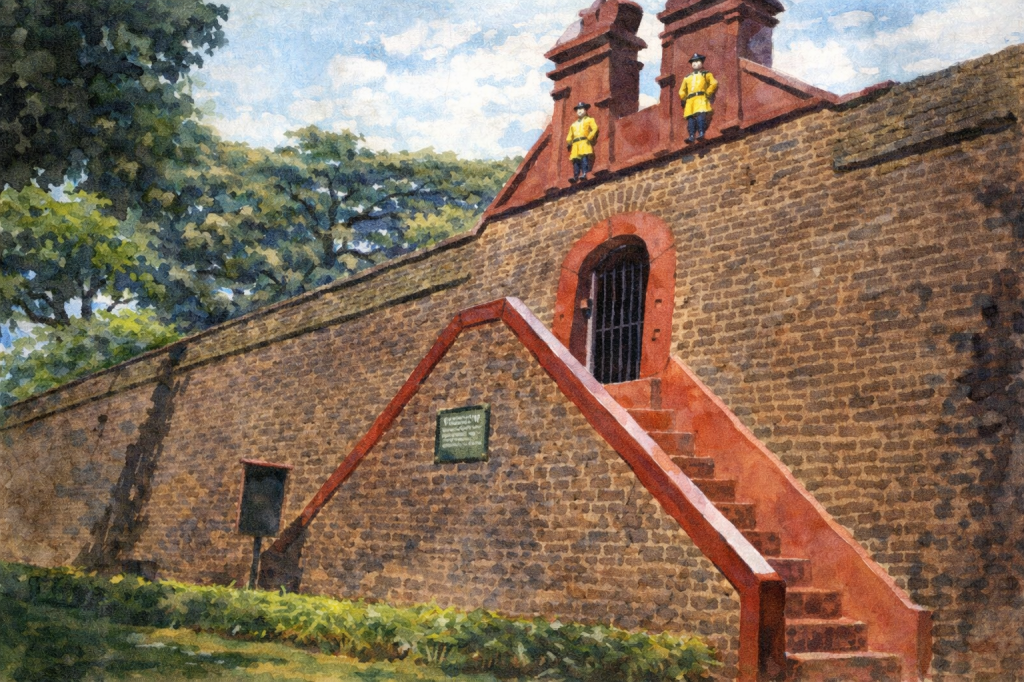
Built in 1708 by the British East India Company with the approval of the Kolathiri Rajas, this fort rose from a moment of conflict and necessity. The British had set up a factory in Thalassery, but its presence angered the local Nair chieftains, who resented the establishment of such a structure without their consent. Attack after attack made work impossible, and the British decided they needed a stronghold both for protection and for the authority they sought to imprint upon Malabar. What followed was a brilliant feat of engineering. The fort was constructed using a mixture of quicklime, egg white, and sugar, a traditional binding formula that gave the walls their remarkable strength. Walking through the arched entrance today, it is easy to see why this fort still stands tall after three hundred years. Its carved wooden doors and thick ramparts have survived monsoons, invasions, and political upheavals.
By 1776, the fort had evolved beyond a defensive outpost as it became the administrative headquarters of the British in Malabar, a role it continued to play even after India gained independence. At the entrance, you’ll notice narrow steps climbing toward a small doorway. This cleverly designed feature was meant to prevent large groups of enemies from storming in a subtle reminder of the tension and uncertainty that once surrounded these walls. The remains of an old lighthouse stand within the fort, once used to guide mariners to the harbor, and history also tells us that the British operated a mint here, producing their local currency known as the pagoda. Inside the fort lies one of its most intriguing secrets: a network of underground tunnels that once linked the fort to the sea. These tunnels were used to store and transport highly valuable goods like pepper, cardamom, and spices that made Malabar globally famous. Although the two major tunnels remain sealed today, just knowing they exist adds a compelling air of mystery to the experience of exploring the fort.
The most dramatic story associated with Thalassery Fort unfolded when Kerala Varma Pazhassi Raja, the Lion of Kerala, met Lord Wellesley here. The meeting was presented as an attempt at peace, but in reality, the British had planned to arrest the king. Their scheme unraveled the moment they saw Pazhassi arrive with his loyal warriors and the formidable Kurichiya bowmen. Outnumbered in their own fort, the British officers could do little but watch as their carefully laid trap dissolved into embarrassment, a moment that remains a proud tale in local history.
Through the decades, the fort survived numerous threats. The French tried repeatedly to capture it for strategic control over Malabar but failed, eventually turning their attention to nearby Mahe, which they captured in 1725. Later, Hyder Ali too was unable to seize the fort during his campaigns across the region. His son, Tipu Sultan, however succeeded for a time, handing over control to the Arrakkal family. But after Tipu’s defeat in the Anglo-Mysore War of 1792, the British reclaimed the fort as Malabar came back under their authority.
Today, the Thalassery Fort remains one of the finest colonial-era structures in Kerala. As you stroll through its breezy lawns and admire its unaltered star-shaped ramparts, you’ll feel as though you’ve stepped into a living museum. The fort sits proudly in the heritage heart of Thalassery, an unmistakable landmark that stands not merely as a monument, but as a witness to centuries of power, rivalry, trade, and resilience.
 STORIES by HEARITAGE
Leave a comment