Place of Interest: Temple <> District: Kannur
Nestled in the serene town of Thaliparamba in Kerala stands one of India’s most ancient and spiritually powerful temples, the Rajarajeswara Temple which is dedicated to Lord Shiva. One among the 108 Shiva temples consecrated by Lord Parasurama, this temple is not only a marvel of architecture but also a living chronicle of divine legends, royal patronage, and timeless devotion.
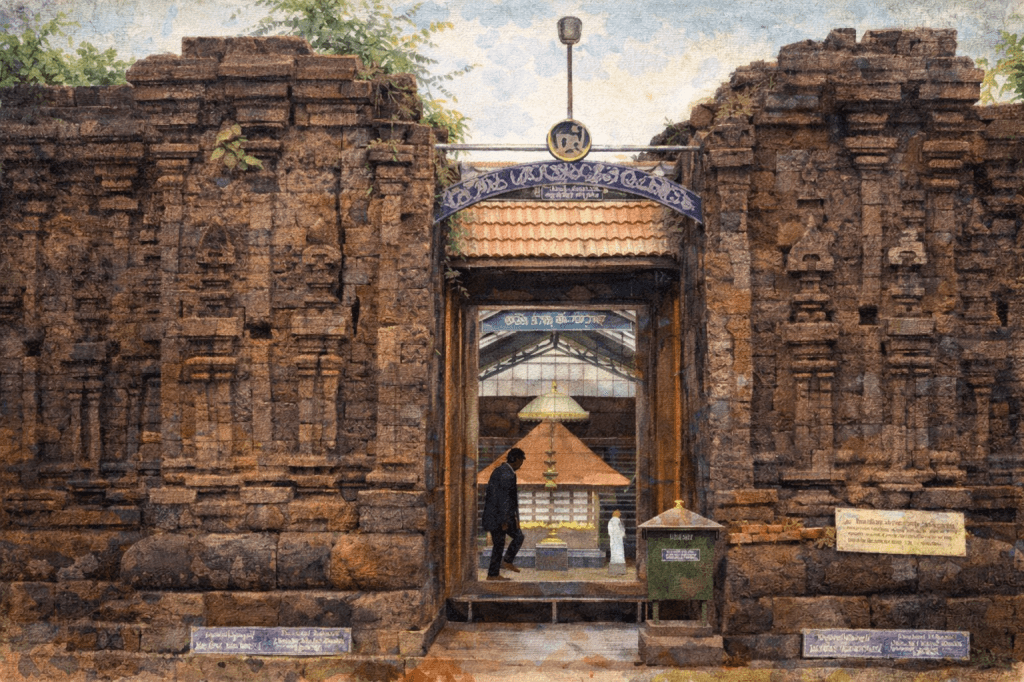
The temple’s towering Shikhara rises high into the sky, earning it the distinction of having the tallest temple tower of its era. According to legend, the temple began as a humble shrine with a simple Namaskara Mandapam which was later completed to its grand form by King Raja Raja Chola I in the early 11th century.
Unlike most South Indian temples, the Rajarajeswara Temple has no flagstaff (Kodimaram). The reason is deeply symbolic as the presiding deity here is revered not as a mere god but as the Lord Supreme, the Emperor Himself, in the form of Sadashiva. Here, there are no annual festivals, no dhara rituals to calm the deity, and the Lord never leaves His sanctum has a rare distinction among Shiva temples. The energy that fills the sanctum is said to be so transcendental that it surpasses the ordinary realm of devotion.
The temple is steeped in ancient lore. It is believed that Lord Rama himself stopped here on his return from Lanka to offer prayers to Lord Shiva. The spot before the sanctum, the Namaskara Mandapam, is thus considered so sacred that no devotee is permitted to enter it. The temple’s spiritual strength is also sought for Prasna, an age-old astrological ceremony performed to resolve issues concerning temples across South India. This divine consultation takes place on a raised platform within the temple complex, following traditions that date back centuries.
The Shivalingam enshrined here has an extraordinary legend. The Lingam is said to be several thousand years old & has a legend behind its appearance. Shanaka & the other sons of Brahma churned the discs of sun to reduce its heat & with the dust that emanated from this was used by Lord Shiva to create three Jyotirlingas and were gifted to Goddess Parvathy. In the Treta Yuga, Sage Mandhata prayed to Lord Shiva & happy with his penance told Goddess Parvathy to present him one of the Jyotirlingas. The sage was instructed to install the Lingam in a place untouched by death of any creature or never had any dead body fallen on it, a sacred place of pure life. After long searching, he found a tiny patch of land no bigger than a plate (Thalam) where no death had occurred. The Lingam was installed there, and the place came to be known as Thaliparamba or Thalaparambu, the plate on land. At the end of Treta Yuga, the lingam disappeared from the place as it sank into the earth. Post the Treta Yuga, Muchukundan who was son of Mandhata again penanced & acquired the second lingam from Goddess Parvathy which he placed in the same place as the earlier lingam. Over the ages, this second Lingam also sank into the earth. The third lingam was installed by King Shathasoman with the guidance of Sage Agastya who conducted 12 and 1/2 namaskarams & was made permanent by Lord Shiva Himself. Even today, devotees perform twelve and a half prostrations before the sanctum, honoring this ancient act of divine grace.
It was Lord Parasurama, aided by the celestial architect Vishwakarma, who reconstructed the present temple. The sacred ghee lamp lit by Sage Agastya still burns eternally within, symbolizing the undying flame of devotion.
Among the temple’s many unique customs, one stands out: women are permitted entry only in the evenings. While men can visit at any time, women may enter after the Athazha Pooja, when the Lord assumes his form as a Grihastha (householder) with Goddess Parvathy and their sons, Ganesha and Subramanya. It is believed that during this time, Lord Shiva is most benevolent and gracious, so the perfect moment for women to offer their prayers. The only exception is Maha Shivratri, when women can enter even during the day.
Another captivating legend surrounds a sealed western door within the temple. The legend for this has a unique story attached with it. Devi Mahalakshmi came to the temple to pay obeisance to Rajarajeswara. Lord Shiva wanted the goddess to bestow all the prosperity to the temple but could not ask for it, so he assumed the form of Lord Vishnu. Goddess Mahalakshmi on seeing her Lord sat next to him on the seat of Goddess Parvathy. Soon, Shiva assumed his own form & realising her mistake Goddess Mahalakshmi hurried to exit the gate when the Bhootaganas or servants of Lord Shiva closed the door. When Lord Vishnu came looking for his consort, the Bhutaganas pleaded with him to allow Mahalakshmi to stay in the temple for which Lord Vishnu obliged. Thus the door on the west side of the Nalambalam at the temple is permanently kept shut to not allow Mahalakshmi leave the temple & thus keeping the prosperity for ever.
Beyond its spiritual aura, the Rajarajeswara Temple is also a center of art and scholarship. The temple has long been a venue for Chakyar Koothu and Koodiyattam, Kerala’s ancient temple arts. The most esteemed honor a scholar or artist can receive, the Veera Sringala (Golden Bracelet) is awarded here, recognizing outstanding contributions to knowledge and culture. Architecturally, the temple features a two-tier pyramidal structure, with thick granite walls that have withstood centuries of change and invasion. Even during Tipu Sultan’s campaigns, when many temples fell to destruction, the local Muslim community united to protect this sacred site, a shining example of Kerala’s harmony and shared heritage.
Standing in the temple courtyard, surrounded by the fragrance of oil lamps and the rhythm of temple bells, one feels a rare tranquility as if time itself pauses in reverence. The Rajarajeswara Temple of Thaliparamba is not merely a place of worship; it is a living embodiment of faith, legend, and divine continuity. Every stone, every ritual, and every legend here speaks of a spiritual legacy that has survived the years blessing the land, its people, and all who come seeking the timeless grace of Lord Rajarajeswara.
Story No: 16


Leave a Reply