Place of Interest: Temple <> District: Thrissur
Dedicated to Lord Krishna in his most divine four-armed form, the very vision revealed to Vasudeva and Devaki in the prison of Kamsa is Guruvayur Temple which is revered as the Dwarka of the South. For countless devotees, it is Bhooloka Vaikunta, the earthly abode of Lord Vishnu where heaven feels just an arm’s reach away. To step into Guruvayur is to step into a living tapestry of faith woven over thousands of years.
The origins of Guruvayur vanish into myth, extending over 5000 years according to tradition. The story begins with King Sutapa and Queen Preshni whose intense devotion moved Lord Brahma to grant them a sacred idol of Lord Vishnu, an idol personally handed to him by the Lord. Delighted by their devotion, Vishnu granted them a divine boon to be born as His parents in three incarnations. Thus, the holy idol passed through three births as Sutapa and Preshni who became parents to Prishnigarbha, as Kashyapa and Aditi who became parents of Vamana and finally as Vasudeva and Devaki who became parents of Krishna. After Krishna’s departure from the world and the great submergence of Dwarka, the idol was rescued by Guru Brihaspathi and Vayu Deva. At Lord Shiva’s instruction who himself was in penance at the site consecrated the idol at the present location. From Guru and Vayu emerged the name Guruvayur, and the deity became known as Guruvayurappan, the Lord who came here with the blessings of the celestial Guru and the Wind God.
Though its earliest structure is lost to time, legends say that King Janamejaya angry with the death of his father Parikshit due to a snake bite conducted brutal snake sacrifice and this afflicted him with leprosy. Sage Atreya asked him to worship at Guruvayur for his cure that led to the first shrine being built here. During the dominance of Shaivite worship the temple fell into obscurity. As per a legend a Brahmin believed to be Lord Shiva himself in disguise blessed the temple for feeding him generously, restoring its prosperity for all ages to come. From the 16th century onward, Tamil literary works and devotional songs began referencing Guruvayur, marking its rise as a vibrant center of Krishna worship.
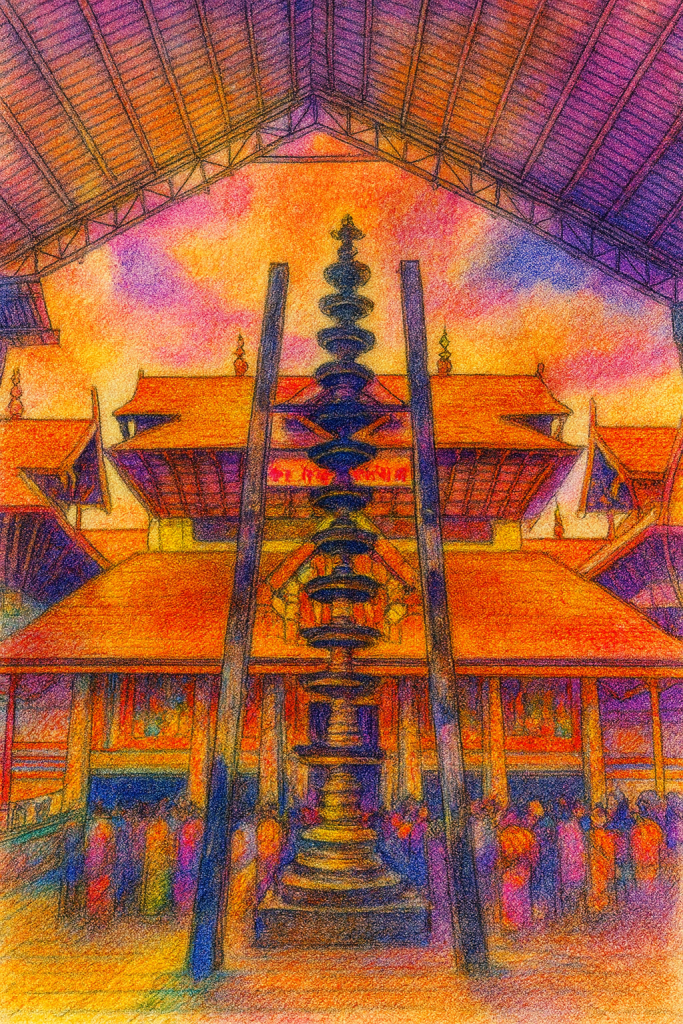
Guruvayur’s history is also a story of resilience. The Dutch set fire to the gopuram in the 1700s, Hyder Ali demanded ransom to spare the shrine. Tipu Sultan tried to destroy it but a sudden downpour miraculously extinguished the flames and fearing further attacks, devotees hid the sacred idol in a safe underground shrine until Tipu’s death. In the 19th and 20th centuries, the temple expanded with the Chuttambalam, Koothambalam the iconic Vilakkumadam and copper-sheeted roofing. A devastating fire in 1970 destroyed much of the structure, but the sanctum sanctorum remained untouched & a miracle that deepened the faith of millions. The temple was later rebuilt to the grandeur we witness today.
Guruvayur has long been a haven for saints poets, and philosophers. Melpathur Narayana Bhattathiri composed his Narayaneeyam here while Poonthanam Namboothiri found spiritual solace in this sacred space. Rituals at the temple follow traditions laid out by Adi Shankaracharya and the Chennas Namboothiri family has preserved these customs for centuries. The temple pond called rudratheertham is where Lord Shiva is said to have sat for penance & is an important part of the temple complex.
A special charm of Guruvayur is its elephants. The nearby Punathur Kotta houses the largest number of temple elephants in Asia. Among its list of inmates was the legendary Guruvayur Kesavan who still remains immortal in the hearts of devotees, an embodiment of devotion, discipline, and majestic grace. Such was the beauty that he became the first recipient of the title “Gajaraja” which is King of Elephants in 1973. Kesavan graced the festivals of Guruvayur for over 50 years with elance, grace and absolute authority. Such was his grace that no elephant before him or after him have been able to outshine his height & posture. Kesavan was a devout of the Lord and this showed in his last moments when on the Ekadasi festival day, the frail elephant felt tiredness, bend down to ask his mahout to remove the thidambu on him and prostrated before the beloved god to breathe his last. Even today on the Ekadasi festival day, elephants of the temple stand in front of his life size statue & garland as a tribute.
Elephants still form an integral part of temple rituals, festivals and processions including a special run called Aanayottam where elephants race with one another. Guruvayur’s calendar is filled with vibrant celebrations like Guruvayur Ekadasi which is the temple’s biggest festival, Vishu when devotees gather for the first darshan of the new year, Arattu that is the ceremonial bath of the deity, countless weddings performed in the temple premises believed to bring blessings to newlyweds. Each festival transforms the town into a glowing canvas of lamps, chants, and joyous devotion. A unique offering here is Thulabharam where devotees are weighed against offerings like pulses, sugar, bananas or even gold symbolizing surrender to the Lord.
To visit Guruvayur is to experience a softness of spirit that few places offer. The fragrance of sandalwood, the rhythmic chants, the glow of thousands of lamps and the sweet resonance of devotion create an atmosphere where time slows and the heart feels lighter. Every pilgrim who bows before Guruvayurappan carries home a part of His divine grace. For many, the journey becomes a turning point in life, a gentle reminder that faith, like the Lord Himself, is eternal.
Story No: 66


Leave a Reply