Place of Interest: Church <> District: Kannur
Thalassery, in North Kerala is a town where history lingers gently at every turn. Known for its fort, coastal trade and cultural firsts, the town also preserves memories of individuals whose lives quietly shaped the social conscience of Malabar. While the Thalassery Fort draws most visitors, a short walk behind it, reveals a far more understated yet deeply moving heritage site, the St John’s Anglican Chapel. Facing the Arabian Sea in dignified silence, this rustic Gothic chapel stands as a tribute to a man whose life became inseparable from the town he once reached by accident: Brennansaippu. At first glance, St. John’s Chapel appears modest, simple interiors, unadorned walls and restrained architecture when compared to the grand churches of Kerala. Yet pilgrims, travellers and history enthusiasts soon realise that the chapel’s true significance lies not in its scale, but in the life it commemorates.
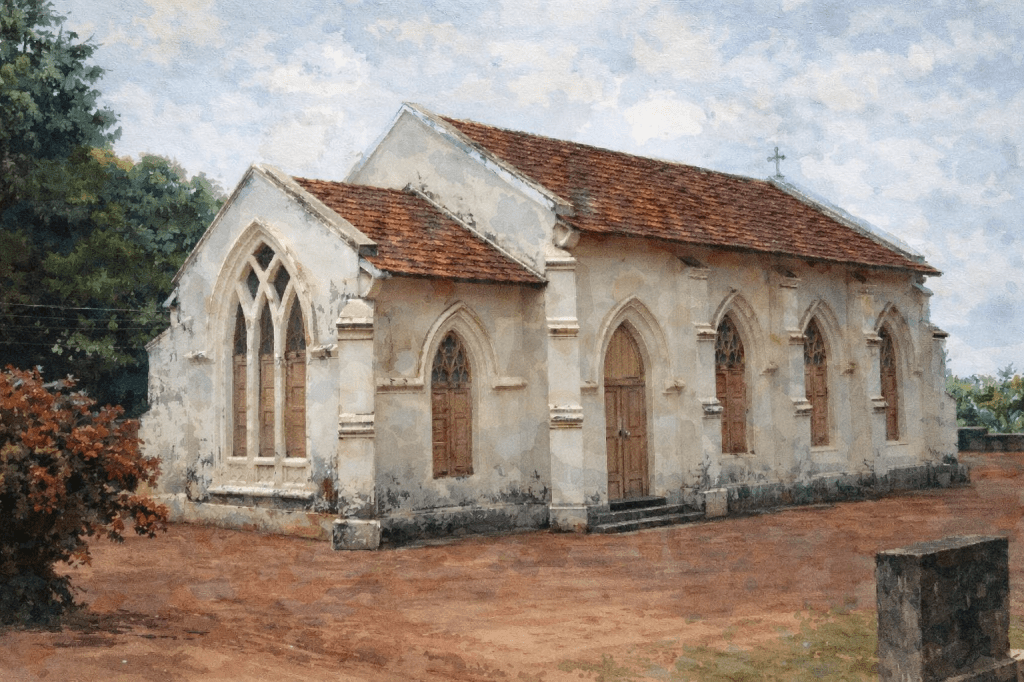
The structure seen today was built in 1869, a decade after Brennan’s death, replacing an earlier prayer hall that stood beside the old Dutch cemetery, which still exists within the compound. Brennan’s tomb lies here, bearing the inscription: “A sterling upright Englishman”, a rare and fitting epitaph that captures how deeply he was respected by the people of Thalassery. Edward Brennan was born in England and joined the East India Company at a young age, serving initially as a cabin boy.
Known for his gentle manners and humility even in his youth, his life took an unexpected turn during a stormy voyage along the Indian peninsula. The ship he was on was wrecked near the Kannur coast and Brennan narrowly escaped death, swimming ashore near Thalassery. Local fishermen rescued him and nursed him back to health. The traumatic incident instilled in him a deep fear of the sea and altered the course of his life forever. Choosing not to return to maritime service, Brennan remained in Thalassery. Recognising his diligence and integrity, the East India Company appointed him as Master Assistant at the Thalassery Port in 1824. What followed was a remarkable transformation from a British official to a beloved local figure.
Brennan immersed himself in the town, learned the local language and spent long hours conversing with dock workers, sailors and townsfolk along the port lanes. His empathy and generosity earned him the affectionate title “Brennan Saip”, a mark of respect rarely accorded to Europeans at the time. It was said that Thalassery had never known a foreigner as humble and approachable as him until much later, when Hermann Gundert arrived on Malabar’s shores. Through his interactions, Brennan became acutely aware of the social inequalities around him. Education, he believed was the most powerful means of upliftment. In 1846, after nearly two decades in Thalassery, he founded the Tellecherry Poor Fund, contributing an initial sum of 3,000 rupees from his own savings. The purpose was simple yet revolutionary, to provide support to the poor and needy without discrimination. Brennan personally oversaw the fund until his death in 1859.
For Thalassery, Edward Brennen was not just a man who stayed here, he was the person who changed the fortunes of this trading town. As Master Attendant of Thalassery Port, Edward Brennen made significant contributions to the town’s development as a key colonial trade hub on the Malabar Coast. Serving under the East India Company’s Bombay Marine Services, he oversaw vital port operations, including navigation systems, moorings and pilotage, ensuring safe and efficient maritime trade. His work supported the movement and storage of major export goods such as spices, timber and cereals, strengthening links between the port and inland regions like Wayanad and Coorg. By ensuring the upkeep of longstanding structures like the Custom House and coordinating logistics with nearby establishments such as Thalassery Fort, he helped integrate administrative, defensive and trade functions. Overall, his efforts were instrumental in transforming Thalassery into a stable and economically significant port town.
Though his greatest dream was to establish a free school for the people of Thalassery, Brennan could not realise it during his lifetime. Determined that his vision would live on, he bequeathed his entire savings amounting to more than one lakh rupees to the Poor Fund, instructing the trustees to start a free educational institution. Honouring his will, the trustees established a small school in the heart of Thalassery in 1861. With assistance from the Basel Mission, the school grew steadily and was upgraded to a high school by 1868. Education here was offered free of cost, just as Brennan had envisioned attracting students from across the region. The institution later faced decline when the Basel Mission withdrew due to financial constraints. However, Brennan’s legacy was far from forgotten. In 1894, with support from the Thalassery municipality and British authorities, the school was elevated to a college. Over time, it earned immense academic distinction, eventually relocating after Independence to a spacious campus at Dharmadam where it continues today as Government Brennan College as a living monument to one man’s lifelong belief in education as a social equaliser.
St. John’s Anglican Chapel, where Brennan rests, fell into neglect for a period but has since been carefully restored. Architecturally, it shares similarities with the English Church at Nadakkavu in Kozhikode, though in a more restrained form. Its quiet presence by the sea mirrors the life of the man it honours as unassuming, steadfast and deeply humane.
For anyone visiting Thalassery, St. John’s Chapel is not merely a heritage structure. It is a place to pause and reflect on how compassion can transcend nationality, power and time. In understanding Edward Brennan’s life, one understands Thalassery itself as a town shaped not only by rulers and traders, but by kindness, conviction and the enduring power of giving back.
Story No: 94


Leave a Reply