Along the shores of Malabar where the Arabian Sea has shaped both trade and thought lies Ponnani, a town that resonates deeply in Kerala’s social and spiritual memory. For centuries, Ponnani was not merely a port or a marketplace; it was a centre of learning, faith, and quiet resistance. At the heart of this legacy stands the Ponnani Valiya Juma Masjid, a monument that has illuminated minds and moulded generations for over five hundred years & was once the heart of the port of Tyndis. To walk into the Valiya Palli today is not just to enter a mosque, it is to step into a chapter of history where devotion met scholarship and where the response to oppression was not blind rage but enlightened understanding.
Ponnani’s identity was forged through centuries of maritime exchange with the Arab world. The very name of the town is believed to have evolved from the use of gold coins “pon-nanayam” paid by Arab traders for spices, timber and local produce. Long before European powers cast their shadows on Malabar, Arab merchants had made Ponnani a thriving port bringing with them not only commerce but also culture and belief. When Malik Dinar, the revered Islamic missionary arrived in Kerala it was the people of Ponnani and its surrounding villages who were among the earliest to embrace Islam. Over time the density of mosques and the depth of religious scholarship earned Ponnani the proud title of “Little Mecca of Malabar.” Though many mosques here predate the Valiya Juma Masjid, none would come to shape the destiny of Malabar Muslims quite like it.
The story of the Valiya Juma Masjid, built in 1519, is inseparable from the life of Sheikh Ali Ahmed Al Ma’baari, fondly remembered as Zainuddin Makhdum. A man of extraordinary intellect and spiritual depth, Makhdum was not content with local learning alone. He travelled to Mecca, immersing himself in theology before moving on to the famed Al-Azhar University in Egypt where he spent five years refining his scholarship. When he returned to Ponnani in the early 16th century, Malabar was no longer the land he had left behind. The Portuguese having arrived on the shores of Kerala were asserting dominance through violence, trade monopolies and religious intolerance. The Zamorin’s forces and the Marakkar naval chiefs were locked in continuous battles with the invaders and among the Mappila youth, anger and calls for armed jihad were growing louder. Makhdum sensed the danger of a generation driven by fury without direction. His response was revolutionary: jihad through knowledge.
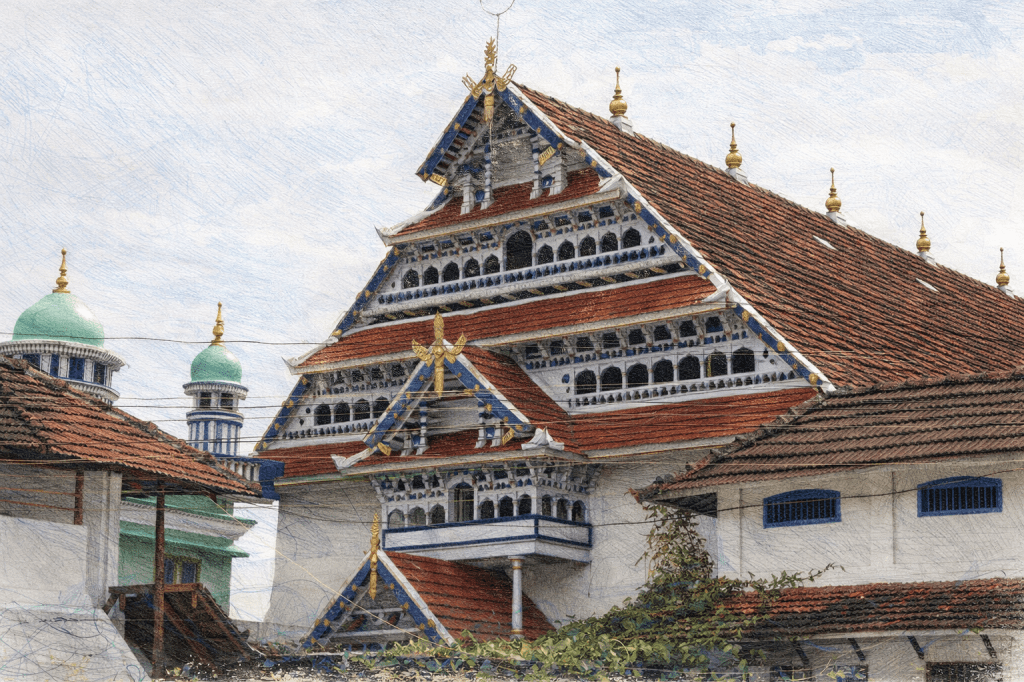
The Valiya Juma Masjid was conceived not merely as a place of prayer but as a university of faith. At a time when resources were scarce due to Portuguese control over trade building such a large structure seemed almost impossible. It was the Zamorin Raja who provided a solution by offering a single massive teak tree and assigning his most skilled carpenter, the royal Ashari, to the task. The entire wooden structure of the mosque with its gables, beams and ceilings was crafted from this single teak tree. As the mosque neared completion, the carpenter climbed to the roof & gazed westward, closed his eyes in deep contemplation and descended transformed. Moved by what he claimed to have seen and heard during the years of Makhdum’s teachings, he embraced Islam. Zainuddin Makhdum welcomed him and from that day he was known as Ashari Thangal. Ashari Thangal remained close to the mosque for the rest of his life becoming a respected figure in Ponnani. Today, his tomb lies within the mosque complex & beside that of Makhdum himself in a silent testimony to a spiritual journey born from knowledge.
Once the mosque was completed, Zainuddin Makhdum transformed it into the foremost centre of Islamic learning in Malabar. Students from across the region travelled to Ponnani to study theology, jurisprudence and ethics under his guidance. To recognise scholarly excellence, Makhdum introduced the unique tradition of Vilakkiruthal which is “sitting around the lamp.” Students who completed their studies would sit beside their teacher around a brass oil lamp receiving the title of Musaliyar marking them as masters of Islamic theology. The use of a lamp inside a mosque was uncommon at the time but Makhdum had adopted this practice from Al-Azhar blending global learning traditions with local customs. Remarkably, Vilakkiruthal continues even today making the Valiya Palli one of the rare institutions in the Islamic world where an unbroken academic tradition survives.
Makhdum was not a scholar confined to books, he was deeply engaged with the realities of his time. Recognising the destructive potential of unchecked rage, he worked tirelessly to foster unity between Nairs and Mappilas encouraging them to stand together against Portuguese oppression. During this turbulent period he composed “Tahrid Jihad,” a powerful poem that reframed resistance as a moral and collective duty, grounded in justice rather than vengeance. The poem helped mobilise support for the Zamorin and the Marakkars while maintaining the ethical framework of Islam. Zainuddin Makhdum’s intellectual lineage did not end with him. His grandson, Zainuddin Makhdum II was trained at the Valiya Palli and carried the torch of scholarship to North Malabar. A prolific writer and reformer, Makhdum II authored “Tuhfat al-Mujahideen,” a detailed chronicle of Portuguese atrocities and a call to defend faith and homeland. He also wrote “Fathul Mueen,” a seminal work on Islamic jurisprudence that remains influential across the Muslim world. Makhdum II spent much of his life in Chombal, and his tomb today lies at the Kunjhipalli Mosque near Mahe continuing the sacred geography of Malabar’s Islamic heritage. For generations, the Valiya Juma Masjid served as the spiritual and intellectual lighthouse of Malabar’s Mappila community. Long after the Makhdums, the mosque remained a venue for discussions, debates and resistance against British colonial rule. It was also a space where poets, scholars and reformers penned works that shaped Kerala’s Islamic thought.
Today, the Ponnani Valiya Juma Masjid stands beautifully restored with its ornate wooden gables glowing with quiet dignity. The annual nercha draws devotees from far and wide but the mosque’s greatest offering remains unchanged, education. Young students still gather here, learning under the same principles envisioned by Zainuddin Makhdum five centuries ago. For visitors, the mosque offers more than architectural beauty; it offers a lesson in how knowledge can be the most powerful form of resistance. To visit Ponnani is to understand why this town was called Little Mecca, and to stand within the Valiya Palli is to realise that faith, when guided by wisdom can illuminate even the darkest chapters of history.
 STORIES by HEARITAGE
Leave a comment