Place of Interest: Parks <> District: Thiruvananthapuram
The identity of modern Kerala is inseparably linked to the enlightened legacy of the Travancore kingdom. From the state emblem to administrative traditions, the imprint of Travancore continues to shape Kerala’s public life. What distinguishes the Travancore rulers from many of their contemporaries was their deep belief that a kingdom’s true prosperity lay not merely in wealth or military power, but in the intellectual, cultural and social well-being of its people. Among the many institutions born out of this progressive vision, the Thiruvananthapuram Zoo set within the historic Museum complex stands out as a remarkable example of how governance, education and conservation were thoughtfully interwoven.
When Swathi Thirunal Rama Varma assumed the throne in 1829, Travancore entered what historians often call its golden era. Though his reign lasted less than two decades, Swathi Thirunal’s influence on Kerala’s cultural and administrative landscape was profound. Celebrated as one of India’s greatest royal composers and a patron of arts, he was also a keen reformer who believed that exposure to knowledge whether through education, science or history was essential for an informed society. This philosophy led to the conception of public institutions that were rare in princely India at the time. Swathi Thirunal envisioned a museum that would allow ordinary people to encounter history, art and natural treasures that were otherwise confined to royal palaces. His personal interest in artefacts, manuscripts, musical instruments and even exotic animals naturally fed into this idea.
Like many rulers of his time, Swathi Thirunal maintained a royal menagerie, a collection of animals acquired through diplomatic exchanges, hunting expeditions and rescue efforts. These animals were not merely symbols of power; they fascinated visiting scholars and foreign dignitaries offering glimpses into distant lands and unfamiliar species. Gradually, the king realised that such wonders should not be restricted to elite audiences. He wanted his people to see, learn, and marvel to develop curiosity about the natural world. With the support of the British Resident General Cullen, plans were drawn up to establish a public museum complex that would eventually include animal enclosures. However, Swathi Thirunal’s untimely death in 1846 brought many of his ambitious projects to a halt. It was his successor and brother, Uthram Thirunal who revived and realised this dream. In 1855, a formal committee was constituted to develop the museum, and by 1857, the iconic Napier Museum opened its doors to the public.
While the museum displayed artefacts, gifts and stone edicts, it did not attract large crowds on its own. Recognising the need for a broader public appeal, Uthram Thirunal expanded the complex by incorporating a zoological garden. In 1859, the Thiruvananthapuram Zoo was officially opened making it the oldest zoo in India still functioning at its original location. Initially, the zoo resembled the menageries of the 19th century with animals housed in iron cages and enclosures within palace grounds. Yet even in its earliest form, it represented a revolutionary idea that wildlife and nature could be part of public education and leisure.
Post-Independence, attitudes toward wildlife changed significantly across the world and Thiruvananthapuram Zoo evolved with the times. The emphasis gradually shifted from mere exhibition to conservation, animal welfare and environmental education. A major milestone came in 1995 when the zoo underwent extensive modernisation. Traditional cages were replaced with open, naturalistic enclosures where animals live in habitats designed to mimic their native environments. Deep moats, trenches and landscaped barriers now separate visitors from animals, allowing safer and more humane viewing.
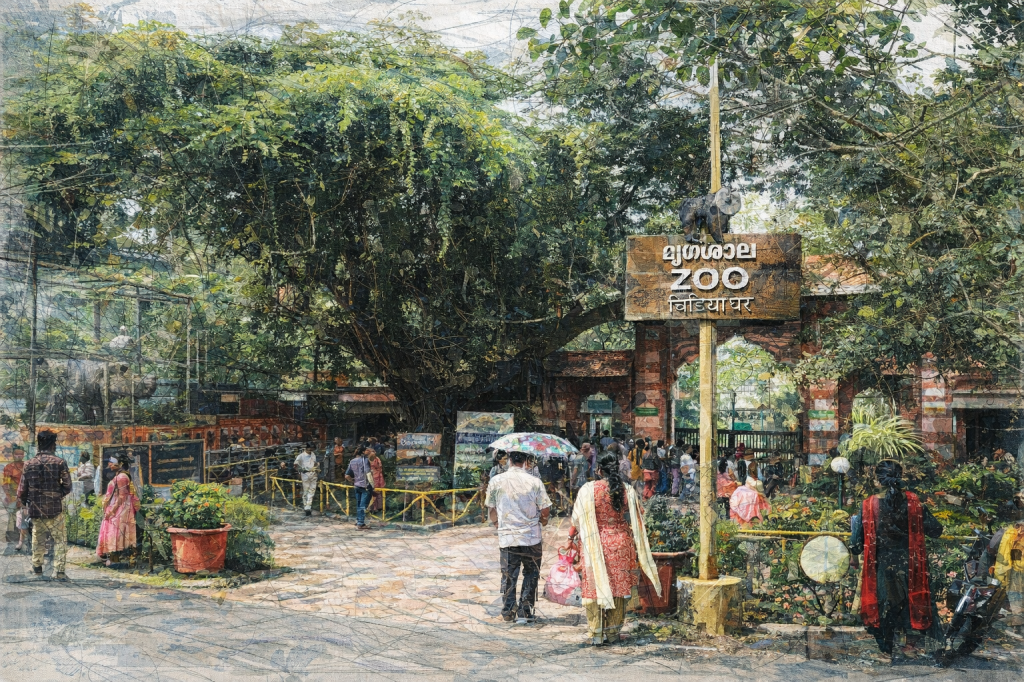
Spread over lush grounds in the heart of the city, the zoo today is as much a green oasis as it is a wildlife centre. Shaded pathways wind through expansive lawns, ponds and wooded stretches making a visit feel more like a walk through a forest than a conventional zoo. The collection includes large mammals such as lions, tigers, leopards, hyenas and deer. A well-planned bird enclosure with colourful and exotic species & dedicated reptile section showcasing snakes and other reptiles from different habitats. The enclosures prioritize animal comfort and natural behavior with clear signage and interpretative boards providing visitors with information about each species, reinforcing the zoo’s role as a centre for learning and awareness, especially for children and students.
Today, the Thiruvananthapuram Zoo remains the most visited section of the Museum complex. It is open on all days except Mondays with a modest entry fee. The zoo has adapted to modern needs by becoming senior-citizen and differently-abled friendly offering battery-operated vehicles for easy navigation across the expansive grounds. Within the same complex lies the Raja Ravi Varma Art Gallery, an essential stop for visitors. The gallery houses masterpieces by Kerala’s most celebrated painter making the complex a rare space where art, history and nature coexist seamlessly.
More than 160 years after it opened to the public, the Thiruvananthapuram Zoo continues to fulfil the dream first imagined by Swathi Thirunal as a space where people could engage with the natural world, learn from it and develop respect for all forms of life. It stands today not just as a recreational destination, but as a living reminder of Travancore’s progressive ideals where governance was rooted in empathy, education and inclusivity. For anyone visiting Thiruvananthapuram, the zoo is not merely a stop on an itinerary, it is a journey through history, reform and nature, all woven together in the quiet shade of centuries-old trees.
Story No: 122


Leave a Reply