Kerala’s tryst with Christianity is unlike that of any other land in the East. Long before European missionaries arrived on Indian shores, the message of Jesus Christ had already taken root here nurtured by trade routes, cultural openness and a society willing to absorb new ideas without erasing its own traditions. Central to this unique history is the arrival of St Thomas the Apostle in the 1st century AD whose preaching gave birth to one of the oldest Christian communities in the world – the St Thomas Christians locally known as the Nasranis. Among the many sacred spaces that narrate this remarkable journey, the Thumpamon Valiya Palli stands as a powerful testament to the endurance, faith and historical consciousness of the Nasrani community.
In the centuries following St Thomas’s martyrdom, Christianity in Kerala evolved in close interaction with West Asian churches. By the early medieval period these Christians came to be known as Nasranis, a name derived from “Nazrani,” followers of Jesus of Nazareth. Their spiritual and liturgical ties with the Syrian Church deeply influenced their worship, language and customs giving rise to what is now known as the Malankara Syrian Christian tradition. The Nasranis were not isolated religious groups; they were agriculturists, traders and community leaders who lived alongside Hindus and Jews, often enjoying royal patronage. They typically settled near forested foothills and fertile river basins where farming and inland trade could flourish. One such settlement that grew into immense importance was Thumpamon, in present-day Pathanamthitta district.
By the 8th century, Thumpamon had emerged as a major centre for Nasrani life in central Kerala. Oral traditions and church records state that the first church at Thumpamon was established in 717 AD making it one of the oldest Christian worship centres in the region. This early structure was modest with a simple prayer hall that reflected the humility and communal spirit of the early Nasranis. Over the next century, Christianity spread rapidly to neighbouring villages. Families migrated to Thumpamon seeking spiritual cohesion and social stability. By 900 AD, the original church could no longer accommodate the growing congregation prompting the Nasranis to rebuild a larger church on the same sacred ground. This act itself reflects an important Nasrani belief: continuity of faith was tied to continuity of sacred space.
The 11th century marked a turning point in Nasrani history. Nilackal, then a flourishing inland trade hub connecting the Western Ghats to coastal ports became home to several affluent Nasrani families. Their prosperity however attracted constant raids from dacoits and rival groups. As insecurity grew, life in Nilackal became untenable. It was during this turbulent period that history, faith and politics intersected. The Raja of Pandalam, facing similar threats decided to shift his capital from Nilackal to Pandalam. Along with him came a large migration of Nasranis, many of whom chose Thumpamon as their new home due to its already established Christian presence. This sudden influx transformed Thumpamon into a major Christian stronghold. Once again, the existing church proved insufficient. The Nasrani community, united by shared hardship and faith resolved to build a far grander church one that could serve as a spiritual anchor for generations to come.
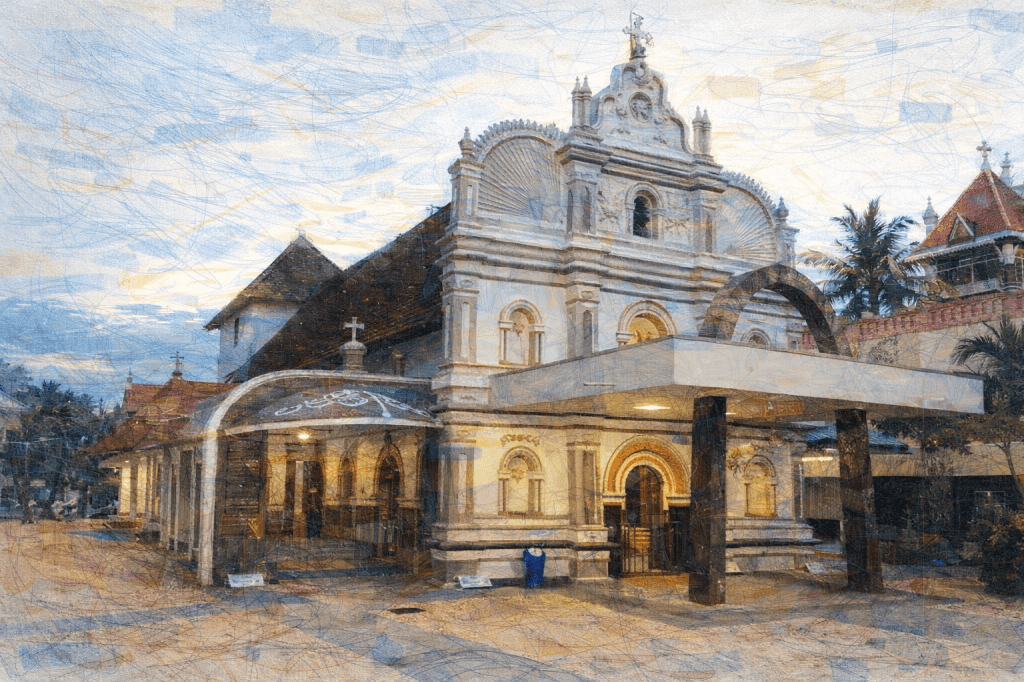
The construction of the present Thumpamon Valiya Palli in 1175 AD was not without challenges. Local Hindu authorities and temple custodians expressed concern that the expansion of a grand church might diminish their religious influence. An oracle is said to have predicted a decline in traditional faiths should the church be built leading to denial of additional land. At this critical juncture the Pandalam Raja intervened decisively recognising the Nasranis as loyal subjects, skilled traders and ethically upright citizens, the king personally purchased the required land and granted it to the Christian community. This act ensured the church’s construction while maintaining social balance. Significantly, the king refrained from extending further privileges, ensuring harmony between communities which is a hallmark of Kerala’s pluralistic past. The completion of the church marked not just an architectural milestone but the consolidation of Nasrani identity in central Kerala.
The arrival of the Portuguese in the late 15th century brought dramatic changes. Unlike earlier traders, the Portuguese came with imperial ambitions and rigid religious authority. They found it unacceptable that Kerala’s Christians did not recognise the supremacy of Rome. This tension culminated in the Synod of Udayamperoor in 1599, held under Portuguese military supervision. The synod declared Malankara practices heretical and forcibly brought the Nasrani Church under Roman Catholic authority. The ancient texts were destroyed and indigenous traditions were suppressed. Resistance emerged under the leadership of Archdeacon Geevarghese of the Cross who rallied the Malankara Christians to preserve their apostolic heritage. Though divisions followed, it was this resistance that ensured the survival of the Malankara Syrian tradition, a legacy that churches like Thumpamon continue to uphold. For centuries, the Malankara Church functioned under a unique system of governance. The Archdeacon (Jathikku Karthavyan) acted as the leader of the community, while parish affairs were managed collectively by priests and elected lay representatives. This democratic and indigenous structure distinguished the Nasranis from other Christian communities worldwide. Thumpamon Valiya Palli played a vital role in this ecclesiastical network serving not merely as a place of worship but as a centre of community decision-making, education and cultural transmission.
Architecturally, Thumpamon Valiya Palli has retained its ancient form despite renovations. It may appear modest when compared to later grand churches but its simplicity echoes its deep antiquity. Stone walls, traditional proportions and an unbroken line of worship give the church an aura of quiet resilience. To this day, Nasrani families consider it auspicious to conduct baptisms, weddings, engagements and major life events here, reaffirming their bond with ancestral faith.
For many St Thomas Christians, a pilgrimage to Thumpamon is not merely devotional, it is a return to roots. Thumpamon Valiya Palli is more than an ancient church; it is a living archive of Nasrani history. It reflects how Christianity in Kerala grew organically through dialogue, migration, royal patronage, resistance and deep-rooted faith. In an age of rapid change, the church stands as a reminder that identity is preserved not by isolation but by continuity and conviction. For anyone seeking to understand the story of the Nasranis of Kerala, a visit to Thumpamon is not optional, it is essential. Here, history is not confined to books; it breathes through stone, prayer and the enduring spirit of a community that has stood firm for over thirteen centuries.
 STORIES by HEARITAGE
Leave a comment