Place of Interest: Palace <> District: Kannur
Hidden along the shores of Kannur stands a palace that tells a story unlike any other in India, Arrakkal Kotta which was the seat of Kerala’s only Muslim royal family and continues to bask in its old glory. Walking through its age-old corridors one can almost hear the echoes of prayers, diplomacy and the rhythm of waves that once carried ships bound for faraway lands.
The Arrakkal Royal family follows a matrilineal system of succession, a rare tradition that placed equal importance on both men and women. The eldest member, whether male or female ascends the throne. Thus, Kannur witnessed not just kings who were called Arrakkal Rajah but queens who ruled with wisdom and grace were called the Arrakkal Beevis. In a time when patriarchy defined kingdoms, this family’s vision of shared power made them truly exceptional. Though their domain was a principality of Kannur and the distant Lakshadweep Islands, their influence rippled across the Arabian Sea. Being skilled traders and shrewd diplomats, the Arrakkal rulers built cordial ties with powers near and far: the Kolathiris, Zamorins, Mysore Sultans and even the Dutch and British when they arrived as merchants. Their trade relations with the Arabs gave birth to a rich cultural fabric that still defines the Mappila communities along Kerala’s coast.
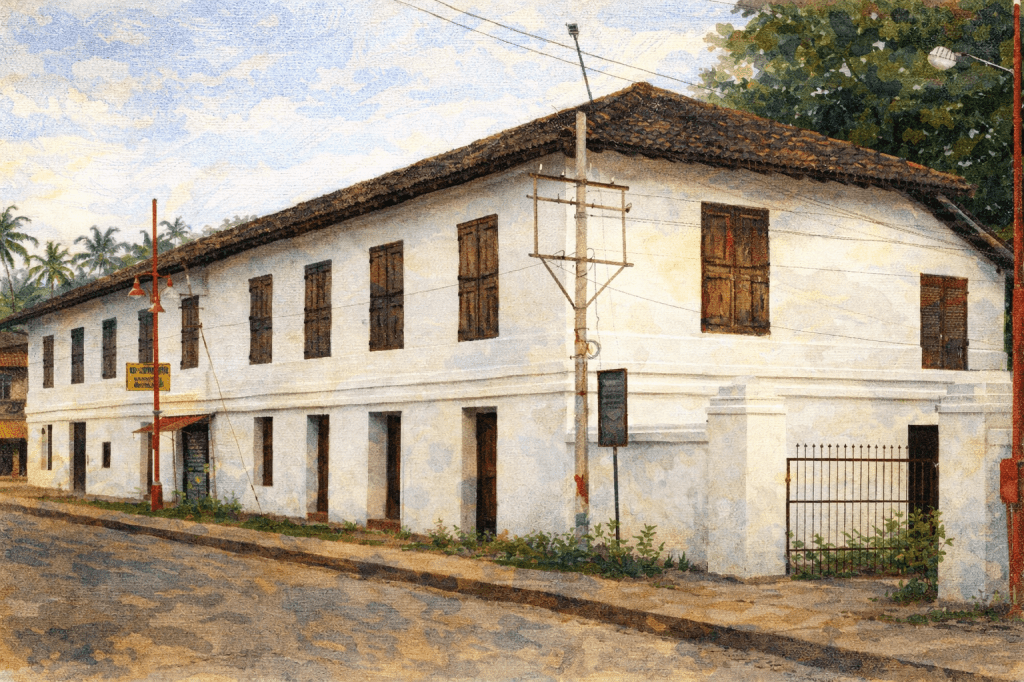
Stepping into the Arrakkal Museum today feels like traveling back in time. Today part of the sprawling Arrakkal Palace complex is a museum opened to the public in 2015 and offers a window into the royal life of a family that once ruled the waves. The architecture reflects a subtle blend of Kerala tradition and Islamic aesthetics with long courtyards, prayer halls and sunlit verandas that whisper stories of devotion and diplomacy. Inside, a soft glow lights up a small room where a chair and an ever-burning lamp stand in quiet reverence to Muhammad Ali Raja, the family’s first ruler. The Durbar Hall showcases gifts, medals, royal artifacts and everyday items that speak volumes of their maritime past. From the palace balconies, one can still see the tranquil Mappila Bay, where royal ships once set sail to Lakshadweep, carrying spices, coconuts and the hopes of a thriving trade.
Legends too breathe life into the Arrakkal story. It is said that the lineage of the Arrakkal family comes from the great king Cheraman Perumal who in 636 AD embraced Islam & went to Mecca. From Mecca he sent an emissary to Kannur & asked his Nephew Mahabali to convert to Islam & embrace the name of Mohammad Ali. Perumal asked Ali to take over the rule from Kannur. It is this lineage of Ali which still stands & the succession plan of giving importance to both genders was as per the directions of Perumal. Another legend is about an incident where a Kolathiri maiden fell in a pond & a Muslim man around jumped to rescue her. As she drowned the lady lost her mundu the man draped her in his own mundu. As per tradition in the old times, any person who gives a Pudava (or angavastram) to an unmarried girl is to be taken as her husband. This is termed as Sambandham by the Kolathiris & Nayars. The Kolathiri Raja married his daughter to this man & as per dowry carved a small fief of land for the man. As per custom the lady after marriage converted to Islam & became the first Beevi of the Arrakkal Family.
Arakkal rulers were mostly hard working people & traders who worked for the betterment of their people. For centuries they had traded with the Arabs for spices, condiments, honey etc. The arrival of Portuguese traders by the start of the 15th century changed all this as the Portuguese wanted to create a monopoly of trade. The prosperity of the rulers was mostly due to the hold over Lakshadweep in trading coconut & other spices. The Portuguese decided to take control over this trade by levying taxes & this soured the relation further. The relation with the Portuguese never got better till the Dutch took over the control. The Arrakkal family actually were quite shrewd in the manners of trade as they never stayed loyal to any one regime. They gave importance to trade & have made many u-turns in history. The Arrakkal rulers are also criticised for having given the Mysore rulers Hyder Ali & later his son Tipu Sultan opportunity to invade Malabar & control it for a brief period. The Arrakkal Raja was spared in the invasion & made a vassal.
In 1783 the Kannur fort was taken over by the British from the Arrakkal family; they signed a peace treaty with the British to keep control over Kannur. When it became difficult to pay exorbitant taxes, they joined the Mysore Raja Tipu Sultan in the Anglo war. Post the war when Tipu was defeated, the Arrakkal family again joined the British. This fickle policy of Arakkal was a point of concern to the British who wanted to keep absolute control of Malabar & so by the start of 19th century took all powers from the Arrakkal Family. They were allowed to keep control of lakshadweep but were to pay heavy tributes to the British. There was a constant bickering between the collectors of British & Arakkal family over the taxes paid & finally in 1850 the British took control of Lakshadweep too giving the Raja powers only to take care of local trading of Mappilas. By the start of the 20th century, the family lost most of its clout & were reduced to a mere phanom sovereignty on paper. The eldest family member still gets a pension from the Govt as per a promise made by the British in 1908.
Yet, their true legacy is not measured by their conquests or losses. It lies in their values & in their equality between men and women, in their devotion to their people and in their embrace of coexistence that shaped Kannur’s cosmopolitan soul. As you wander through the echoing halls of Arrakkal Kotta, you don’t just walk through a palace, you walk through a story of the sea, of faith and of the enduring spirit of Kerala’s royal past.
Story No: 13


Leave a Reply