Place of Interest: Temple <> District: Malappuram
Kerala is often described in mythology as the blessed land of Lord Vishnu. Tradition holds that this sacred strip of land was gifted to Sage Parasurama by Anantha, the celestial serpent upon whom Lord Vishnu reclines. Across Kerala, temples dedicated to Vishnu and serpent deities are plentiful with their legends woven into the cultural fabric of the state. Yet, amidst these countless shrines stands a remarkable exception, a temple dedicated not to Vishnu himself, but to his faithful mount, Garuda who is the king of birds.
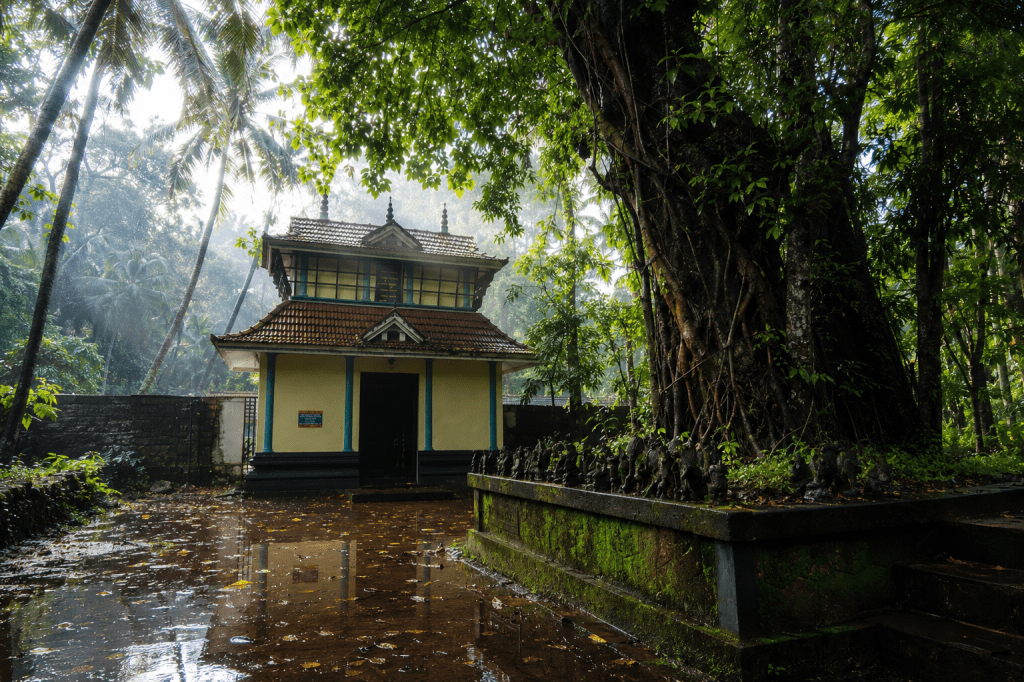
Hidden away in the quiet village of Tripangode near Tirur lies the ancient Vellamassery Garudan Temple believed by many to be the only temple in India where Garuda is worshipped as the principal deity. Nestled within a serene sacred grove, far removed from the bustle of modern life, this temple is a living repository of folklore, devotion and ancient wisdom.
The origins of the temple are believed to stretch back more than 1800 years. Interestingly, the principal deity here is Lord Vishnu in his second incarnation of Koorma, the Divine Tortoise making it one of the rarest Vaishnava shrines in Kerala. This story takes us back to the cosmic event known as the Samudra Manthan or the Churning of the Ocean seeking the nectar of immortality. The Devas and Asuras used Mount Mandara as a churning rod and the serpent Vasuki as the rope. However, the tremendous strain caused the mountain to sink into the depths of the ocean. In response to their prayers, Lord Vishnu assumed the form of a gigantic tortoise and positioned himself beneath the mountain. Using his shell as a pivot, Mount Mandara remained steady allowing the churning to continue and ultimately leading to the emergence of Amritam, the nectar of immortality. Through this act, Vishnu restored balance to the universe and preserved the cosmic order. At Vellamassery, devotees worship this rarely represented Koorma Avatar whose presence lends the temple a unique place among Kerala’s sacred sites.
While Lord Vishnu’s Koorma form sanctifies the temple, its identity and fame are inseparably linked to Garuda. Behind the Vishnu shrine stands a modest yet revered sanctum dedicated to the celestial eagle. The story of Garuda’s presence begins at the temple’s sacred pond, or Theerthakulam. According to local tradition, a sage once performed severe penance here as he was troubled by the suffering and sins that burdened humanity. Lord Vishnu pleased by his devotion, descended to earth riding Garuda. As Vishnu revealed the means by which human suffering could be alleviated, Garuda rested beside the pond. Centuries later, during the reign of the Vettathu Raja, a temple was constructed at this sacred location. Tradition further states that one of the disciples of Adi Shankaracharya undertook penance here adding another layer of sanctity to the site.
Among the many stories associated with the temple none is more captivating than the tale of the legendary master craftsman Perunthachan. One day, Perunthachan arrived at the court of the Vettathu Raja carrying several exquisitely carved idols. Among them was a striking image of Garuda so lifelike that it seemed poised to take flight at any moment. The king enchanted by its beauty, remarked that he wished the idol could truly come alive and soar into the sky. Perunthachan replied that such a miracle was possible but only if the idol were touched by a woman of perfect chastity. Intrigued, the king first invited the queen to touch the idol but nothing happened. One after another, the wives of ministers and courtiers stepped forward but the idol remained still. Disappointed and embarrassed, the king turned again to the master craftsman.
Perunthachan then summoned his own wife. As her hand touched the idol, Garuda sprang to life and rose into the air proving her virtue before the entire court. The astonished courtiers followed the divine bird as it flew across the countryside and arrived at the Vishnu temple. There, Garuda descended upon a mysterious white tortoise resting near the sacred pond. The tortoise and Garuda then moved together toward the temple before disappearing from sight. This event was interpreted as a divine sign as Lord Vishnu had claimed Garuda as his own and brought him to his sacred abode. In honour of this miracle, the king constructed a shrine for Garuda. The place came to be known as Vellamassery “the land of the white tortoise” preserving the memory of the extraordinary event.
The journey to Vellamassery itself feels like a pilgrimage into another age. Narrow village roads lead through dense sacred groves where ancient trees form a natural canopy overhead. The temple follows the understated elegance characteristic of Kerala architecture. The central shrine houses Lord Vishnu and is surrounded by a traditional chuttambalam. Smaller shrines dedicated to Ganapati, Bhagavathi and Vettakkorumakan stand within the complex while later additions include sanctums for Shiva and Shankara Narayana. History records that the temple suffered severe destruction during the campaigns of Tipu Sultan. Yet the faith of the local community never wavered & the temple was painstakingly rebuilt by the faithful on the very same sacred ground preserving its traditions for future generations.
Perhaps the most fascinating aspect of Vellamassery is the relationship between Garuda and the serpent world. In Hindu tradition, Garuda is the eternal adversary of serpents, yet at Vellamassery local belief transforms this ancient rivalry into one of divine harmony. During the sacred Mandala season, it is said that serpents visit the grove to seek Garuda’s blessings for another year of life on earth. In return, they vow not to harm devotees or pilgrims. This unique belief has made the temple a renowned centre for relief from Naga Dosha and serpent-related afflictions. Older generations recall how villagers troubled by snake infestations would capture the reptiles in earthen pots and release them within the temple groves, to never seen again.
For centuries, the temple has also been associated with healing. Families bring children suffering from skin ailments and offer prayers before receiving panchakshari oil which is traditionally applied to affected areas. The oil is also carried home as a remedy against snake bites and suspected poisoning. Another unique custom involves placing yams or other tubers at the temple steps while praying for relief from skin eruptions, moles and other physical afflictions. Devotees also offer Noorum Palum which is a sacred mixture of lime and milk traditionally associated with serpent worship. Sarpadosha Parihara poojas are conducted here under the divine protection of Garuda himself. A distinctive prasadam distributed at the temple is Manjal Payasam, a turmeric-infused sweet porridge. Turmeric, revered in Indian tradition for its purifying and medicinal qualities, symbolises protection from poison and disease.
The temple assumes special significance during Mandalakalam, the sacred forty-one-day pilgrimage season associated with Sabarimala. The three Sundays that fall within this period are considered exceptionally auspicious as devotees believe that worship offered on these Mandala Sundays carries the spiritual merit of an entire year of prayers. The rituals follow traditional Vaishnava practices accompanied by Kerala’s sacred percussion ensembles. Notably, the temple maintains the simplicity of its ancient traditions without the ceremonial use of elephants. Long before social reform movements transformed Kerala society, this temple was known for welcoming devotees irrespective of caste or social status. At a time when many shrines remained inaccessible to large sections of society, Vellamassery stood as a sanctuary open to all.
Today, the Vellamassery Garudan Temple remains a place where mythology and devotion coexist in remarkable harmony. Its stories range from ancient legends and folk traditions to deeply held personal beliefs passed down through generations. Whether one arrives as a pilgrim seeking divine blessings, a parent praying for a child’s health, a farmer searching for protection or simply a traveller drawn by Kerala’s hidden spiritual heritage, the temple offers a sense of peace that transcends explanation. Amidst the whispering groves and ancient shrines, Garuda continues his eternal vigil as the guardian of devotees, protector against unseen dangers and a symbol of faith soaring beyond the boundaries of myth and time.
Story No: 138


Leave a comment