Place of Interest: Temple <> District: Kozhikode
Every city has a story hidden beneath myths & legends. Some are written in stone, some in memory and a few survive only because generations chose to believe them. In Kozhikode, one such story rests quietly atop a gentle hill at Govindapuram, where the sacred precincts of the Valayanad Devi Temple continue to guard the destiny of the city. The climb towards the temple is unassuming as the bustle of modern Kozhikode gradually fades, replaced by the rustle of old trees and the soothing silence that surrounds Kerala’s sacred groves. As the traditional gopuram comes into view, one realizes that this is more than just another temple. It is a place where mythology and history have become inseparable.
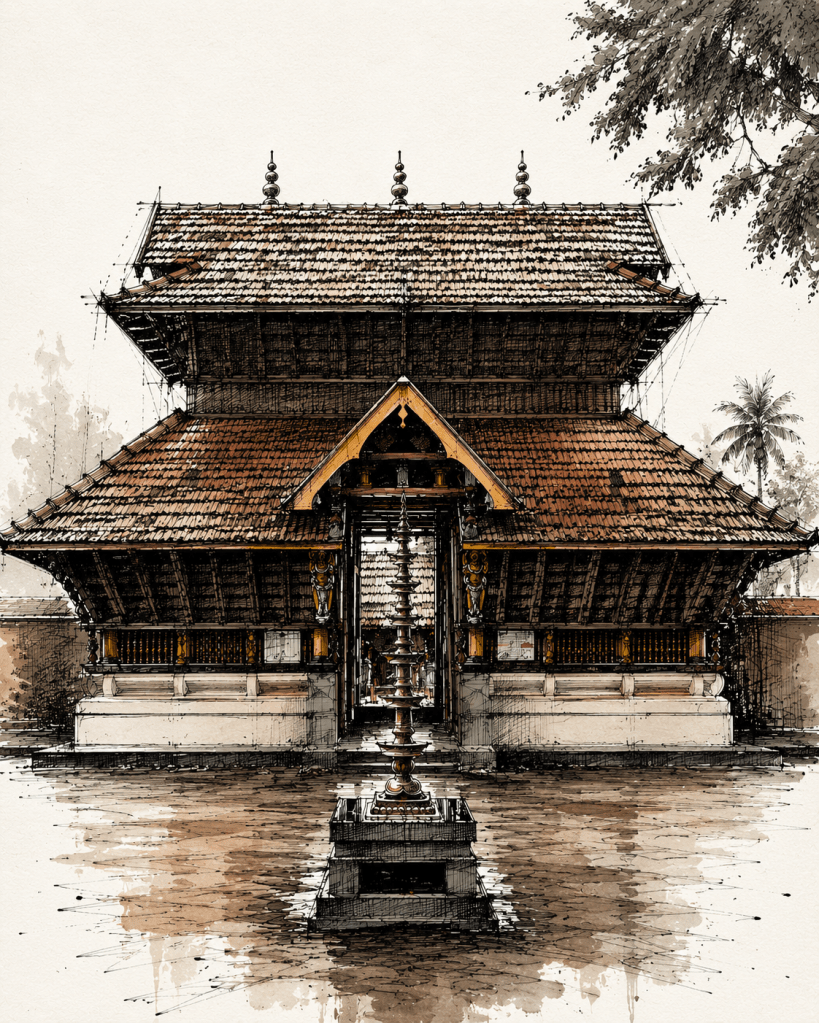
For centuries this has been the royal temple of the Zamorins (Samuthiris), the legendary rulers of Calicut. Even today, despite the passing of kingdoms and empires, the temple remains deeply intertwined with their identity. The fierce yet compassionate Goddess Chandika, enshrined here as the family deity of the Zamorin dynasty, is regarded as the divine force that transformed a regional chieftain into the ruler of one of India’s greatest medieval ports.
The story begins long before Kozhikode became the famed City of Spices. During the age of Cheraman Perumal, Kerala was divided among several powerful chieftains known as Swaroopams. The Zamorins belonged to the Nediyiruppu Swaroopam, an ambitious lineage destined to expand its influence across Malabar. Yet one kingdom stood firmly in their way, Valluvanad which was ruled by the formidable Valluva Konathiri. Despite possessing greater military strength and wealth, the Zamorin repeatedly failed to conquer his rival. The reason, legend says, was not the strength of armies but the strength of devotion.
Konathiri was a devoted worshipper of the Goddess at the sacred Thirumanthamkunnu Temple and her divine protection shielded his kingdom from defeat. Determined to seek the Goddess’s blessings for himself, the Zamorin disguised his royal identity and travelled to the shrine as an ordinary devotee. Through days of sincere penance, he won the favour of the Goddess. When she finally appeared before him, he asked for only one boon; that she accompany him to Kozhikode. The Goddess agreed, but with a condition. She would follow him as long as he never turned back.
The journey towards the coast began. The Zamorin walked ahead while the soft rhythm of the Goddess’s anklets assured him that she remained close behind. Mile after mile, he continued without hesitation. But as they neared Kozhikode, the sound of the anklets began to fade. Doubt overcame faith and unable to resist, the Zamorin turned around and there she stood, then vanished. Heartbroken, the king fell at the spot in despair. Moved by his devotion, the Goddess hurled one of her divine bangles into the sky and instructed him to build a temple wherever it finally came to rest, promising that her presence would forever remain there. The bangle travelled through the skies for an entire week before descending upon a hill overlooking Kozhikode. That sacred hill became Valayanad, “the land of the bangle” while the place where it circled the skies came to be known as Azhchavattom, literally “the place where it revolved for a week.”
Standing within the temple today, it is easy to understand why this legend continues to live in the hearts of devotees. Tradition believes that the divine bangle still rests beneath the temple grounds, silently blessing everyone who enters. Inside the sanctum, the Goddess reveals herself in her majestic Chandika form, carved from stone and holding the sacred Nandakam sword. Her presence is powerful yet graceful embodying both protection and fierce compassion. Sharing the sanctum are the Saptamatrikas or the seven divine mothers: Brahmani, Maheshwari, Kaumari, Vaishnavi, Varahi, Indrani and Chamundi, each representing a different manifestation of feminine cosmic energy.
At the temple, one architectural feature immediately captures attention. Devotees view the Goddess through wooden door panels rather than an unobstructed entrance, subtly recalling the legendary moment when the Zamorin turned back to glimpse his beloved deity. Although the temple faces north, an uncommon orientation in Kerala temple architecture, the presence of Lord Shiva adds balance to the sacred space. Among the subsidiary shrines, Kshetrapalan commands particular reverence as the guardian deity of the temple. After bringing the Goddess to Kozhikode, the Zamorin is believed to have performed Guruthi here, seeking her blessings before each battle. Tradition holds that from then onward, victory consistently favoured the Zamorin, laying the foundation for the rise of Calicut as one of the greatest trading centres of the Indian Ocean.
The rituals practiced at Valayanad are among the most distinctive in Kerala. The temple follows the ancient Rurujit Vidhana, a rare system that beautifully blends Kashmiri Tantric traditions with Kerala’s own ritual heritage. Guruthi occupies a central place in worship, where a brilliant crimson offering prepared from turmeric, slaked lime and sacred ingredients symbolically represents blood, invoking the fierce protective energy of the Goddess. Equally mesmerizing is the Kalamezhuthum Pattum ceremony where natural coloured powders are transformed into breathtaking floor murals depicting the Goddess. Architecturally, the temple remains a fine example of Kerala’s traditional style. The sloping tiled roofs, timber craftsmanship, laterite walls and peaceful sacred grove create an atmosphere that feels timeless. At the heart of the temple lies a revered Sreechakra consecrated by the great Sivayogi Thayyavur Sivasankar, adding another layer of spiritual significance to this already sacred shrine.
The annual festival, celebrated over seven days during Makaram beginning on the Karthika star, transforms the hill into a vibrant celebration of devotion and culture. The Goddess’s sacred sword is ceremonially brought from the ancient Tali Mahadeva Temple, reaffirming the historic bond between the two shrines. Classical dance performances, Mohiniyattam, Bharatanatyam, Thiruvathira, Chendamelam, Tayambaka, Ganamela and traditional theatre fill the temple grounds with life. Among the most moving ceremonies are the Pallivetta and Arattu. The final sacred bath of the Goddess takes place at the grove called Tarakal which is the very place where tradition believes she disappeared after the Zamorin looked back. As the haunting melodies of Thottampattu echo through the grove, mythology momentarily feels like lived history.
Whether one arrives as a devotee, a traveller or simply a seeker of stories, the temple offers something beyond ritual. It reveals how faith can shape kingdoms, how legends can define cities and how a single divine bangle came to symbolize the very identity of Kozhikode. Perched quietly above the city, Valayanad Devi Temple remains not merely a place of worship, but the spiritual heart of Calicut & a timeless reminder that every great civilization is built as much upon belief as upon stone.
Story No: 139


Leave a Reply